


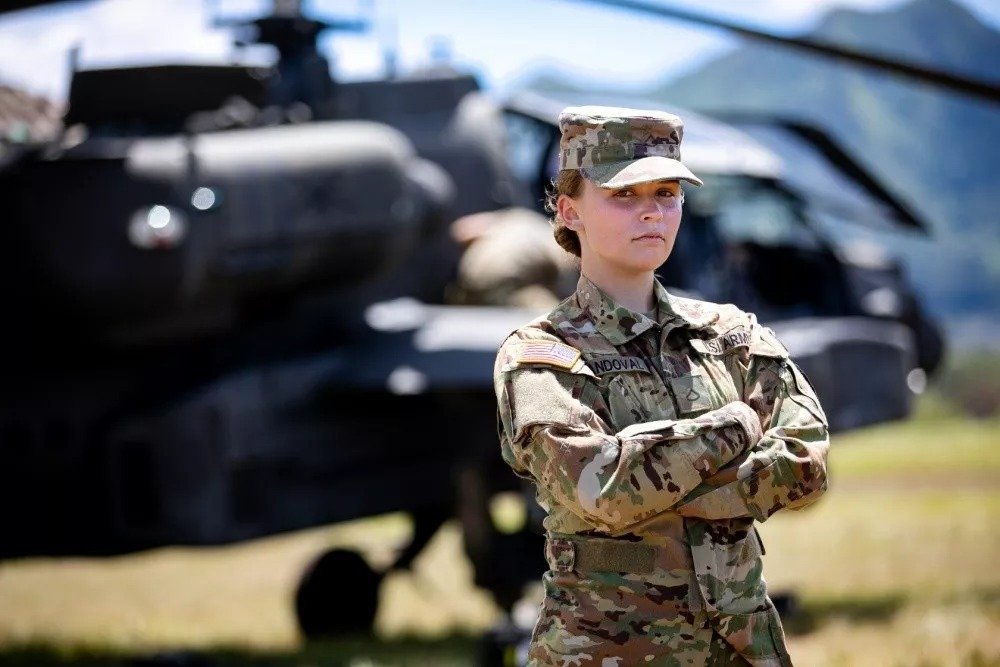
The President of the Republic’s announcement regarding voluntary enlistment of women in the National Guard has sparked debate and discussions, as this proposal has been circulating in public dialogue for several years.
According to the proposal, which is currently under consideration, women’s service in the National Guard is expected to be voluntary, ranging from six to 14 months.
Information suggests that incentives, such as points for public sector employment, social security, and others, are being considered. The proposal must be approved by the Council of Ministers and subsequently acquire legislative status.
It is noted here that women’s entry into the National Guard in Cyprus occurred in 1990, when the first series of Volunteer Non-Commissioned Officers was hired on a contract basis at the rank of Sergeant. After a few years, they were granted permanent positions.
Women have been serving in the National Guard professionally for over three decades, while in the case of conscript service, the difference lies in the fact that women’s enlistment will be voluntary and unpaid.
Internationally, the enlistment of women is not a new concept. However, even today, relatively few countries conscript their female population.
One such country is the State of Israel, which, since the establishment of its Defence Forces in 1948, has primarily assigned women to bureaucratic and medical positions. Over time, their roles have expanded, and they now constitute a significant pillar in shaping the country’s Armed Forces.
Regarding Europe, more and more Scandinavian countries have begun to introduce compulsory conscription for women, as the war in Ukraine increases insecurity and creates a sense of urgency.
Norway became the first European country and NATO member state to extend compulsory conscription to all its citizens, regardless of gender, in 2014. The first training series of conscripts, including women, was called up in the summer of 2016, while previously, women were allowed to volunteer for the Armed Forces.
In 2017, the Swedish government decided to introduce compulsory conscription for all genders, after many years of voluntary service exclusively for men. According to the country’s defence minister, this decision was made due to the deterioration of the security environment in Europe and around Sweden, requiring the reinforcement of the Armed Forces.
Denmark also plans to include women in military service, increasing not only the number of conscripts but also the duration of service from four to eleven months, as announced by the country’s prime minister, Mette Frederiksen, last March.
In Finland, there is a voluntary military service for women between the ages of 18 and 29, while Greece announced last March that it would introduce voluntary military service for women based on the Finnish model.
Nikos Dendias, the Greek Minister of Foreign Affairs, stated during the International Women’s Day event, among other things, regarding women’s conscription: “The relevant legislation has existed since 1977. The question is how to implement this provision for the voluntary enlistment of women.”
It is expected that after completing their voluntary military service, women will remain part of the reserves until they turn 60.
Last July, the German Armed Forces’ Chief Inspector, Carsten Bauer, expressed openness to the idea of women’s conscription if conscription becomes mandatory, warning that voluntary conscription is insufficient to address personnel shortages.
It is worth noting that compulsory military service in Germany was suspended in 2011 after 55 years.
Andris Spruds, the Latvian Minister of Defence, also supports the idea of women’s conscription. However, he noted that this issue should be discussed in Parliament and society to find solutions acceptable to all.
Apart from Europe, compulsory military service exists in Asian and African countries such as Eritrea, Libya, China, North Korea, Mozambique, Mali, and Myanmar.
Notably, Eritrea imposes military service on all citizens between the ages of 18 and 40, while in North Korea, compulsory military service is mandatory for both men and women from the age of 17.
Challenges and the gender dimension
The government’s intention to create the necessary legislative framework for women’s voluntary enlistment in Cyprus sparks parallel discussions, including the gender equality dimension and the modernisation of the National Guard to meet today’s challenges.
Beyond examining and addressing the challenges related to the National Guard’s overall operation, it is necessary to thoroughly examine the advantages and practical issues that women’s voluntary enlistment may bring.
Regarding gender equality, it is noted that enhancing women’s roles in education and duties on an equal footing with men is expected to lead to more women choosing the field of the Armed Forces for their professional advancement.
In this context, recognising that women in the Armed Forces compete with men from a disadvantaged position due to their physical nature and strength, it is essential that the relevant military personnel prepare tomorrow’s female soldiers adequately to excel in every field.
It is also necessary to create an appropriate environment for women, leaving behind outdated stereotypes.
Even though female personnel has been part of the Armed Forces for many years, there are still reports of discrimination.
Notably, this issue was raised in Cyprus two years ago when permanent non-commissioned officers, who served as Volunteer Non-Commissioned Officers in the 5th, 6th, 7th, and 8th series, complained of “gender discrimination in the workplace,” with members of the parliamentary Human Rights Committee stating that their human rights had been flagrantly violated.

