


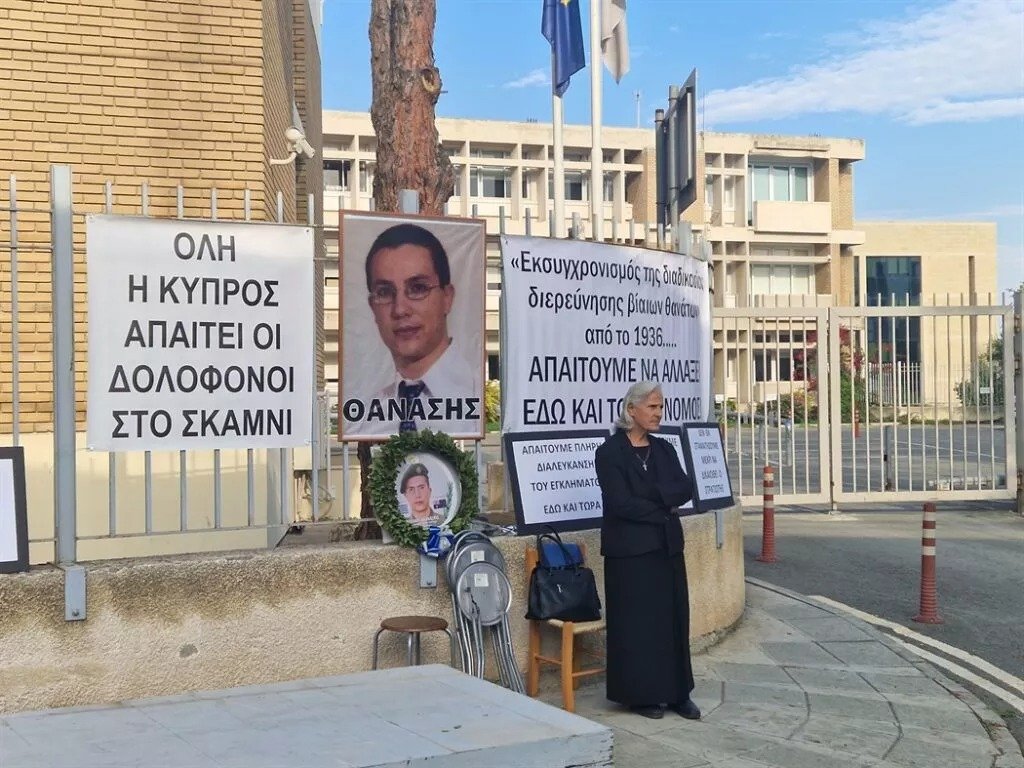
Criminal investigators have concluded for the second time in two and a half years that the death of National Guardsman Thanasis Nicolaou was the result of a criminal act, according to a new report submitted to the Cabinet yesterday.
The report by investigators Lambros Pappas and Thanasis Athanasiou, delivered 10 months after their appointment, assigns responsibility for errors and omissions in the 2005 case.
Twenty years after the 26-year-old architect’s death, and following numerous investigations and a tireless campaign by his mother, the case has now been officially classified as homicide, confirming a report by Phileleftheros.
The investigation required three separate police inquiries, three criminal investigations by independent investigators, three death investigations, and two investigations by the Ministry of Defence.
The findings were presented to Cabinet yesterday, with President Christodoulides personally telephoning Thanasis’s mother, Andriana Nicolaou, to inform her she would receive a copy of the report, which will also be forwarded to the Attorney General.
Government Spokesman Constantinos Letymbiotis said the investigators completed their work on 7 March 2025, the deadline set by Cabinet. “Cabinet will forward the report to the Republic’s Attorney General today, in accordance with Article 113 of the Constitution, who will proceed with appropriate actions,” Letymbiotis said.
When asked about Mrs Nicolaou’s reported reluctance for the report to be sent to the Attorney General, the spokesman responded: “The Cyprus Constitution is clear, and in a constitutional state there is no other procedure. This is the established process.”
Attorney General George Savvides, commenting on the investigators’ report, called it “a tragic situation, a tragic story which has troubled the country. A family suffered the worst possible loss—losing their child. The Republic of Cyprus was found guilty of not properly investigating the circumstances of Thanasis’s death.”
Savvides added: “I believe many attempts have been made over time to determine the cause of death. More important is who is responsible. I cannot judge or comment on what happened under previous Law Office leadership.”
The report apparently assigns clear responsibility to the medical examiner who conducted the autopsy at the scene and the subsequent post-mortem examination. State coroner Panikos Stavrianos faces allegations including failure to fulfil legal duty and other more serious offences, with questions about whether conspiracy charges following the commission of a felony—homicide—have been added.
While the report concludes that a criminal act occurred, it appears no evidence has emerged identifying the perpetrators or those who ordered the killing.
Nicolaou’s mother, in a social media post responding to the Attorney General’s comments, questioned who had fought the legal battle for her son’s remains to be exhumed, highlighting her struggle at the Limassol Court during the death investigation where, she claims, “the Law Office representative supported Stavrianos’s positions.”
In earlier statements before receiving the report, Mrs Nikolaou said: “For 20 years, the killers have been walking free. They killed Thanasis and tarnished his name.” She emphasised that she demands exemplary punishment for all involved.
“If it weren’t for the army, I would still have my child,” she added, claiming the cover-up was orchestrated by “Stavrianos, police officers and army officials” and later continued by the Law Office.
“No judge and no government will bring my child back. But they can restore his memory by punishing the guilty,” she concluded.
Thanasis Nicolaou’s body was found under a bridge in Alassa in 2005. His death was initially deemed a suicide by the army and the police. But after his remains were exhumed in 2020 over suspicions of foul play, further autopsies showed he had been beaten and strangled. Since then, two new probes confirmed that he was killed. No suspects have been identified or arrested.
Read more:

