


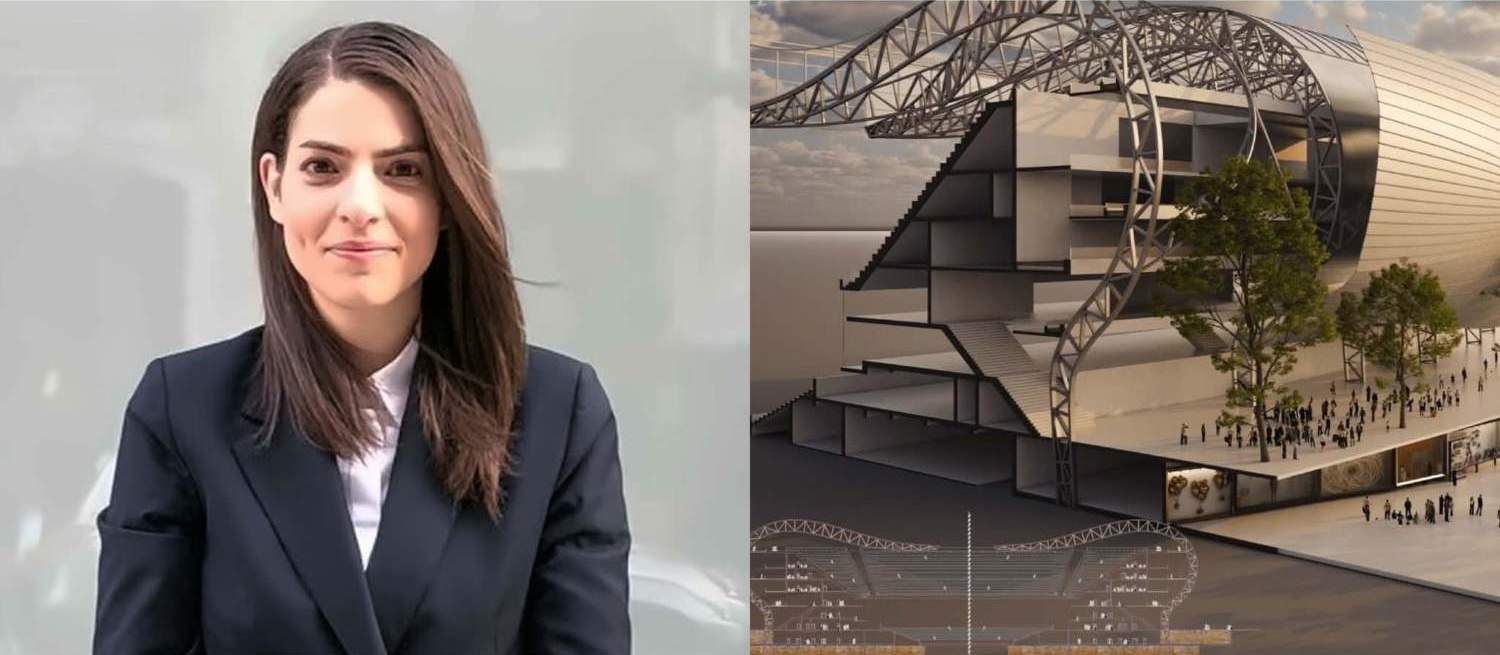
In a region where climate change is moving faster than the issuance of building permits, New-York based architect Eleni Kalapoda sees artificial intelligence not as a replacement for human creativity, but as a critical tool for survival.
Speaking to en.philenews, the former Renzo Piano Building Workshop architect argued that as Cyprus and the wider Mediterranean face record heat, water scarcity, and aggressive coastal development, AI must be harnessed to rediscover ancient spatial wisdom, from deep shade, to thick walls.

“Technology at its best should help us rediscover the wisdom of shade, courtyards, and thick walls, not replace it,” Kalapoda said.
With experience spanning London, New York, and the Autodesk Advisory Council, Kalapoda outlines why the architect must remain an author rather than a spectator, warning against the risks of urban homogenisation, skill erosion, and unchecked automation in design.
How would you classify artificial intelligence in architecture?
I would classify it as an instrument, not an author. AI is a remarkably powerful assistant for analysis, iteration, and documentation, and an increasingly capable partner in early design exploration. But architecture is ultimately an act of judgement and responsibility: deciding what a place should be, for whom, and at what cost to the environment and the surrounding community. Those decisions carry legal, ethical, and civic weight, and they remain with the architect. If I had to put it in one line, AI widens the field of options; the architect remains accountable for the choice.
When did you first experience using AI in architecture? What were your thoughts?
My first encounters were with the computational tools that preceded today’s generative models: parametric scripting, environmental and daylight simulation, and optimisation routines that test hundreds of variations of a facade or a massing. The real shift came with the arrival of generative image and language models around 2022. My first reaction was a mixture of fascination and caution. Fascination, because I could suddenly see a dozen atmospheres for a space in an afternoon; caution, because the images were persuasive long before they were buildable. A beautiful picture is not a building, and the profession had to learn quickly not to confuse the two.
Has your perception of AI use in architecture changed over time?
Very much so. At first, the conversation was dominated by images, and I think that slightly distorted public expectations. Today I am far more interested in the less glamorous applications: code compliance checks, energy and carbon modelling at the earliest design stage, analysis of how occupants actually use buildings, and coordinating complex documentation. These are the areas where AI genuinely improves outcomes at scale. My view has moved from “what can it draw?” to “what can it help us identify before we commit to building?”
Has AI had any effect on the way architects design and explore concepts?
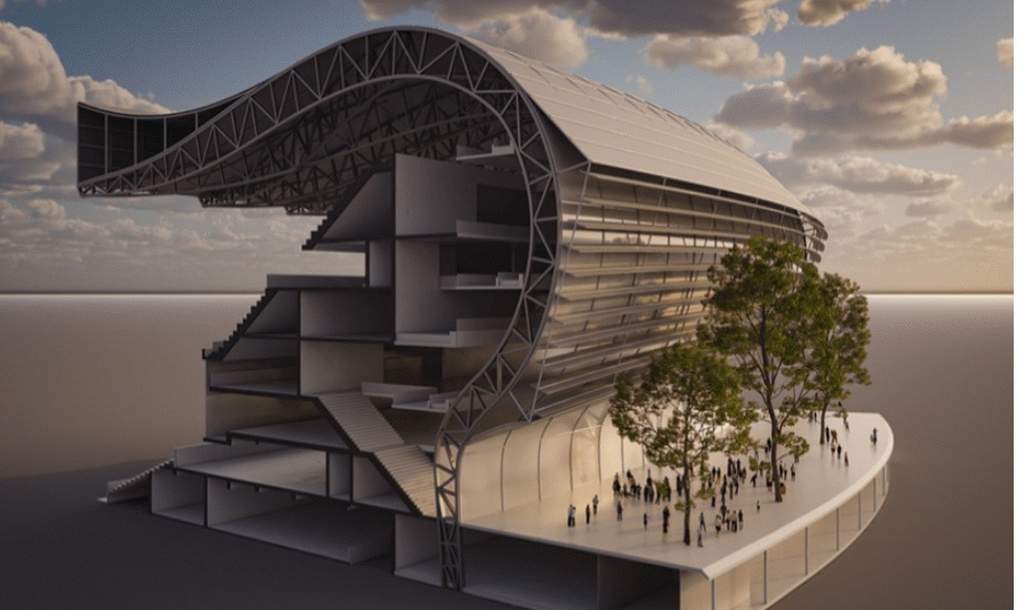
Yes, profoundly, particularly at the beginning of a project. Architects can now test orientation, daylight, embodied carbon, and spatial options in parallel, rather than one at a time, before the design hardens. That changes the conversation with clients: instead of presenting one scheme and defending it, we can show the consequences of several and decide together on evidence. It is also changing what buildings are asked to do. Offices, libraries and schools are being reconsidered as places for collaboration, learning and human contact, precisely because so much routine work can now happen anywhere. AI is reshaping the brief as much as the drawing.
Have you found AI useful for creating new ideas, or does it work more off existing concepts?
By its nature, it works from what already exists. These models learn from vast bodies of past images and texts, so they are extraordinary at recombination and at revealing possibilities one might not have considered. Still, they do not, on their own, understand a particular site, climate, culture, or community. Genuinely new architecture tends to come from close attention to a specific place and its people. I find AI most valuable as a provocation: it can quickly widen the field of options, and the architect’s task is to recognise which of those options actually belongs to the place and its communities.
Do you find AI-generated images useful throughout your process?
Useful at the beginning, and to be used with discipline thereafter. Early on, they help clients and communities discuss mood, material and light before anything is fixed, which can make the conversation more inclusive. As a project develops, however, the image must give way to the drawing, the calculation and the specification. An AI image can suggest a timber canopy; it cannot tell you whether it will stand, how it will weather or what carbon it carries. I treat these images as sketches for discussion, never as promises.
Have you found it difficult to balance AI help with your own ideas and judgment?
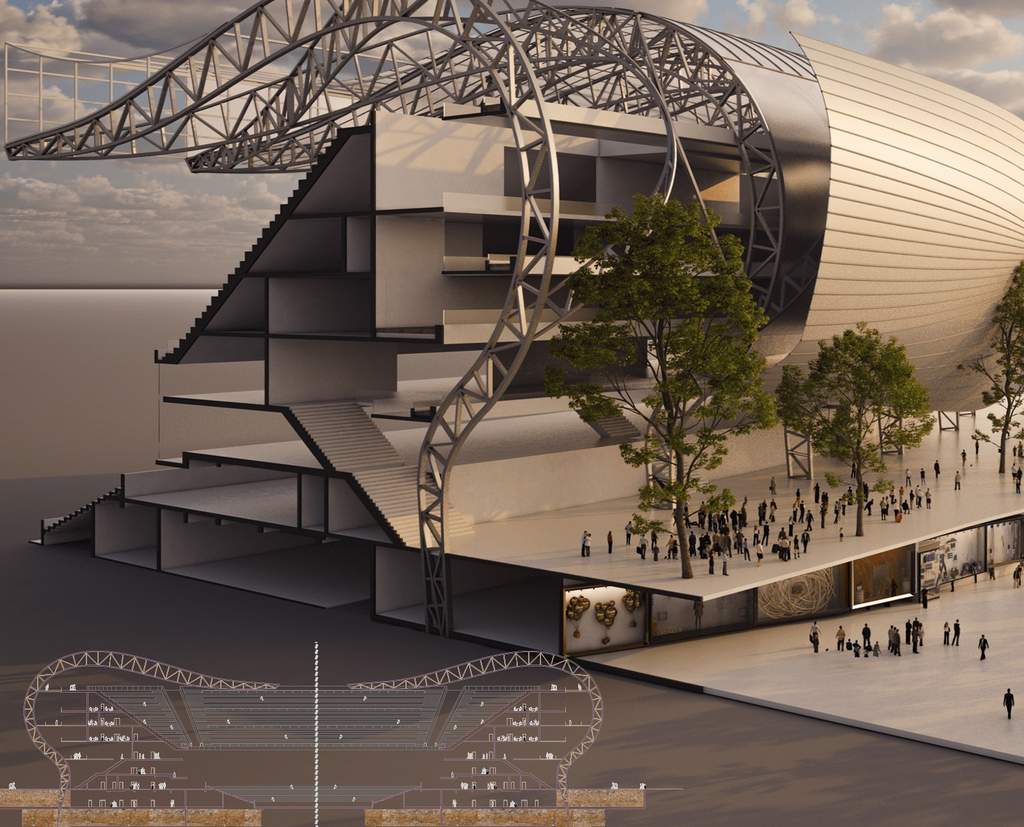
The balance isn’t difficult if you’re clear about roles from the outset. I use AI to accelerate the work that benefits from speed, such as research, comparison, and iteration, and I reserve for myself, and for the design team, the decisions that require judgement: what the building should be, how it treats its neighbours, and what it asks of the planet. Serving on juries has reinforced this. When assessing projects, outstanding work is rarely distinguished by the tool; it comes from clarity of intention, care for the people who will use the building, and rigour in environmental performance.
What has AI helped with the most in architecture? Has your workload significantly decreased?
It has helped most with time-consuming design tasks: research, early analysis, documentation, and coordination. That said, I wouldn’t say the workload has decreased so much as shifted. The time saved on repetitive tasks tends to be reinvested in exploring more options, deeper environmental analysis, and engagement with clients and communities. The best result, in my view, is not fewer hours, but better-informed decisions made earlier, when they cost least to change.
Have you noticed any limitations regarding AI use in architecture?
Several. AI does not understand context in the way architects must: local climate, ground conditions, heritage, culture, and the lived experience of a neighbourhood. It can produce confident answers that are simply wrong, whether because it misread a regulation or produced a structurally implausible form. Its outputs are only as good as the data behind them, and building data is often fragmented and proprietary. And there is a quieter limitation: because these models learn from what has already been built, they can nudge design towards the average, when most places need something contextual.
Do you think any risks will come with AI use in architecture?
Yes, and they deserve open discussion. The first is accountability: when a building fails, responsibility must rest with a qualified professional, not with software. The second is the erosion of skills: if younger architects never learn to reason through a plan or a detail themselves, they will struggle to recognise when the LLM is wrong. The third is homogenisation: cities that begin to look alike because they draw from the same datasets. And there are questions of intellectual property, data privacy, and the considerable energy demands of AI itself, which sit uneasily with our climate commitments.
Have you worked on any significant projects using AI?
My closest engagement with AI has been in shaping how these tools are developed and evaluated, rather than in delegating design to them. As a member of the Autodesk Advisory Council (2025–27), I contribute a practising architect’s perspective on the design and construction software many firms rely on, including how AI capabilities are integrated responsibly. I also review research for AI and machine-learning conferences (NeurIPS, CoRL, amongst others), which keeps me close to where the technology is heading and its limits. In my own work, I use AI tools for research, early-stage analysis, and environmental studies, always verifying professionally before anything informs a design decision.
What response is taken if an AI-generated design contains a major error?
The same response as for any design error: it must be caught before it leaves the office, and the professional who signs the drawings is responsible. That is why verification is non-negotiable. Every AI output that informs a design, whether a structural assumption, a code interpretation, or an area calculation, should be checked by a qualified person, and the process should be documented so that one can trace how a decision was made. If an error reaches a client or a site, it is corrected through normal professional channels: design revision, coordination with engineers, and, where necessary, notification under the contract. The tool does not change the duty of care; if anything, it raises its importance.
What do you think the best approach to AI use in architecture would be? How do you see its use evolving in the future?
The best approach is human led: transparent about where AI is used, rigorous in verifying what it produces, and grounded in clear professional responsibility. I would like to see the profession, educators, and regulators agree on shared standards, as they have for sustainability, so clients and the public can trust the process. Looking ahead, I expect AI to become far less visible and far more useful: woven into design software, into how buildings are operated, and into how cities plan for heat, flooding, and changing patterns of work. Its greatest promise, to my mind, lies in helping us build less wastefully and adapt existing buildings more intelligently, which is one of the most urgent tasks we face. The architect’s role will not disappear; it will become more strategic and, if we use these tools wisely, more humane.

