


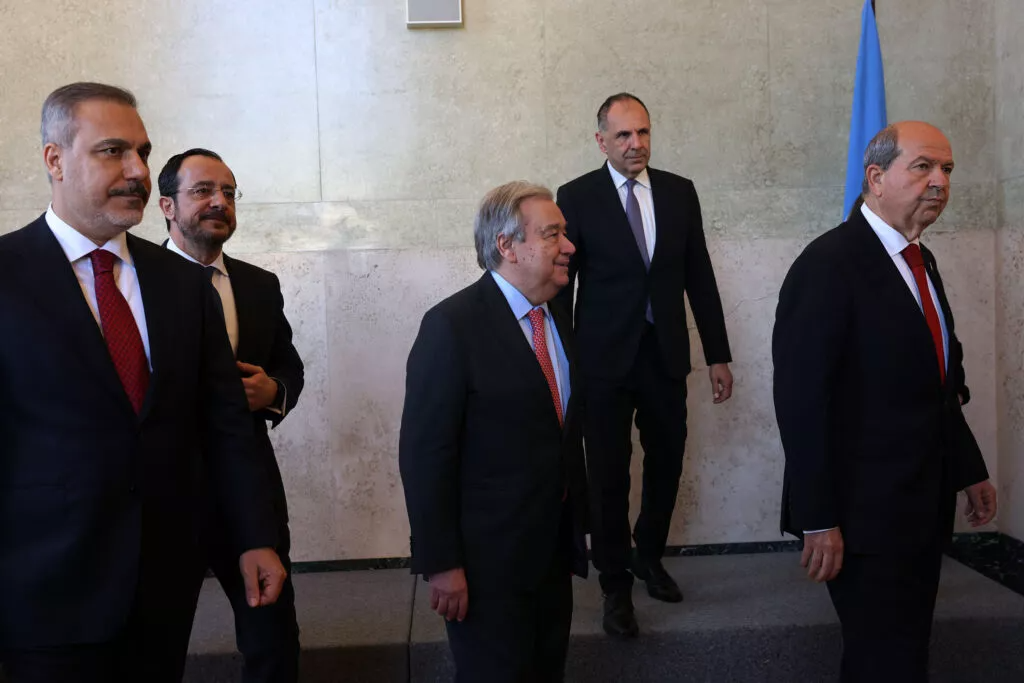
Turkish Cypriot leader Ersin Tatar was quick to announce the proposed appointment of a UN Secretary-General’s personal envoy, without disclosing his firm opposition during discussions at the Palace of Nations that necessitated extended consultations with Turkish Foreign Minister Hakan Fidan before he changed his position.
Before the official announcement, Tatar attempted to restrict Maria Angela Holguín Cuellar’s mandate to confidence-building measures only. However, UN Secretary-General António Guterres ultimately announced that the personal envoy on Cyprus would be tasked with preparing future steps in the peace process.
Sources familiar with the negotiations reveal that extensive discussions occurred regarding the envoy appointment, as Tatar categorically opposed any UN Secretary-General appointment initiative.
During the deliberations, President Christodoulides reportedly indicated his preference for appointing a special envoy while acknowledging potential difficulties, expressing willingness to accept a personal envoy as had previously been established.
Despite broad consensus supporting the appointment, Tatar maintained his opposition throughout initial discussions.
In response to the impasse, Secretary-General Guterres temporarily shifted focus to scheduling the next meeting, proposing late July in Geneva with the established format – an informal conference including both communities and the three guarantor powers.
Following a brief recess, discussions on the appointment resumed without apparent progress. Sources indicate that at one point, Tatar questioned the necessity of appointing a new envoy after Holguín Cuellar had been unable to identify common ground between the sides.
The Secretary-General, however, remained resolute, communicating that an envoy appointment decision would proceed.
Subsequently, Tatar requested time for private consultations with Foreign Minister Fidan. After an extended conversation conducted in Turkish, Tatar returned with a modified position, indicating willingness to accept an envoy appointment while insisting their mandate be limited to confidence-building measures.
Guterres immediately clarified that the envoy’s role would not be restricted to confidence-building measures and presented three distinct options: a special envoy for Cyprus, a special envoy for moving the process forward, or a special adviser to undertake a good offices mission.
Following intervention by the Turkish Foreign Minister, participants reached a consensus on appointing a personal envoy to prepare the next steps in the negotiations.
Upon returning to Ankara, Fidan – who maintained a notable silence while in Geneva – characterised the UN Secretary-General as “a leader we highly appreciate, a qualified leader. The position reflects the conscience of the international system to some extent,” adding that Turkey accepted the informal meeting proposal “to show our constructive attitude.”
Addressing the broader context, Fidan referenced previous diplomatic efforts, noting that Holguin Cuellar “examined the situation, spoke with all sides for six months, and prepared a report. This report was recorded, and it stated, ‘There is no common ground between the two sides.’”
“There is a reality in Cyprus where the two communities live separately with their own institutions,” Fidan continued. “The fact that one of these communities is recognised as a state and has access to all kinds of resources, while the other is not recognised, is the root cause of the injustice on the island. This injustice must be corrected.”
Read more:

