


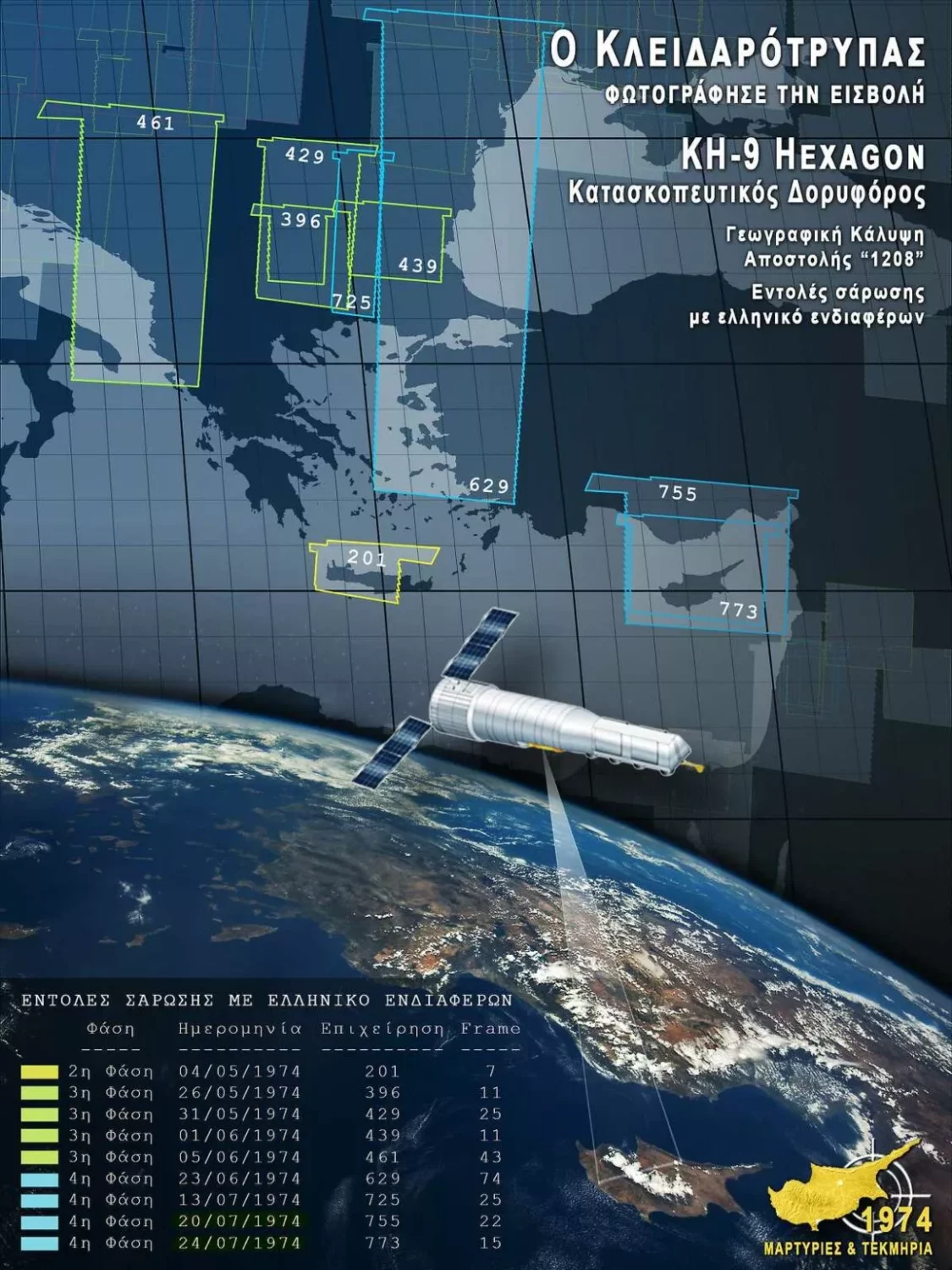
Since April 21, 1974, an American high-altitude spy plane, specifically the U-2 Dragon Lady, has been stationed at the British Bases in Akrotiri. This aircraft has a long history, having been used to take photographs during the Turkish invasion.
Odysseas Christou, a historical researcher and expert in Geographic Information Systems (GIS) and remote sensing, told “Phileleftheros” that in April 2014, the 40th anniversary of the deployment of U-2 planes in Cyprus was celebrated.
Mr. Christou, referencing the publication of photos from the period of the 1974 Turkish invasion by “Phileleftheros” last Saturday, noted that the Dragon Lady squadron arrived in Cyprus as part of Operation OLIVE HARVEST, which involved monitoring the Egypt-Israel peace agreement.
Regarding the actions of American satellites that documented the Turkish invasion, Mr. Christou mentioned that from the data he examined (released in 2020), these satellites had previously photographed areas of Northern Greece. Two days before the coup d’état on July 14, 1974, dense photography was recorded over Sofia. According to Mr. Christou, there were reports that Greece would be attacked by Bulgaria, which was not confirmed.
Soviet and American Satellite Activity Over Cyprus Before the Turkish Invasion
During the period leading up to the Turkish invasion of Cyprus, there was noticeable satellite activity over the island from both the United States and the Soviet Union. Just before the coup, a Soviet satellite was launched, followed by additional launches on July 25 and 26. On August 7, the Soviets launched another satellite.
As reported in “Phileleftheros” on Saturday, the Americans, upon realizing the activity of the Soviet satellites, responded accordingly. On August 13, one day before the start of the second Turkish invasion, the Washington Post published an article noting that the Soviets had launched a new satellite and placed it in orbit over Cyprus. This news was also reprinted in newspapers in Greece and by “Phileleftheros.”
Mr. Christou noted that monitoring the events in Cyprus led to a conflict among US agencies at the time.
Thomas Boyatt, who joined the US State Department in 1959 and served as a political advisor from 1967 to 1970, and as the Director of the Office of Cyprus Affairs from 1971 to 1974, submitted a Memorandum of Protest on August 9. In this memorandum, he highlighted the shortcomings of the intelligence analysis mechanism that failed to predict the coup in Cyprus, resulting in the American agencies being caught off guard, as he claimed.
The Aftermath of the Cyprus Coup: Intelligence Failures and Investigations
Following the events in Cyprus, a comprehensive review of the information flow, known as the “CYPRUS COUP POST-MORTEM REPORT,” was ordered. This report was delivered to then-Secretary of State Henry Kissinger on September 10, 1974. The issue gained significant attention and was discussed by the relevant committee in the US House of Representatives. The committee’s findings became known as the Pike Committee Report. On February 13, 1976, there were related articles in the Cypriot press, along with Kissinger’s statement/threat of resignation due to the revelations.
Responsibilities were also sought from the COMIREX committee, which was responsible for evaluating photographic targets and ranking them in order of priority.
COMIREX was dissatisfied with the draft report and, in a memorandum, provided comments and suggested the redrafting of certain paragraphs. These confidential documents were discovered by researcher Odysseas Christou, who mentioned that they contained valuable information that helped form a clearer picture for his research.

