


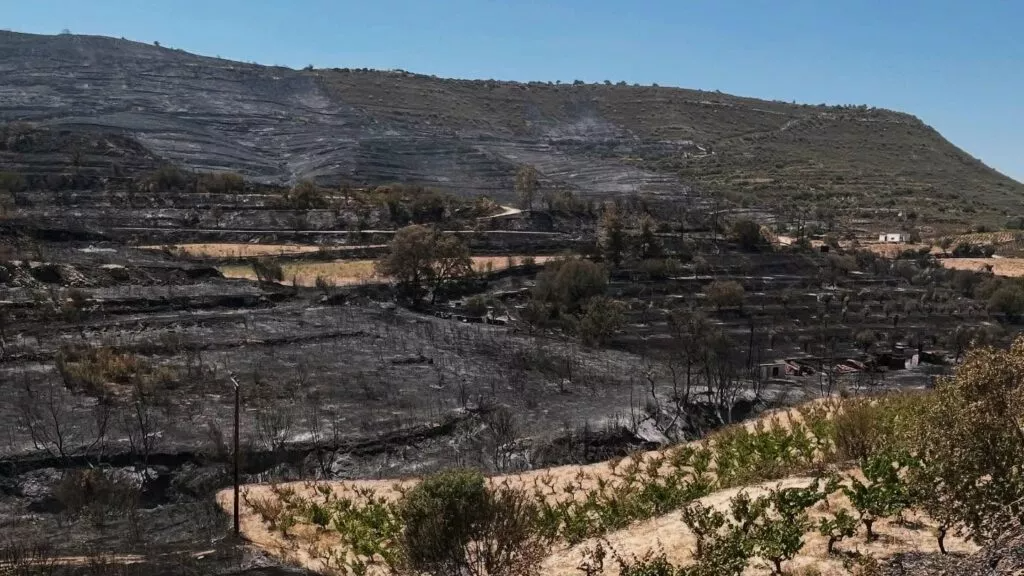
Three catastrophic forest fires have struck Cyprus in recent years, each revealing how escalating extreme weather conditions can transform natural disasters into human tragedies.
The progression from Solea in 2016 through Arakapas in 2021 to Malia in 2025 demonstrates a pattern: whilst drought and heat remained constant factors, intensifying wind conditions proved the decisive element determining whether fires could be contained or became deadly.
Solea 2016: The foundation of disaster
The Solea fire of 17-22 July 2016 established the baseline for Cyprus’s modern wildfire challenges.
Kalopanagiotis weather station recorded temperatures reaching 39°C with relative humidity dropping below 20% during peak hours. Wind speeds averaged 3 metres per second with gusts reaching 8 m/s (30 km/h).
Though winds remained moderate, the combination of prolonged drought and mountainous terrain created conditions that overwhelmed firefighting capabilities.
The Department of Meteorology noted the dangerous sequence of heat-dryness-wind that enabled rapid fire spread across difficult terrain.
Arakapas 2021: Escalation to lethality
Five years later, the Arakapas fire of 3-5 July 2021 demonstrated how intensified conditions could prove fatal. Eptagonia station recorded similar temperatures (32-35°C) and critically low humidity (12-20%), but wind gusts reaching 66 km/h (Force 8) transformed the scenario.
These powerful gusts created “explosive fire behaviour” – a meteorological term describing rapid, uncontrolled fire expansion that can overwhelm evacuation procedures and firefighting resources within hours. The result was Cyprus’s deadliest wildfire in decades.
Malia 2025: Unprecedented extremes
The Malia fire of 23-25 July 2025 reached conditions meteorologists classify as approaching “explosive fire behaviour” under unprecedented circumstances. At 2:30pm on 23 July, the local weather station recorded a lethal combination: 40°C temperature, 20% humidity, and wind gusts of 42.1 knots (78 km/h, Force 9).
Statistical analysis reveals such wind intensities have only 0.199% probability of occurrence, typically during thunderstorms. The alarming factor was clear skies – no storm system explained the extreme gusts, making this event meteorologically unprecedented.
The fire’s thermal intensity was so extreme that Kourris Dam station, kilometres away, recorded 58.3°C at midnight – evidence of how the blaze created its own weather system.
The anatomy of disaster
Meteorological Director Filippos Tymvios explains that wind gusts function as both fire transport mechanisms, carrying burning material over long distances to create new fire fronts, and flame intensifiers through increased oxygen supply.
Most dangerously, gusts often don’t follow prevailing wind direction, causing sudden, unpredictable changes in fire behaviour that can trap evacuation routes and endanger firefighting personnel.
Escalating pattern of threat
The three fires reveal clear escalation:
- Solea: Challenging conditions with 18-knot maximum gusts
- Arakapas: Dangerous conditions with 36-knot gusts causing explosive behaviour
- Malia: Unprecedented conditions with 42-knot gusts under clear skies
Each fire maintained the common denominators of extreme heat and drought, but progressive wind intensification determined whether communities could escape tragedy.
This analysis transcends historical documentation to provide critical warnings for Cyprus’s climate future. The meteorological progression suggests traditional firefighting strategies may prove inadequate against increasingly extreme weather combinations.
Read more:

