


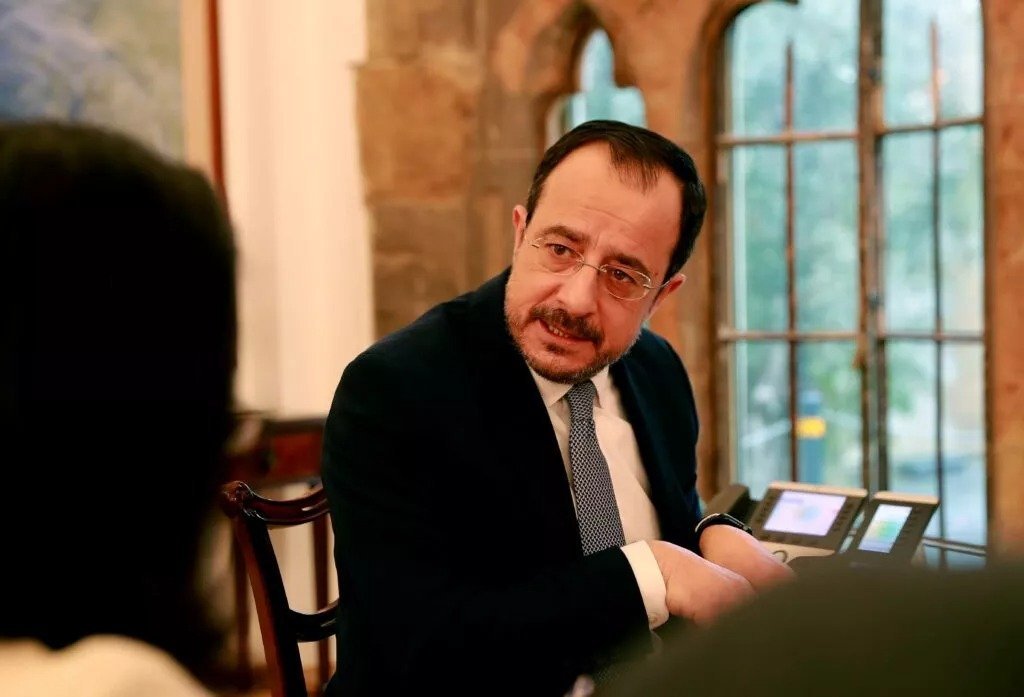
Interview with Androulla Taramounta, Costas Venizelos, Andreas Bimbishis and Frixos Dalitis
President Christodoulides appears determined to leverage the Republic of Cyprus’s comparative advantages, particularly its geographical position. In this context, a decision has been made to upgrade the naval base at Mari and the air base in Paphos.
The President has made it clear that these bases will not be given to any third country; they remain bases of the Republic of Cyprus that will provide facilities to any country that requests them.
He doesn’t hide that discussions have taken place with the Americans. American experts are expected to provide their input in January. Their involvement will be either technical expertise or financial assistance.
In his interview with philenews, the President speaks frankly about NATO. He points out that Cyprus should have been in NATO since 1960.
However, Britain wanted to maintain sole control of its strategic advantages in Cyprus through its bases. He didn’t rule out joining the Alliance, emphasising that “when conditions are right”, we will become a NATO member state.
Regarding the Cyprus issue, the President expects a UN envoy in January to prepare the ground.
He considers it a significant change that the President of the European Commission has moved the Cyprus issue and the financial regulation, along with the Green Line regulation, which were under the Directorate-General for Reform.
The first has been transferred to her own office and the regulations under the Directorate-General for Regional Policy. He notes that they are discussing names with Ursula von der Leyen for the EU Special Envoy.
Will the Americans ultimately be given a base on Cypriot soil?
We have decided, within the framework of strengthening the Republic of Cyprus’s deterrent power, to utilise what we consider our comparative advantages. Foreigners see our geographical position as our key advantage. We’ve decided to proceed with upgrading the base at Mari and the base in Paphos.
I have a memo before me indicating a cost of 14.7 million euros and an implementation period of 18 months. We’ve had discussions with the Americans who are interested, and who have used the “Andreas Papandreou” base for humanitarian purposes.
And I repeat to avoid any misunderstanding. Senators from both parties came, I met them at the “Andreas Papandreou” base, I met with American military officials, and I’m pleased because in their reports about cooperation with the National Guard, they noted the professionalism of our force’s personnel.
Whether the Americans help us or not, the “A. Papandreou” base will be upgraded. The Americans have shown interest. The US Ambassador has informed me that specialists and technicians who deal with air bases will come in January. We want them to give us their opinion on the base’s infrastructure.
To what extent will their involvement be?
Their involvement will be either through technical assistance or financial aid. In any case, the base will continue to be a base of the Republic of Cyprus.
Regarding the naval base, I’m speaking with the President of the European Commission. I spoke again recently about EU financial contribution through a specific Union programme so that the base can host any vessel from an EU member state.
Will it be a base of the Republic of Cyprus?
Both will be bases of the Republic of Cyprus. There’s no question of giving a base to anyone else.
Will they provide facilities to any state or only to Western ones?
It depends if it’s for humanitarian purposes. Let me remind you that during the crisis, our ports were used by China to evacuate two thousand Chinese from the region. We haven’t refused anyone for humanitarian reasons.
There’s no question of refusing. These are all things that highlight our country, to strengthen it even more. There was a day at the “A. Papandreou” base when we couldn’t host people and had to refuse, and they made other choices. We don’t want to lose this comparative advantage.
And at the same time, our own people are being trained. Regarding American military schools, we’ve sent four names of interested individuals. Soon we’ll have other announcements in this direction regarding our military cooperation, before the end of Joe Biden’s term.
For all this, they accuse you of turning Cyprus into an American springboard.
We’re neither a springboard nor anything else. Now, regarding Syria. We went to Brussels, presented our approach, had the discussion.
At the same time, however, as the Republic of Cyprus, we put forward two proposals. First, in 2012, Cyprus was used as a base for the unit that dealt with chemical weapons in Syria, and we said we’re ready to play this role.
Second, there’s the issue of missing persons in Syria, we have the expertise, we’re ready to take initiative and help with this issue.
So, are we gradually moving towards NATO, or is it still too early?
It’s not about NATO. If it were feasible to join NATO tomorrow, we would do it. In fact, from a historical perspective, Cyprus should have been in NATO since 1960.
The reason it didn’t join wasn’t because of Turkey, but because of another country that wanted to maintain sole control of the strategic advantages it had in Cyprus.
Since Cyprus’s membership isn’t feasible at present, we’re trying to secure these advantages through training, expertise, and reorganisation. And when conditions are right, we’ll become a NATO member state.
Including arms purchases?
Yes, including arms purchases. Buying American arms is among our considerations.
Defence is expensive. Can Cyprus afford these steps financially?
Yes, our economy’s current state allows us to further strengthen the Republic of Cyprus’s deterrent power. That’s why our economy is important, that’s why I mentioned earlier all those internal factors we need to strengthen. Because they affect the Cyprus issue too. Because you’re much less vulnerable both to pressure and exploitation.
You say we’ll work to break the deadlock on the Cyprus issue. It’s significant that there’s movement.
We said we would strengthen the Republic of Cyprus both in Europe and internationally. We’ve done this, not with words, but with actions. The fact that we managed to be elected to the UN Human Rights Council with such a high percentage says a lot.
We said one of our main goals is to clear Cyprus’s name internationally. We’re working hard in this direction. Foreign firms see all this. No foreigner will come to invest if they see corruption in this country. We said we would stabilise the economy. It’s been done.
Regarding the Cyprus issue, while there’s been movement recently that seems to be leading to an informal five-party meeting, aren’t you worried about a potential failure that this time could have worse consequences than in the past?
Let me be clear that a new failure in the Cyprus issue would be a very negative development. Perhaps some are banking on a negative outcome to build a narrative and arguments to achieve other goals. That’s why it’s very important that any developments are positive.
And what we do in our foreign policy is directly linked to the Cyprus issue. Interest in the Cyprus issue is being generated because they see that what the Republic of Cyprus is doing today must be able to continue tomorrow through a potential solution to the Cyprus issue. All these naturally come as our allies in this effort.
I expect we’ll have a UN visit in January. Most likely Di Carlo, to prepare the ground. We’re talking with all these states and strengthening our positions so they can help us.
It’s important for us that the President of the European Commission has moved the Cyprus issue and the financial regulation, and the Green Line regulation, which were under the Directorate-General for Reform. The Commission President recently decided that the Cyprus issue falls directly under her office regarding the talks. The financial regulation and Green Line regulation went under the Directorate-General for Regional Policy, since our occupied areas are part of the EU and the implementation of the European acquis has been suspended.
There will be more from the European Union demonstrating its interest. Next March, the UN Secretary-General has been invited to the European Council, and the Cyprus issue will be one of the agenda items.
Does placing the Cyprus issue under Ms. von der Leyen’s umbrella mean promoting the appointment of an EU envoy?
I can tell you that we’re discussing specific names with the President.
You’ve been discussing names and the issue of appointing an envoy for over a year?
Today we have a new Commission, which is already showing results. The fact that she took the Cyprus issue under her office is very significant. And we had this support from all these member states on EU-Turkish matters.
You said a UN visit is expected in January. So will the issue of opening new checkpoints be clarified by then?
They’re not directly linked. Regarding checkpoints, we’ve done our preparation with maps and alternative proposals. We have positions, we’re specific, we’ve given dates in January for this meeting.
At the UN reception, I proposed to Mr. Tatar that we meet so the negotiators can brief us and we can give them instructions. I’m waiting for a response. Even if he responds tomorrow, I am ready for a meeting.
Mr. Tatar says he won’t discuss anything except Mia Milia.
He can say whatever he wants publicly. Let’s discuss it and see the results. We have our positions and red lines too. I won’t state them publicly; I’ll go to the table and discuss them with him.
So the informal five-party meeting doesn’t depend on an agreement about the checkpoints?
It doesn’t depend at all on the meeting. Although an agreement on checkpoints would be a positive indication. Turkey’s position was that Britain didn’t need to be present at the expanded meeting. Then Turkey argued that Britain should be represented by a low-ranking Foreign Office official at the expanded meeting. Look at the results. All these are intertwined with our foreign policy.
In case of failure, what frightens you? Recognition?
What worries me most is them building infrastructure to promote another form of solution. I see a desire from Turkey to discuss. Even the discussions – which some had characterised as mere pleasantries, in Baku but especially in Budapest, with Turkey’s Foreign Minister – were substantial.
They were about the governance chapter. In other cases, while we approached them, the Turks had no desire for discussion. Today I see a willingness, but it will become apparent in practice whether this willingness they show – at least publicly – translates into something concrete on the Cyprus issue.
Criticism was exercised, even from government coalition parties, for allowing Fidan to attend the informal Foreign Affairs Council (FAC) after seven years. For us, it was important that he went to the FAC and heard from 22 other states what the Republic of Cyprus was saying.
The fact that the President of the European Commission went to Turkey – at a time when Ankara is trying to present itself as a mediator regarding Syria, and they’re putting three conditions for EU-Turkish relations with one of them being the Cyprus issue – is important, just as Cyprus-related obligations of Turkey are defined through the Enlargement Conclusions, a result of the close and excellent cooperation between the Foreign Minister and the Deputy Minister of European Affairs, two of my closest associates.
Mr. President, for those worried that with Turkey’s upgrading in the conflict environment in our region, Cyprus is the weak link, what is your counter-argument?
Assad’s removal was a positive development, considering what has happened in recent years and the aligned stance of the overwhelming majority of the international community regarding the regime. The most important thing is Syria’s next day.
At the last European Council, first I and then the Greek Prime Minister presented the situation in the region. And I can tell you that many of our colleagues didn’t know what this situation was. It’s very important that among what we mentioned were the positions of Egypt, Jordan, and the United Arab Emirates.
We see reactions from the Western world, as with the Arab Spring, that essentially all the region’s problems have been solved, and what ultimately emerged was an Arab winter. We saw it in Libya and also how the situation in Syria began.
That’s why together with Greece and Austria, we put down a specific plan and said there needs to be a roadmap. We pointed out that Assad’s removal is a positive development, Syria is entering a new era, and as the EU, we’re ready to help, to play a role.
This help depends step by step. If they do A, the EU will do B, and so forth. If, on the other hand, they exclude minorities, Christians, etc., the EU won’t come to help. Let me remind you that while Mr. Fidan was in Syria, Cyprus’s Foreign Minister was in Israel. And that has its significance.
The Republic of Cyprus is not politically weak
Is the EU’s goal to speak directly with the new situation in Syria?
At this moment, there is contact at a lower EU level. We told them that Syria is just 100 kilometres from Cyprus, so allow us to know better what’s happening than any other member state. We asked for a special representative to talk with them. We went to the summit representing not only Cyprus but also Egypt, Jordan, and the UAE. These were their positions. And these countries asked us to convey their positions to Brussels, which shows they trust us.
How do you reassure people’s concerns that Turkey might not get what it wants there but might be given concessions in Cyprus?
If Cyprus were politically weak, externally, perhaps Turkey could achieve these goals. But it is not like that.
Read more:

