


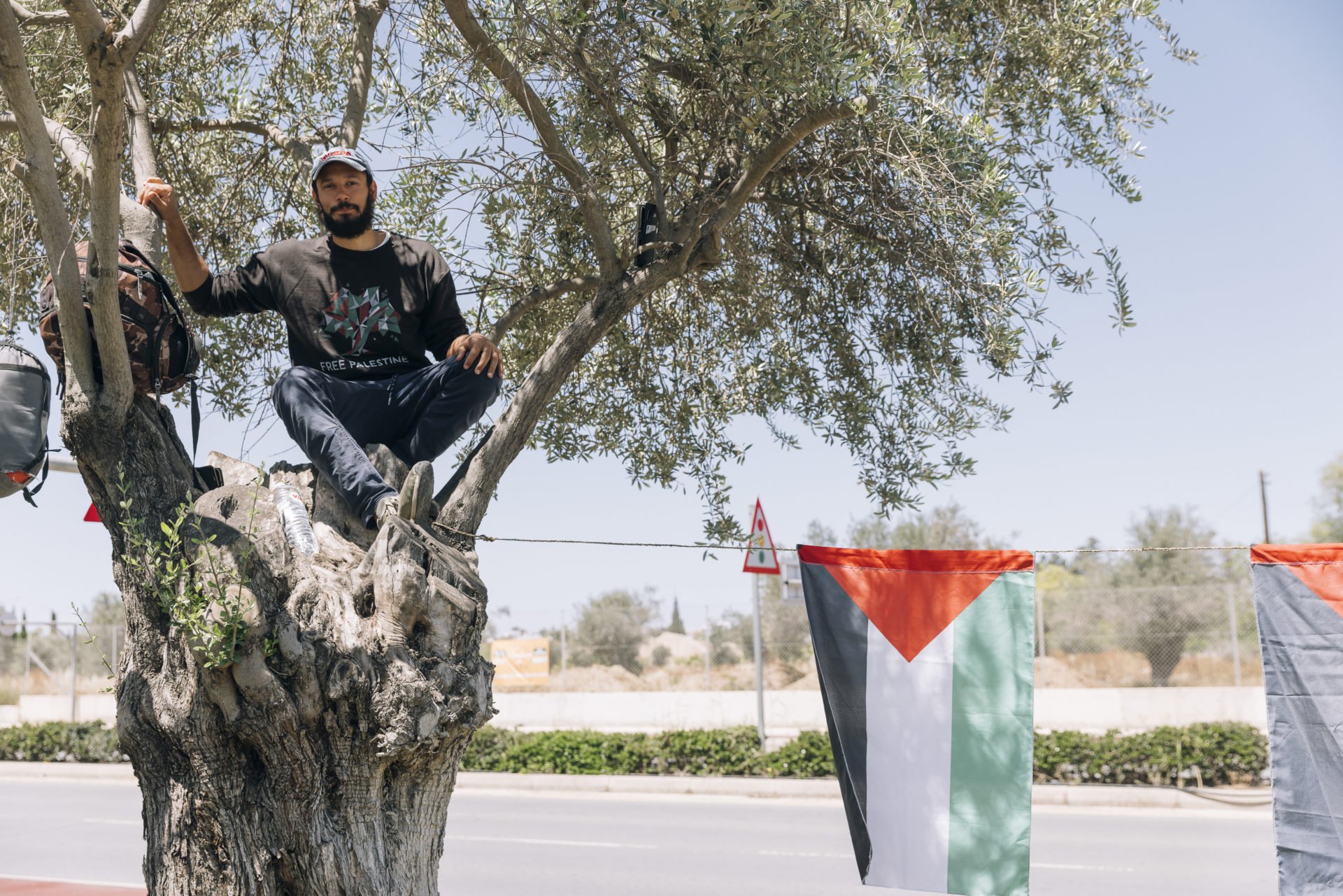
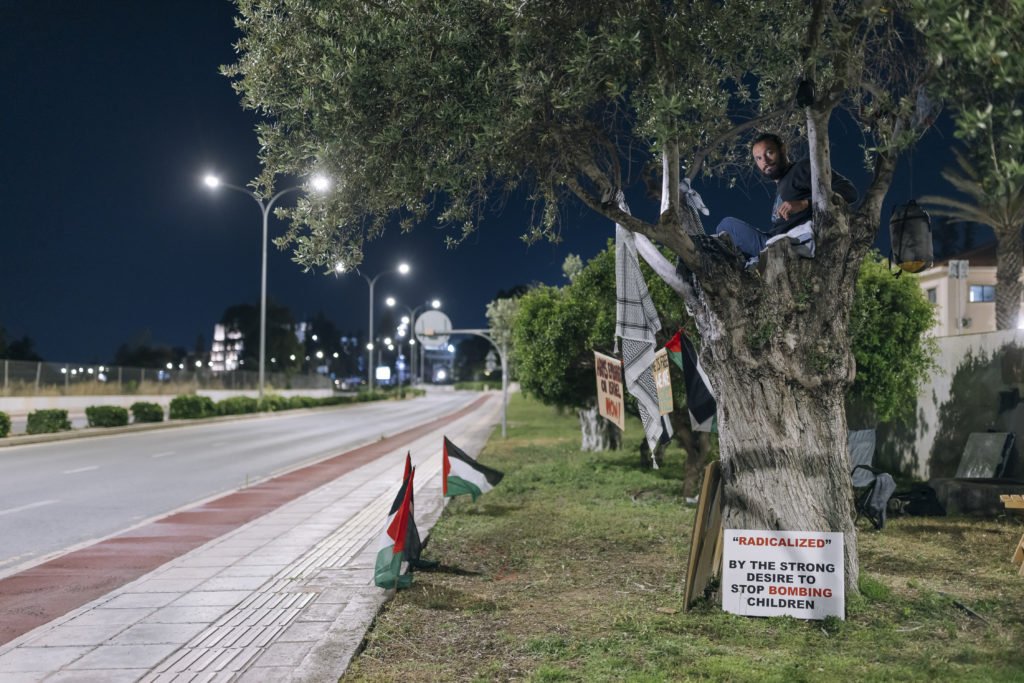
A cluster of olive trees stands at the Ayiou Prokopiou roundabout in Engomi, Nicosia where traffic circles endlessly and most passersby barely glance upward. But those who do might notice Louis Allan perched among the silvery leaves of one such tree, a solitary figure engaged in what he calls “an act of empathy and resistance.”
Allan, in his 30s, is a soft-spoken activist with a philosophical bent and a calm, confident demeanour. He has taken up residence in this tree for a five-day hunger strike. He subsists on just two liters of water daily—the same ration reportedly available to the average Gazan civilian—as a protest against the ongoing blockade of humanitarian aid to Gaza.
“The hunger strike is a way to represent the blockade of aid,” Allan explains, adjusting his position on the branch. “Drinking two litres of water, which is what the average person in Gaza has access to.” This self-imposed restriction, he says, is central to his protest, a physical embodiment of distant suffering made local and visible.
“I’m doing this in solidarity with Palestinians,” Allan explains from his arboreal post. The afternoon sun filters through the leaves above him. “This is about raising awareness about the current blockade stopping any food or aid from going into Gaza.”
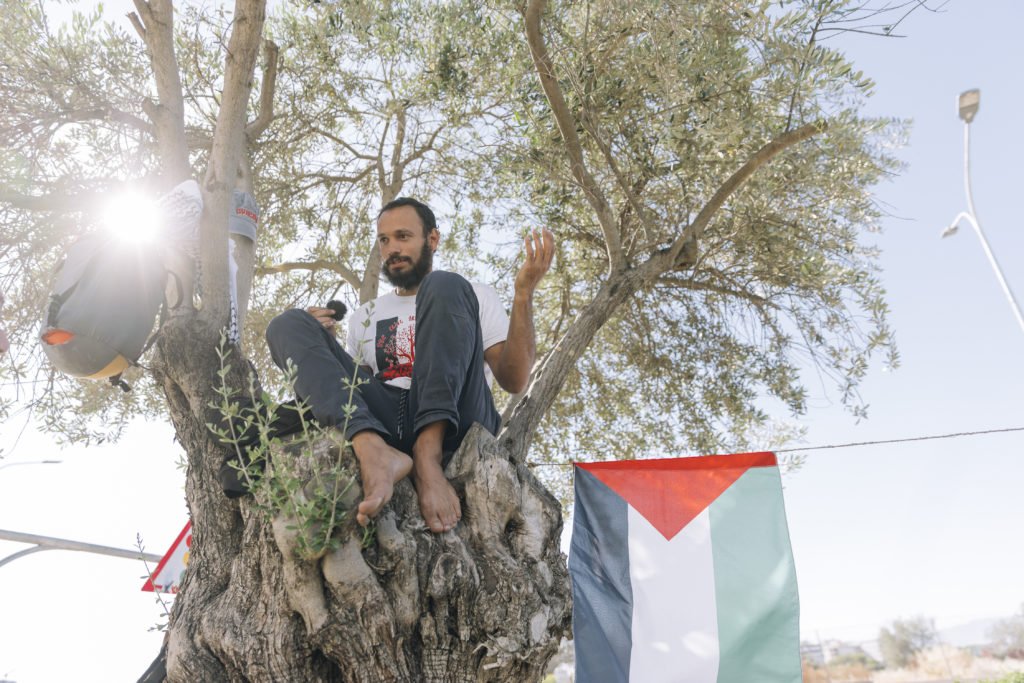
From his perch, Allan kindly hands me down a small microphone to record the interview. A smartphone is attached to a makeshift holder on a nearby branch—he’s livestreaming his endeavour, he explains, but offers to mute the broadcast during our conversation.
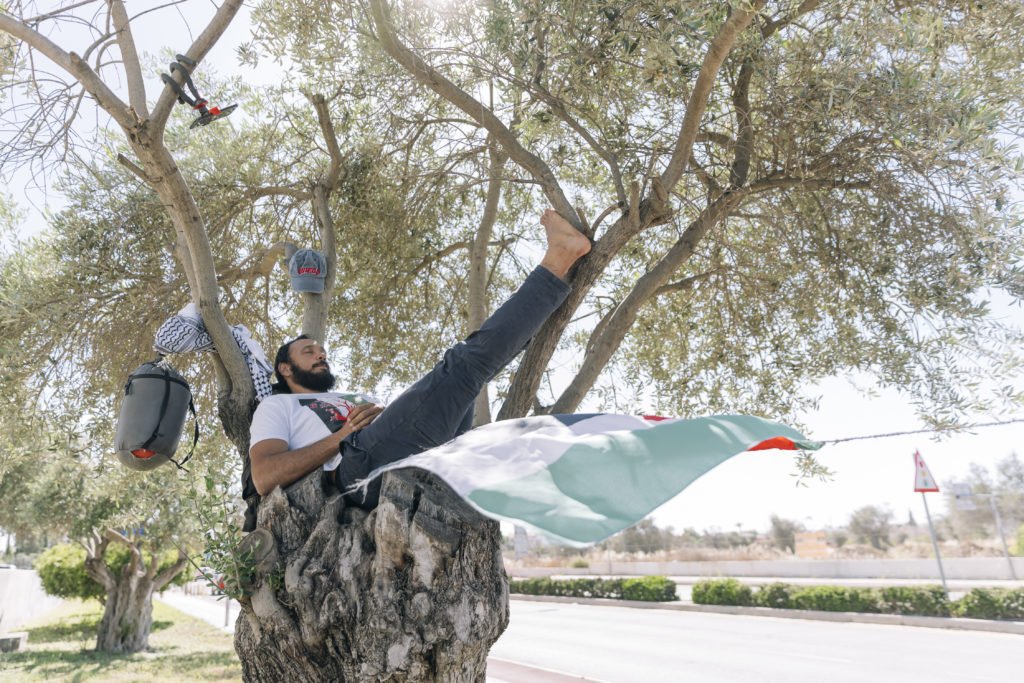
“I’ve been thinking about different ways to raise awareness,” Allan says, referring to his livestream which is available on his social media channels under the handle @move_with_louis. “The idea of this is to raise awareness and to get people’s attention, and then the question is, what do you do with that attention?”
What distinguishes Allan’s protest is not just its unusual setting but his thoughtful approach to activism itself. Where many demonstrations are characterised by anger and confrontation, Allan speaks deliberately about fear, interconnectedness, and what he describes as universal human experiences.
“I coach people how to have a better relationship with fear,” he says, referencing his professional work. “A big part of fear is avoidance—avoiding pain and suffering, avoiding doing things that are difficult.”
For Allan, the tree sit and hunger strike represent a personal challenge as much as a political statement. He prepared physically with a three-day fast beforehand, but insists the mental preparation has been lifelong. “I’ve been preparing my whole life in terms of sitting with pain and discomfort and suffering,” he says. “If we’re always avoiding these things, it can lead to a life of instant gratification.”
The roundabout in Engomi wasn’t his first choice. Allan initially envisioned protesting outside the Presidential Palace or Eleftheria Square but reconsidered, calculating that authorities would likely remove him within hours. Instead, he chose this public yet somewhat peripheral location, where olive trees—long a symbol of peace and resilience —provide both practical support and symbolic resonance.
Just a day into his protest, Allan reports he was confronted by two young men who spoke to him in Hebrew, allegedly stole Palestinian flags he had displayed, and later returned with a group who hurled verbal abuse. Even during our conversation, a car speeds past the roundabout, a passenger leaning out the window to shout “Out!” at Allan, a British Cypriot—presumably an abbreviated command for a foreigner to “get out of my country.” Allan barely registers the interruption, his calm demeanour undisturbed.
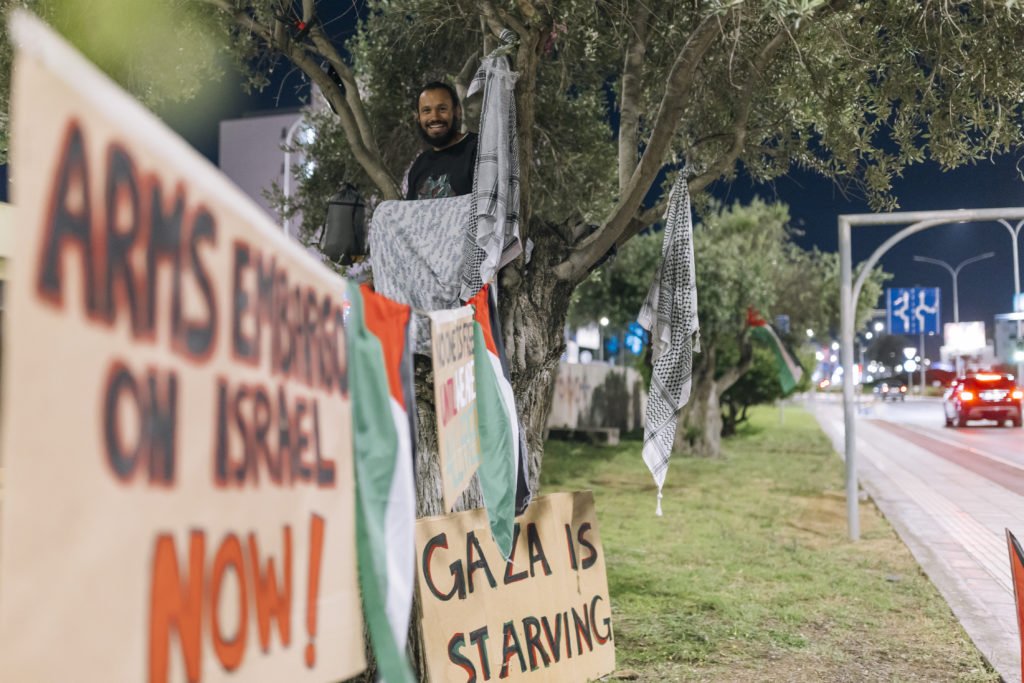
Allan’s critique extends to Cyprus itself. When asked about the Cypriot government’s position, he points to what he sees as hypocrisy: “The Republic of Cyprus is occupied currently, and we’re supporting the occupation of another country,” he says, referencing President Christodoulides’ visit to Israel on May 4 and the government’s diplomatic ties with Israel.
A key to the tacit approval of this war, Allan argues, is a widespread desensitisation to suffering. “The way we receive information is either through graphic content which is very hard and painful to watch, and then people maybe don’t want to watch it because it’s uncomfortable, or it’s through stats and statistics and figures, which is hard to connect with,” he says.
His approach aims to create something more tangible—a visual reminder of human capacity for both suffering and solidarity. Allan sees his protest not as a single act but as part of a continuum of resistance, suggesting that change comes through “small actions here and there consistently” rather than grand gestures.
“I’m not looking at outcomes,” he adds. “I’m doing it because it’s a way of living. It’s a way of expressing solidarity with the Palestinians and with the people there.”
From his perch in the olive tree, Allan has created a curious sight in Nicosia—a man voluntarily experiencing a fraction of the deprivation faced by those in Gaza, hoping that his discomfort might pierce through the collective numbness that allows such suffering to continue 370 km away.
(Pictures by Emma Louise Charalambous)

