


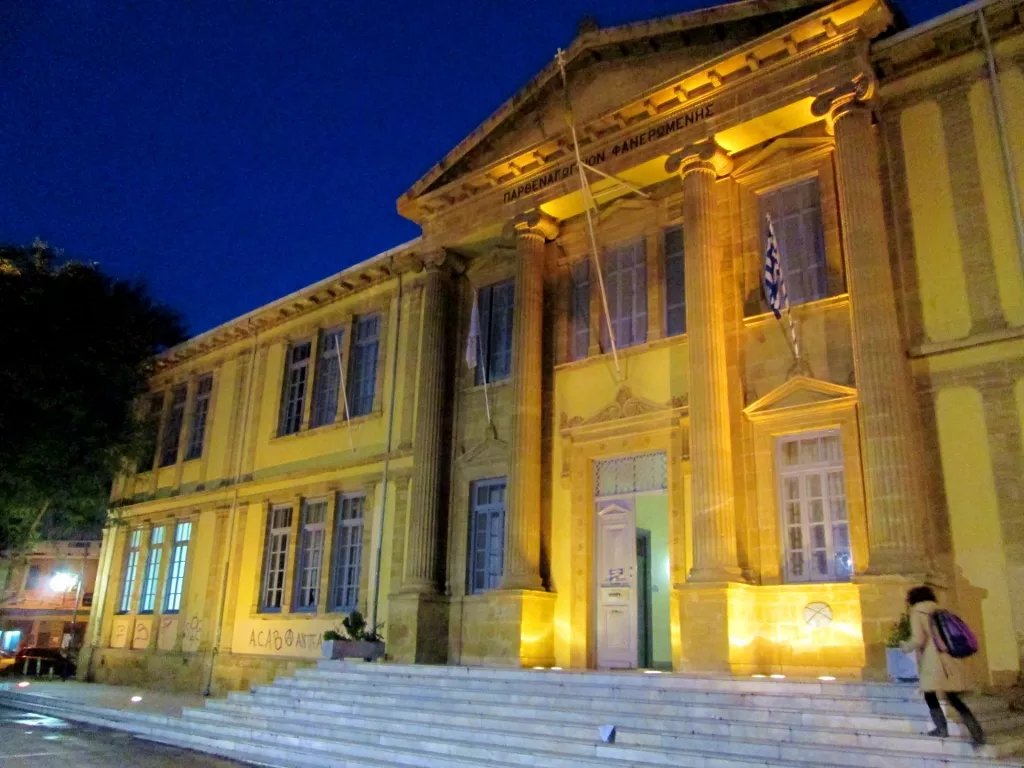
The Archbishopric has applied for planning permission to renovate the Faneromeni school building in Nicosia’s walled city and create a public square behind it, about five and a half years after agreeing with the government that the University of Cyprus could use the building for its architecture school. The move is part of a wider plan to revitalise the walled city, which stalled for years over costs.
The application, submitted by the Archbishopric as owner of the building, covers the renovation and structural reinforcement of the school and a new public square on the site of a basketball court behind it. The court sits above the Faneromeni underground car park, which holds 123 vehicles and will also be upgraded as part of the project. The work will be carried out by the Archbishopric’s technical services together with those of the University of Cyprus.
Years of setbacks
The memorandum of understanding signed in April 2021 provides for the Archbishopric to lease the school to the state for 33 years at a rent of about 150,000 euros a year, with the state granting its use to the university.
Since then, a series of setbacks threatened to sink the plan. At one stage, with the cost of renovating the building among the reasons cited, it looked set to be abandoned, and there were reports that the Archbishopric favoured letting the National and Kapodistrian University of Athens use the building.
Another issue was that the architecture school would need additional space for laboratories, classrooms, seminar rooms and postgraduate and doctoral facilities. When the costs were calculated, the project was estimated at about 15 million euros, which was seen as too high, and the plan stalled. Nicosia Mayor Charalambos Prountzos disputed that the cost would have climbed so high.
Prountzos told Phileleftheros he was pleased with the developments. Revitalising the walled city was a long-term strategic goal based on integrated planning, including boosting academic and research activity in the area, he said, adding that the vision was paying off and that he was confident the area had a future.
Wider regeneration plan
Besides moving the architecture school to Faneromeni, the memorandum provided for identifying suitable buildings owned by the Archbishopric or others for use by the municipality or the university as student halls, university faculties or other educational and research facilities. The municipality and the Archbishopric have each already opened one student hall.
The memorandum also provided for linking the historic centre with the university’s premises on Kallipoleos Avenue and its campus in Aglantzia.
Incentives for owners and investors
Planning incentives were also approved, including the transfer of building density from notable buildings built before 1960, or later, once they are repaired and restored. Buildings that are demolished and rebuilt keep their building density. Plot coverage can be increased by up to 10 per cent to allow for sensitive adaptations and modern needs.
The government also offered incentives to those creating student accommodation. Private investors had already shown interest in developing student halls, and after a 15 million euro fund was announced, other businesspeople also looked at doing business in the walled city. Some plan to create facilities for students, academics and researchers who will either live in the historic centre or spend many hours a day there.
Owners have also shown renewed interest in having their buildings listed so they can make full use of the incentives.
Prountzos said the municipality would make every effort to revitalise the city, through the Faneromeni project and other projects already completed, under way or planned.

