


This news piece was first published on policypress.cy
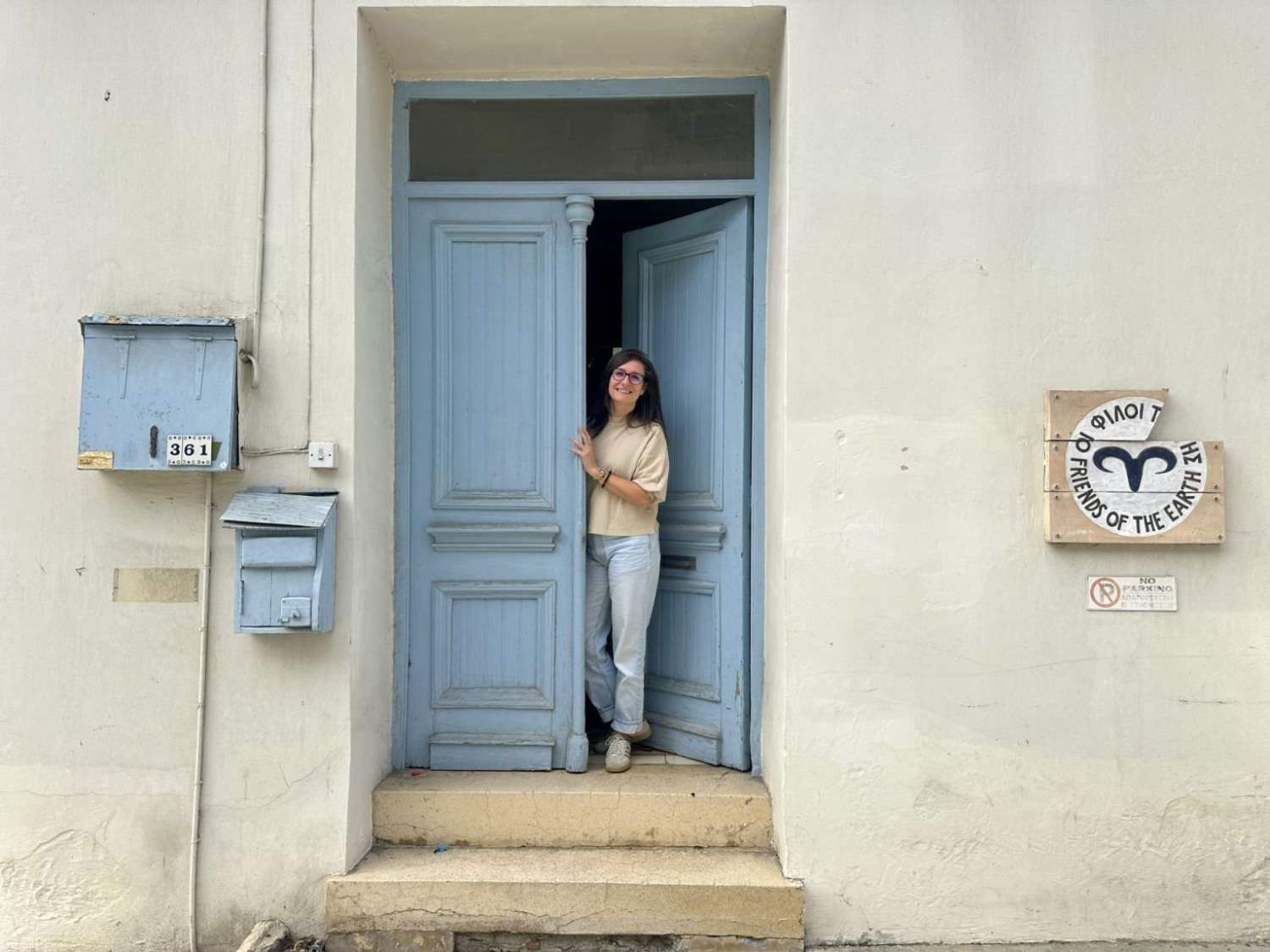
In the first contribution to our new interview series on Civil Society Organisations, the Policypress team interviewed Friends of the Earth Cyprus (FoE Cyprus). FoE Cyprus is part of a wider European and International network under the umbrella of the ‘Friends of the Earth’ name, allowing it to tap into a pool of experience, experts, and resources for its operations. Established in 1993, FoE Cyprus is “a grassroots organisation” which campaigns and advocates for environmental and social justice. For them, it is “the same struggle”.
Policypress talked to Antonia Christou, the President of FoE Cyprus, on the campaigning and advocacy efforts of the organisation, as well as the specific issues which it tries to address here on the island.
Introducing the organisation, Antonia explained how “important the word justice [is] for us, because we bring the environmental and the social aspect” together due to their connectivity. “For example, if we talk about energy and energy democracy, then we don’t only consider the…environmental impact of energy, like from fossil fuels, but who has access to clean and affordable energy.”
Rising temperatures and growing risks of heatstroke, and conversely lack of insulation for warmth in Cyprus homes impact Cypriot society unequally, according to FoE Cyprus. Antonia stressed that when approaching their campaigns and recommendations to decision-makers, “consideration of who is affected by an action, a policy, a law” should be the priority as much as the environment.
“I think that it’s part of how we have to think, not just in CO2 and in numbers, but what does it actually mean to the people who are living in this country?” An approach which directly reflects the dual operations of FoE Cyprus in their campaigns and advocacy on governance and grassroots levels.
Political will in campaigning for change
In FoE Cyprus’ efforts in the government, their approach is data and fact-driven. “We are often invited to the committees” like for the environment or transport, “for a variety of subjects [which] we will support with data, and we will send suggestions for specific elements.”
Antonia referenced a couple of examples in their efforts with micromobility and the banning of silly string to exemplify this approach. According to FoE Cyprus, it took part in discussions with Parliament concerning electric scooters and reliance on cars in March 2026, and the health hazards of silly string in March 2025, where FoE Cyprus argued their positions using “elements with data showing”.
As Antonia pointed out, “it’s always a question of communication; communicating correctly, reaching the correct people with data, really based on proof.” However, the effectiveness of truthful data is also strengthened by “find[ing] allies in what we’re doing”, tying back to the interconnectedness of environmental issues with that of the social.
Such efforts are not always smooth nor fruitful. “It takes time and it’s challenging and it’s difficult and it doesn’t always go somewhere we would like it to, but it’s important that we do it…and that we are able to show to the people and to the decision makers that there is a way to do it different[ly] and better”.
Taking action despite barriers and providing alternatives even if they are not listened to is at the core of FoE Cyprus’ operations on the governance level. FoE Cyprus’ concerns centre on how Cyprus assesses projects affecting Natura 2000 sites. It argues that assessments are often flawed and are carried out without conservation objectives for the site, pointing to Akamas and the Pentakomo aquaculture harbour. On 13 March 2024, the European Commission referred Cyprus to the EU Court of Justice for failing to put in place conservation measures for its Natura 2000 sites. In a separate case on 16 July 2026, the Court ruled that a project’s impact on a Natura 2000 site cannot be properly assessed unless conservation objectives have first been set.
Despite efforts on the local level by FoE Cyprus (along with BirdLife Cyprus, Terra Cypria, Cyprus Wildlife Society and the Initiative for the Protection of Natural Coastlines) through an open letter to Nikos Christodoulides, failures to comply with construction timelines and operation of illegal structures, such as restaurants and kiosks, continue in the Akamas peninsula. The letter called on Christodoulides to commit concretely to the protection of biodiversity and implementation of environmental policies included in his elected governance programme. Despite this, the Audit Office found only 17.67% of works in Akamas’ National Forest Park to be completed, three years after filed complaints, with only 6% of its contracted time for completion left, on top of continued operations of illegal premises and mobile businesses due to lack of supervision despite the issuing of environmental terms in 2021.
Hence FoE Cyprus has also actively engaged in its campaigning on a European level with their submission of “a petition at the Petitions committee (PETI)…in 2022 along with Terra Cypria” later presenting their case in February of 2026 at the European Parliament. Antonia theorised that “perhaps it has supported the fact that the European Commission has actually opened a case against the Cypriot government regarding infractions in Natura 2000 area definition and protection.”
Direct action on the local level is demonstrated in FoE Cyprus’s campaigning in regards to the development of the Pentakomo aquaculture port. “When we [in collaboration with BirdLife] learnt about the development of that port, we opened a case and it was the first time that indeed the court ruled that the works had to stop for a period of time” in April 2025. The order was lifted on procedural grounds on 30 May 2025, after the contractor and seven aquaculture companies were admitted to the case. FoE said the court had dismissed the challenge on 8 June 2026, because it had been filed after the 75-day deadline set by Article 146(3) of the Constitution.
“They didn’t even look into everything that we were saying about the environmental impacts, about the assessment [which they argued to be inadequate], the data that we showed”, Antonia explains, “Nothing was taken into account. They just ruled on the fact that it arrived too late.” Construction of the port continues.
“Sometimes, even if we take action, it doesn’t stop the development” Antonia concedes, “but we do try to bring the people who are in charge in front of their consequences…What is important is that we create a precedent that will allow for future cases to be presented at the court and have these as past examples”.
Antonia’s discussion about Pentakomo Port raised a wider concern about the environmental assessments conducted by the Republic of Cyprus. “They seem to be on both sides of the spectrum” she explains, “where sometimes they are effective, for example with [an alternative access] road that was proposed in Paphos from the airport. If it wasn’t for the environmental assessments, these works wouldn’t have been pushed back so far. But then you have environmental assessments that don’t take into consideration the importance of the area…it depends who is doing the assessment and who is behind this project.”
Consideration of the environment and the everyday practices which the government can set precedents for its consideration is, for Antonia, “generally more of a political will and a political mindset”. Despite struggles over environment, and hence citizen protection and justice “we have seen now with the new mayor in Limassol, there have been a lot of changes in the city structure [and] the mobility” priorities in the municipality.
Using the example of waste management in Cyprus, Antonia furthers this idea of government responsibility to set an example and facilitate sustainable practices. As an issue which has gained European-level visibility, on 1 October 2026 the European Commission referred Cyprus to the EU Court of Justice over its failure to ensure adequate treatment of waste. “Unfortunately, we had the sad first place of being the country in Europe with the most food waste”.
Antonia points out the lack of practice “for people to reduce waste before it actually goes in the bag…that is why we need a clearer political will if we really want to reduce our waste…[through] better control and support from the municipalities or authorities generally to reduce waste, to be able to compost, to repair what can be repaired and create, slowly slowly, this mindset of reducing consumption and the use of single use plastics”.
The Department of Fisheries and Marine Research, Ministry of Interior’s Game and Fauna Service, Ministry of Agriculture, Natural Resources and Environment and its Department of Forests did not respond to requests for comment by the time of publication.
Local engagement and awareness
FoE Cyprus’ advocacy is not isolated to discussions with government. As a grassroots organisation, society is at the core of many of their day-to-day operations and projects, as well as their efforts on the governance level, where “the idea is by providing the data and the proof, and communicating, is also being able to persuade the people who are voting for the representatives”.
For example, with the issue of food waste, along with campaigning for government responsibility, FoE Cyprus’ collaboration through the Zero Waste Alliance as well as their own projects aims “to reduce food waste at the source”. Recently, in collaboration on a European project with organisations from Cyprus, Malta, and Portugal, FoE Cyprus aided in the establishment of an application called Food Connect. This app is where “hotels and other restaurants, cafeterias and bakeries can put on something that they have left at the end of the day, and anyone can claim it. It’s free.” However, Antonia stresses that efforts cannot simply stop at countering food waste but must translate into transitioning into “organic and local eating with the seasons, all [as a part of] a mindset that we need to cultivate.”
FoE Cyprus’ concern about food waste is one which extends past the final product which we buy or collect from restaurants, hotels, and supermarkets to “pesticides and the quality of the food that we eat.” FoE Cyprus said in a written response that it was able to collect “six samples from two coastal locations (water samples and biological); a full report with the results and recommendations will be published” in November.
“Scientists explain why glyphosate, for example, is super bad for health”, Christou worries. Findings by the Pesticide Residues Laboratory of the State General Laboratory of breaches of EU pesticide residue limits in 13.1% of plant samples only increased Antonia’s concerns. “It’s really important for the people to understand that what they are putting in their plate, it came from somewhere. Someone used some resources to grow it, water, energy, etc. And understanding all this and creating this kind of awareness is probably the first step.”
The centrality of awareness is a constant focus of FoE Cyprus stressed by Antonia. It is seen in the events organised by FoE Cyprus, detailed by Antonia, in a recent visit to Riverland Bio Farm on 25 October; educational efforts through school visits and book readings; and their Backyard Screening Festival from 9 to 11 September 2026 “where we showed a documentary around…plastic detox and around urban development and also the Palestine issue”.
Their goal is to constantly “try to create a community of people who want to support…working with schools and coming close to nature…it creates a connection where people might have forgotten it.” And for those who may not show up by their own initiative, FoE Cyprus tries “to find what matters to people and find an angle to educate and raise awareness and have them care, even if the first reason they would do something would not be the environment.”
If awareness is FoE Cyprus’ target, engagement is their hurdle. “Engagement is something very complicated, whether it’s with volunteers or people organising events and fundraising. It’s not easy. We rely a lot on European projects, we organise events to bring people in. But indeed, it’s a challenge…we have three people working at the office, one full time and two part time and the board, we are all volunteers”.
With limited resources, Antonia explains how the critical focus for increased engagement is in the changing of the culture of volunteerism in Cyprus from the root point: the youth. “It’s not so much in the culture to volunteer, even when I was a kid it wasn’t normal or encouraged. So this is why we try to speak with young kids and engage them”.
Despite these challenges, Antonia describes their efforts as fruitful and their volunteer base, broad. Christou explains how anyone from “artists who had an exhibition and donated the profits…also people who support at the events” to “volunteers who help with the gardening” are active in their space and projects.
“Volunteers can do everything. They don’t need to be experts, and they don’t need to have [a] specific amount of time to support…It’s really a very big pool of people and we’re very grateful to them.”
Cyprus’ pressing environmental issues and the hope of energy communities
When asked to close off with any urgent issues that require the focus of both the public and decision-makers, Antonia listed three core focuses: “For me [the] most pressing matters for Cyprus are waste…plastic, food waste, all kinds of waste, and then it would probably be pesticides and the quality of food that we eat, and third probably would be energy, energy democracy and energy use.”
The creation of energy communities in Cyprus, as well as across Europe, entails the gathering of people who pool their money for the purchasing of photovoltaics, collaborating and benefiting as a team, Antonia explained. For Antonia and FoE Cyprus, these communities are “ a great way to tackle energy poverty”, one of the core focuses of the organisation.
“There are two types of energy communities that can exist”, Antonia explains, referring to Renewable Energy Communities (RECs) and Citizen Energy Communities (CECs). “They can come together…create some kind of board…[and] decide on how they want to work.”
“Unfortunately, people who are most affected are the ones who least contributed to the problem” and Antonia sees energy communities as a step to returning the lost agency of those impacted.
FoE Cyprus says it advises Limassol municipality’s Climate Neutrality Committee and has expressed interest in its first energy community, providing a space in FoE Cyprus headquarters for community meetings, as well as facilitating discussions on the subject. A similar general interest in energy communities has been seen in Nicosia, with the first operational experiment of an energy community having been set up in Aglantzia as part of the DYNAMO project. “In Cyprus, we have started seeing some energy communities being born, and it’s really nice to see the results”.

Friends of the Earth Cyprus is a non-governmental, non-profit organisation part of Friends of the Earth Europe and International, raising awareness on preservation of the natural environment and campaigning for sustainable policies and solutions to environmental and social problems. See more at https://www.FoEcyprus.org/
Interview conducted on 16 October 2026 by Kristina Arutyunyan and Clara Zinecker.

