


The island reports less access to psychological support at work than the European Union average, even as workers describe heavy workloads and stress-related health problems.
On paper, Cyprus can look like a place where work-related mental health is less pressing than elsewhere in Europe. But the latest European survey suggests a different interpretation, workers may be encountering significant pressures while having fewer formal avenues for support.
The European Agency for Safety and Health at Work’s 2025 OSH Pulse survey, conducted in April, interviewed 503 workers in Cyprus as part of a wider European exercise. Its findings offer a revealing snapshot of the gap between workplace stress and employers’ responses.
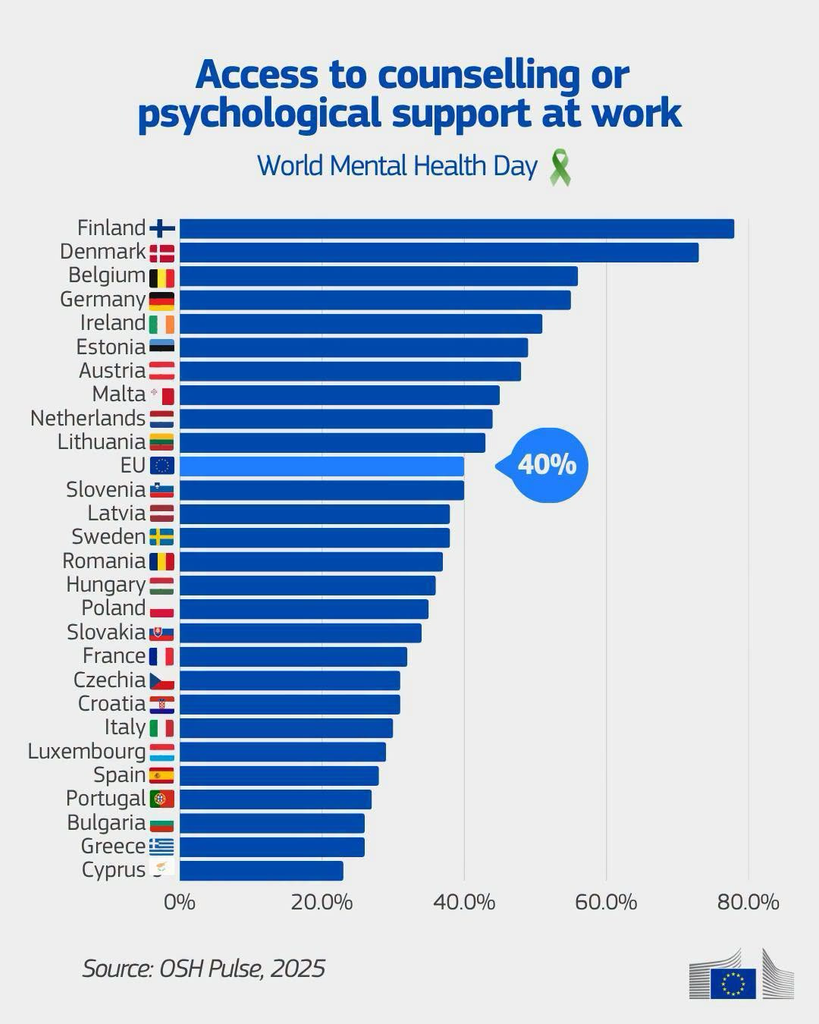
Just 23 percent of workers in Cyprus said counselling or psychological support was available in their workplace, compared with 40 percent across the European Union. Only 33 percent reported access to awareness-raising, information or training on well-being and coping with stress, against 53 percent in the EU. And 34 percent said workers were consulted about stressful aspects of their jobs, compared with 45 percent across the bloc.
Yet the figures do not suggest that Cyprus has escaped workplace pressure. Half of respondents reported exposure to severe time pressure or work overload, above the EU figure of 44 percent. Meanwhile, 37 percent said they had experienced stress, depression or anxiety caused or made worse by their work during the previous 12 months, compared with 35 percent across the EU.
The distinction is important. The availability of counselling is not a measure of how much stress workers experience, and low reported access to support does not necessarily mean that every employer lacks assistance. But the figures suggest that workplace support may not be keeping pace with the pressures employees describe.
The results also reveal a more complicated picture of mental health at work. In Cyprus, 41 percent of respondents agreed that disclosing a mental health condition could harm their career, compared with 48 percent across the EU. The figures suggest that fears about professional consequences remain present, even if they are less widespread than the European average.
Last Friday, European Commissioner for Health and Animal Welfare Olivér Várhelyi said in a statement ahead of World Mental Health Day, “To address the mental health challenges we face today, we must first listen to people, their experiences, their voice, and to turn what we hear into action.”
The case of Cyprus
Cyprus’s economic structure provides part of the context. The island has a service-oriented economy, with employment across tourism, hospitality, retail, construction, professional services and other sectors. Working conditions differ substantially between these industries. Seasonal demand, customer-facing roles, deadlines and long or irregular shifts can create pressures that are not always addressed through formal employee-support programmes.
Working hours are another relevant consideration. Eurostat’s latest data, covering 2025 and updated in September 2026, show that 9.1 percent of employed people in Cyprus usually worked at least 49 hours a week in their main job, down from 10 percent in 2024. The measure does not establish that long hours caused the mental health problems but it offers another indication of the working environment in which those experiences occur.
The broader labour market is relatively strong. In 2025, Cyprus’s employment rate among people aged 20 to 64 reached approximately 81.3 percent, up 1.5 percentage points from 2024 and above the European Union average of 76.1 percent.
But high employment is not the same as good working conditions, the latest workplace survey suggests that many workers still face considerable pressure, while access to counselling remains limited.
In Cyprus, workers were more likely than their European counterparts to report severe time pressure, while substantially fewer said psychological support was available at work.
(Sources: European Commission, Eurostat, Eurobarometer, European Agency for Safety and Health)
Read more:

