


Cyprus rose two places to 28th out of 143 countries in the World Justice Project’s (WJP) Rule of Law Index 2026, making it one of a minority of countries whose score improved this year. Its overall score rose by less than 1 per cent, and it ranks 21st of 31 countries in the European Union, the European Free Trade Association and North America.
Behind the overall gain lies a mixed picture. Cyprus ranks 25th in the world for criminal justice, despite a decline in that area over the past six years. In order and security, its weakest of the eight factors the index measures, it ranks 45th, with a score of 0.79, the lowest in six years.
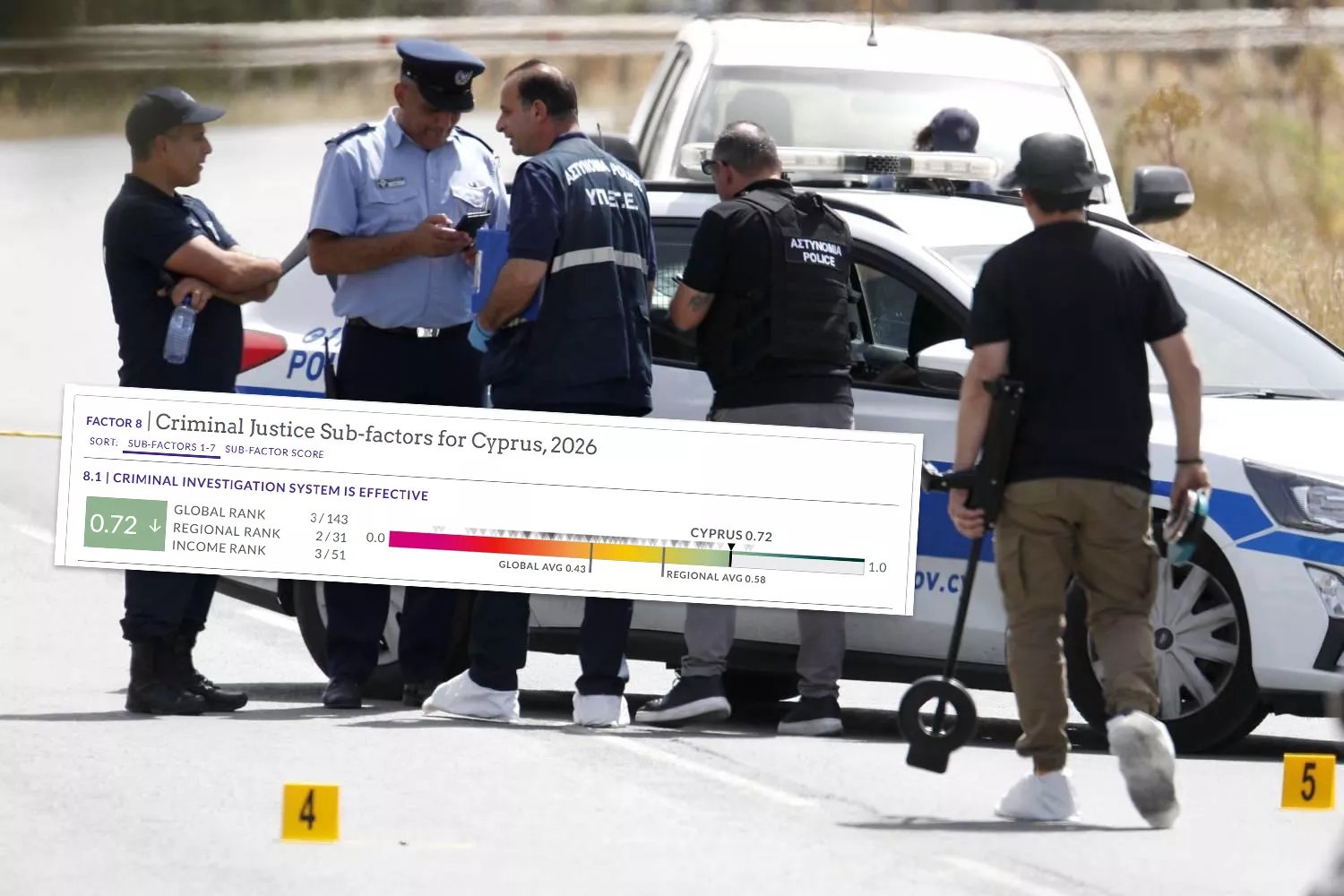
An analysis by Phileleftheros of the seven sub-factors that make up the criminal justice score found that Cyprus’s relatively high ranking is driven by the effectiveness of its criminal investigation system. Its score of 0.72 in that area places it among the top three countries in the world.
Warning over investigators
Police trade unionists say efforts to develop new investigators must continue, as those currently serving will retire and are not being replaced in sufficient numbers.
Nikos Loizides, head of the police branch of the Isotita union, told ANT1 television on Friday that the strong criminal justice result reflected the standard of police investigators.
“I am sounding the alarm about investigations. Our investigators are running out,” he said. He said investigators had aged and were overloaded with cases, and that officers complained new investigators were not coming forward. A solution must be found with the police leadership so that more officers step forward and learn from experienced colleagues, or there would be a problem within a few years, he said.
Asked about the order and security score, Loizides said it should be a cause for concern, as it is linked to crime, public safety and violent acts of vigilantism in neighbourhoods. He linked it to the C3 police modernisation project, which will centralise control of the message control centre and the rapid intervention unit (KEM-OULAE), with more patrols so that officers can reach incidents.
He pointed to the reorganisation that the police chief is trying to carry out, saying the force is 600 officers short and needs a change to its organisational structure.
Global decline
The WJP said the global decline in the rule of law continued in 2026. Fewer countries declined than last year, but the 62 per cent of countries whose scores fell still outnumbered those that improved.
More than 86 per cent of countries, including Cyprus, have shown a continuous decline over the past five years in at least one of the safeguards against authoritarian government: limits on government powers, open government or fundamental rights. The index measure of judicial constraints on government powers fell in 63 per cent of countries, again including Cyprus.
Cyprus was not among the countries where civic freedoms declined. Freedom of opinion and expression fell in 64 per cent of countries, freedom of assembly and association in 67 per cent, and civic participation in 65 per cent.
Improper pressure and interference from the executive have become the main drivers of decline in both criminal and civil justice, the WJP said. Civil justice deteriorated in 64 per cent of countries and criminal justice in 58 per cent.
Civil justice is, however, becoming more accessible, affordable and fair. Access to and affordability of civil justice improved in 54 per cent of countries, and freedom from discrimination in civil justice in 52 per cent, with Cyprus among the improvers on both counts.

