


Authorities have launched an investigation into alleged illegal surrogacy arrangements involving a British couple, as the Mediterranean Institute of Gender Studies (MIGS) called for stronger measures against surrogacy operations.
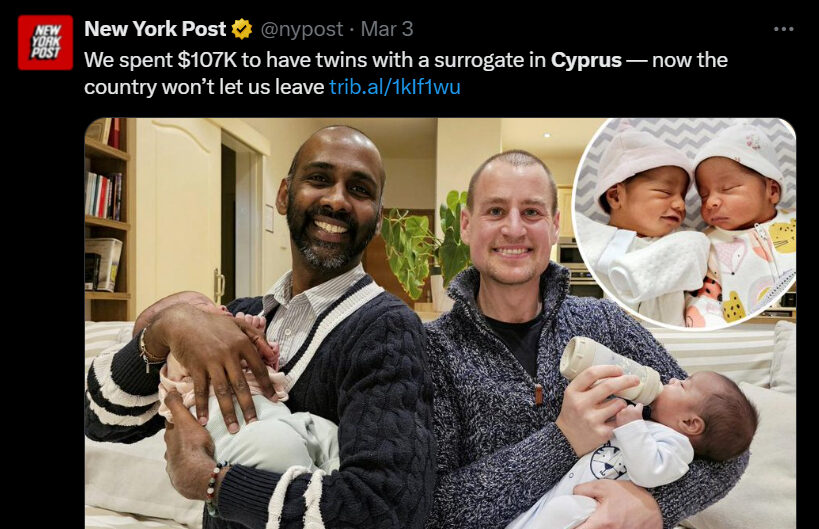
Police in Limassol are examining multiple irregularities in the case of Damian, 33, and Pasan Fernando, 36, from St Albans, who reportedly paid approximately $107,000 for surrogacy services resulting in the birth of twin boys on 3 January.
The payment significantly exceeds the basic medical expenses permitted under Cypriot law, which prohibits commercial surrogacy arrangements. British law contains similar restrictions.
In a statement on Friday, the Mediterranean Institute of Gender Studies (MIGS) raised concerns about surrogacy networks operating in Cyprus. The institute expressed its opposition to surrogacy practices, which it describes as “a serious form of exploitation and commodification of women and children”.
MIGS warned that the substantial financial benefits accruing to individuals and companies managing surrogacy processes create “ideal conditions for trafficking vulnerable women for reproductive exploitation”.
These concerns have been reinforced by testimonies from women internationally who report violence, deprivation of liberty, deception and recruitment into surrogacy networks.
“Surrogacy is a practice with inherent risks to women’s rights and integrity, as it effectively transforms women into ‘reproduction machines’ and the babies they ‘produce’ into objects for sale,” the institute said in a statement.
MIGS emphasised the need to frame the issue in terms of protecting women’s rights and eliminating all forms of violence and exploitation against them.
The institute noted that the European Parliament has classified surrogacy as a form of human trafficking, indicating it can be used as a means of exploitation and degradation of women.
The European Women’s Lobby and the European Migrant Women Network have also stated that surrogacy constitutes a serious form of exploitation and violence against women—physical, economic and psychological.
For these reasons, having a child through a surrogate mother is a prohibited practice in most European countries, including France, Germany, Italy, Spain, Austria, Sweden, Norway, Finland, Belgium, Lithuania, Slovakia, Latvia and Switzerland.
Health Ministry officials have been unable to locate the “World Center Of Baby” clinic allegedly involved in the arrangement. An inspection this week found no premises at the advertised Limassol address near the city’s Public Garden.
The Interior Ministry confirmed that no birth registration for the twins was filed with the Limassol district administration.
Evidence suggests the surrogacy procedure may have occurred in the occupied northern part of Cyprus, with investigators discovering promotional footage showing a medical centre located just past a checkpoint.
The World Center Of Baby reportedly began operating in Cyprus in March 2022 after relocating from Ukraine following the outbreak of war. The company’s website has since been removed following the controversy.
The British couple’s story gained international attention after the New York Post reported they were stranded in Cyprus due to bureaucratic complications.
Based on these concerns, MIGS has called on the Cypriot government to:
- Include surrogacy in legislative initiatives addressing violence against women and human trafficking
- Evaluate the implementation of current legislation and consider prohibiting surrogacy practices
- Publish data on the number of applications submitted to the Council of Medically Assisted Reproduction annually, including approvals, rejections and demographic information of approved surrogate mothers

