


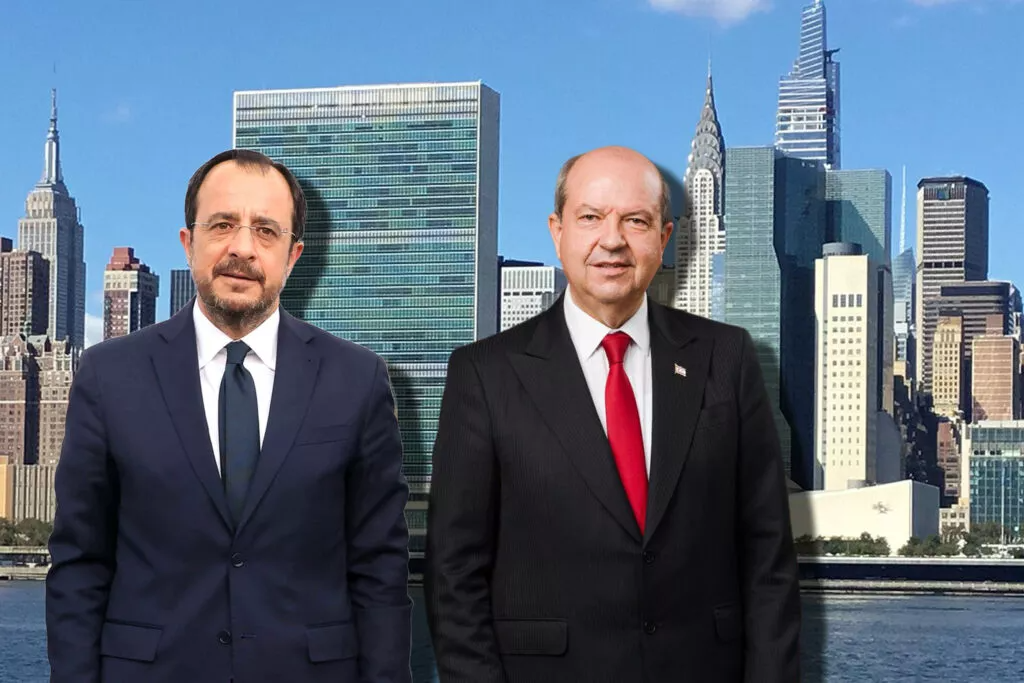
President Christodoulides and Turkish Cypriot leader Ersin Tatar will attend tomorrow’s second informal conference on the Cyprus issue in New York with fundamentally different objectives.
Christodoulides seeks to restart formal negotiations on the Cyprus problem, whilst Tatar demands satisfaction of his preconditions before agreeing to participate in any talks. The Turkish Cypriot leader insists on implementation of the “3 Ds” – direct flights, direct contacts, and direct trade – describing these as non-negotiable requirements rather than bargaining points.
Different approaches to confidence-building measures
The two sides maintain opposing views on confidence-building measures (CBMs). The Greek Cypriot side views CBMs as supportive tools for improving inter-communal relations but not as substitutes for a comprehensive Cyprus solution. The Turkish Cypriot side considers CBMs as vehicles for building “good neighbourly relations” between what it terms two separate states.
Speaking before departure, Christodoulides emphasised that any CBMs “must aim to strengthen efforts to resolve the Cyprus problem on the basis of the agreed framework” and cannot “replace the Cyprus solution in any way”. He ruled out discussing measures that reference Turkish proposals for a two-state solution.
Limited UN expectations
The United Nations’ policy of maintaining equal distance between both sides whilst avoiding pressure for negotiation resumption has allowed the status quo to persist for eight years. UN Secretary-General António Guterres is expected to pursue minimal outcomes at the New York meeting, focusing on CBM agreements whilst referring continued efforts to his personal envoy.
Tatar indicated some progress since March on environmental issues, youth matters, and cultural heritage including cemeteries, but expressed frustration over checkpoint arrangements. He maintains proposals for opening crossing points at Mia Milia and Louroujina, whilst the Greek Cypriot side advocates for “corridors” at Kokkina and Pyroi.
EU role questioned
The absence of European Commission Cyprus envoy Johannes Hahn from the New York meeting has raised questions about EU involvement. Christodoulides noted that Hahn’s appointment was a Nicosia request and his presence would be helpful given Turkish attitudes toward EU participation.
The president referenced the EU’s March letter during Geneva meetings as demonstrating continued European interest in the framework for resolution. He emphasised that progress in EU-Turkey relations, a strategic Turkish objective, depends partly on Cyprus developments.
UN official highlights mistrust
UN Special Representative Colin Stewart briefed the Security Council on Monday, noting what he deems a deep mistrust between the two communities. Stewart identified different narratives between the sides as the primary obstacle, stressing that both communities cite historical injustices.
Security Council members expressed expectations for the New York meeting whilst emphasising confidence-building measures as essential for progress.

