


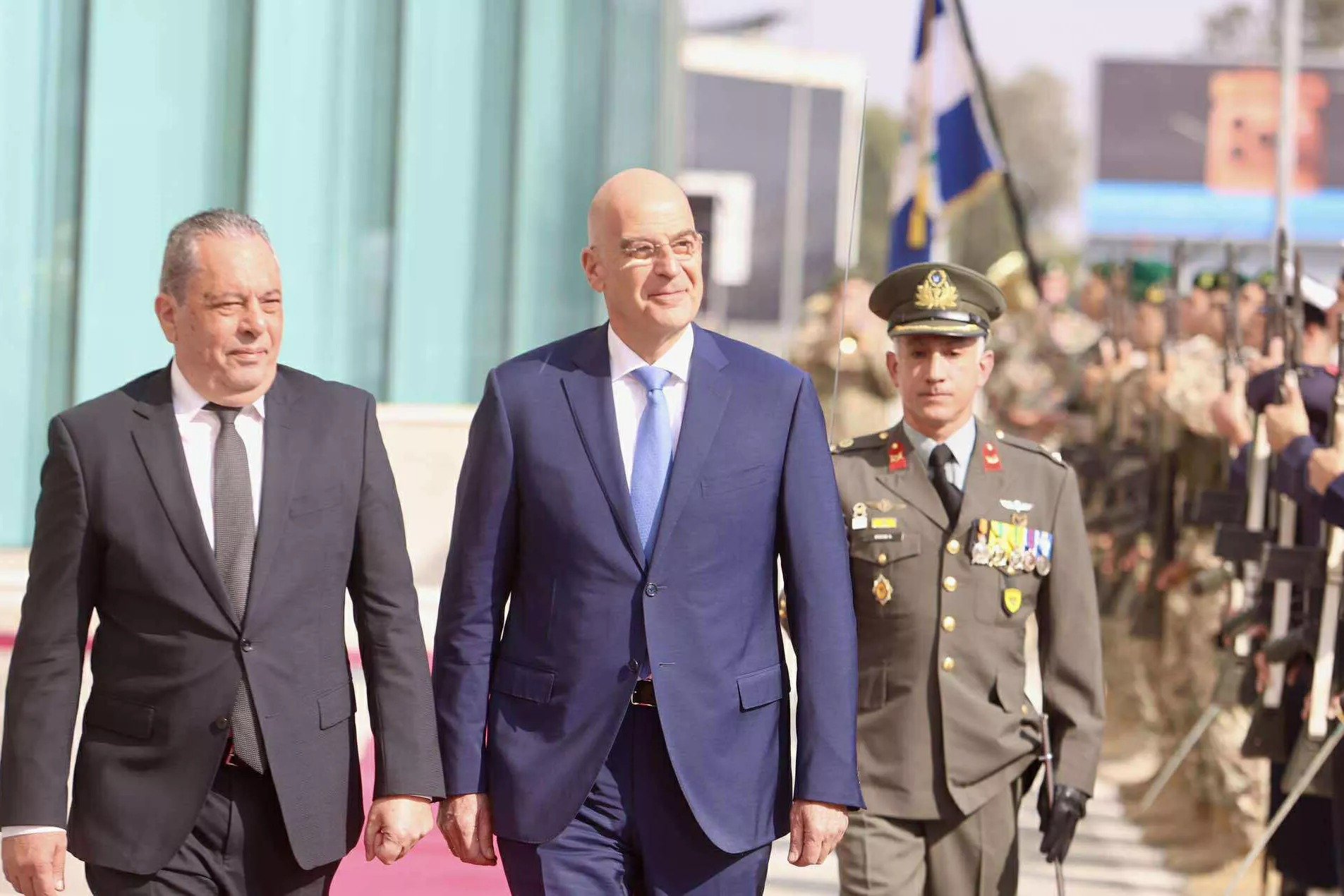
Cyprus and Greece have agreed to pursue joint defence programmes through the European Union’s SAFE regulation, with officials from both countries already discussing specific areas for weapons systems development.
Defence ministers Vasilis Palmas and Nikos Dendias met in Nicosia on Monday and identified concrete sectors for collaboration under SAFE, with anti-drone system development at the top of the list.
Military staff and technical experts from both countries have already begun discussing specific weapons systems development areas.
President Nikos Christodoulides told Dendias that Cyprus’s upcoming EU Council presidency represents a “golden opportunity” to strengthen Greek and Cypriot defence industries and showcase their capabilities.
According to a presidency statement, Christodoulides said the two countries need to see how they can push defence and security issues further, noting these are very important sectors given the Turkish occupation and Turkish provocations, as well as the region’s geostrategic significance.
Dendias said he and his Cypriot counterpart had the opportunity to discuss further deepening defence cooperation on defence industry matters and the ecosystem of both countries.
He added that Cyprus’s EU Council presidency will provide a tremendous opportunity and expressed his anticipation for deepening bilateral cooperation.
Ministers’ statements
Speaking after their meeting at the Defence Ministry in Nicosia, Palmas said the meeting took place within the framework of regular consultations on matters concerning bilateral relations between the two friendly and brotherly countries.
He said they exchanged views on the geopolitical situation in the region as it currently stands and discussed bilateral relations issues, focusing mainly on matters concerning the EU’s SAFE regulation, which concerns strengthening the EU defence industry and European defence.
Palmas said it is self-evident that within the SAFE framework, the two ministries should have synergies and cooperation to further upgrade defensive capabilities and defensive protection for safeguarding sovereignty and territorial integrity.
Dendias thanked Palmas for the reception and President Christodoulides, whom he would meet afterwards. He said it was an opportunity to exchange views on a rapidly changing but extremely complex geopolitical situation, particularly in the Eastern Mediterranean region.
The two ministers also explored more cooperation possibilities between Cyprus and Greece, focusing on the SAFE regulation, which has a tight timeline, Dendias said. He stressed that this regulation provides an opportunity for both Cyprus and Greece to deepen cooperation between them.
Turkey and SAFE participation
Asked whether efforts are being made for other EU member states to exercise a veto if Turkey seeks to join the SAFE programme, Dendias said he and Palmas are perhaps among the few people in Europe who have sat down and read the SAFE regulation, an extremely complex regulation written in the peculiar language of Brussels bureaucracy, precisely so that everyone can understand what they think and express what they judge.
However, within this framework, there are core principles that must be clear, he said. There is a clear commitment from the European Commission on how agreements between the EU and third countries will be introduced for discussion, he noted.
The European Commission itself has committed through a statement that these proposals will come for voting with unanimity, with common understanding from all states, Dendias said. He added that this is self-evident, because if someone threatens the EU itself, it is obvious they cannot participate in the mechanism for addressing this aggression.
Within this framework, he continued, all European countries are expected to align with the self-evident understanding of protecting European space, not only geographically but also European values, democracy and the European approach to protecting human rights.
Read more:

