


In November 2021, with Cyprus facing an unprecedented wave of irregular arrivals, Nicos Anastasiades wrote to Ursula von der Leyen asking for Cyprus to be allowed to suspend asylum applications from people entering the country illegally. The response was emergency funding of more than €10 million.
Five years later, Nikos Christodoulides is no longer asking Cyprus’s partners for an exemption. He is discussing the European rules with them.
In the meantime, Cyprus has transformed both the situation at home and its position in the European debate.
Between January and September 2022, arrivals exceeded 13,000. Over the same period in 2026, they stood at 1,200, a fall of 91%. Asylum applications dropped by 92%, from 16,700 to 1,300.
The comparison is with a peak year, but the decline in Cyprus is still far greater than the European fall, which this year stands at about one-third.
Nicosia’s policy, particularly since 2023, has proved effective, while Brussels now appears to be looking beyond simply sending money to frontline states.
From solidarity to pleading for help
In 2015, when more than one million people reached Europe by sea, Cyprus received just 2,015 asylum applications. Of those, 908 were from Syrians fleeing the civil war in the neighbouring country.
The migration crisis already shaking Europe largely passed Cyprus by.
The European Asylum Support Office (EASO), now the European Union Agency for Asylum (EUAA), had already been providing technical assistance to Cyprus since 2014.
Under the September 2015 relocation programme covering 160,000 refugees from Italy and Greece, Cyprus committed to accepting 440 asylum seekers. It also pledged 69 resettlement places for vulnerable refugees from third countries.
The first group, six people from Syria, Iraq and Eritrea, arrived from Greece on 11 February 2016. Four Africans followed from Italy in May and were transferred to Kofinou.
The final picture, according to the European Commission’s May 2017 report, was different. Cyprus’s legal obligation under the Council decisions stood at 320 people, while 73 had actually been relocated to the island – 18 from Italy and 55 from Greece.
Three years later, in 2018, the situation had changed. Cyprus ranked first in the EU for asylum applications per capita.
By August 2019, with almost 7,000 applications in the first six months alone and more than 14,000 cases pending, Interior Minister Constantinos Petrides wrote to the Commission asking for 5,000 asylum seekers to be relocated to other member states.
Brussels said it was examining the request and was prepared to increase financial and operational support. There was, however, no comment on the relocation request itself.
In 2021, then president Nicos Anastasiades asked in a letter for Article 78(3) of the Treaty, which allows temporary measures in an emergency, to be activated, along with mandatory relocation.
Then interior minister Nicos Nouris calculated that if every member state accepted 200 people, Cyprus would be relieved of 5,000.
Nicosia pointed to decisions concerning Lithuania and Poland, while Nouris highlighted what he saw as an imbalance: Europe responded when migrants could reach Germany, but those arriving in Cyprus, outside the Schengen area, were effectively trapped on the island.
Again, the response was financial. Article 78(3) was not activated.
Nicosia changes its approach
The shift began in 2023 under the government of Nikos Christodoulides and took clearer shape in 2024.
Nicosia did not merely change its domestic policy. It also changed how it dealt with Europe.
In April 2024, after a surge in arrivals from Lebanon, the government suspended the examination of all asylum applications from Syrians and openly said it wanted to pressure the EU into reassessing conditions in Syria.
Interior Minister Constantinos Ioannou set a goal of making Cyprus an unattractive destination.
In June, a Deputy Ministry of Migration was established, bringing the relevant services under a single administration.
The moves drew strong criticism, but they sent Brussels a message that years of correspondence had failed to convey: Cyprus was no longer waiting for permission.
On 15 May 2024, a day after the Migration and Asylum Pact was approved, Cyprus joined 14 other countries, led by Denmark, in signing a letter calling for new solutions, including a review of the concept of a safe third country.
In October that year, Cyprus was one of 11 countries taking part in the first informal meeting of like-minded states. It was convened on the sidelines of the European Council by Italian Prime Minister Giorgia Meloni, Danish Prime Minister Mette Frederiksen and then Dutch prime minister Dick Schoof.
A letter signed by 17 countries followed in December 2025, and another by 22 countries after Ceuta in August 2026. By October, the group had grown to 18 states.
Cyprus’s imprint
Nicosia’s new approach, combined with pressure maintained over previous years, left its mark on European policy in four areas.
Lebanon
In April 2024, as arrivals from the Lebanese coast increased, Christodoulides personally asked von der Leyen to intervene in Beirut.
Shortly beforehand, analysts at the European Policy Centre in Brussels had assessed Cyprus as having limited influence over whether the EU could reach an agreement with Lebanon.
On 2 May, Christodoulides and von der Leyen jointly announced in Beirut a €1 billion package running to 2027, including funding for border control.
Christodoulides presented it as a Cypriot initiative and set out a condition that would later become a broader principle: assistance should be linked to how effectively departures were prevented.
Syria
In May 2024, at a meeting of interior ministers hosted by Nicosia, eight countries called for conditions in Syria to be reassessed so that returns could become possible.
The idea of “safe zones” ran into a ruling by the Court of Justice of the European Union in October 2024, which prohibited designating a country as safe for only part of its territory.
But the debate had begun.
When Assad fell, Cyprus was ready: more than 5,200 Syrians withdrew their applications or returned, while almost 2,000 applications were rejected.
Turkey
Since 2016, Nicosia had insisted that the EU-Turkey Statement on migration should be applied without discrimination.
In 2021, the wording “also vis-à-vis the Republic of Cyprus” was included in European Council conclusions, together with a commitment that the EU would not accept the instrumentalisation of migrants for political purposes.
The wording was repeated in the December 2022 conclusions.
EU presidency
During the first half of 2026, Cyprus held the Presidency of the Council of the EU at a critical point for migration policy.
Two files identified as priorities by the Commission – the new Returns Regulation and the European list of safe countries of origin – were concluded during the Cypriot presidency.
The presidency’s institutional role gave Nicosia the opportunity to help turn into decisions proposals it had previously pursued through letters alongside like-minded partners.
Europe adopts the Cypriot agenda
Ursula von der Leyen had made faster negotiations on the two files a priority in October 2025, during the meeting of like-minded countries on the sidelines of the European Council.
Both were concluded within eight months, during the first half of 2026 under the Cypriot presidency.
On 23 February, the Council approved the first common list of safe countries of origin: Bangladesh, Colombia, Egypt, India, Kosovo, Morocco and Tunisia.
Candidate countries can also fall within the list under certain conditions, theoretically including Turkey.
The concept of a safe third country was revised on the same day.
A member state can now reject an application as inadmissible if the applicant merely passed through a safe third country or if an agreement exists with that country. This was the demand contained in the letter signed by 15 countries two years earlier.
On 1 June, with Deputy Migration Minister Nicholas Ioannides acting as negotiator, the Council and European Parliament reached agreement on the Returns Regulation.
The new framework allows for return hubs in third countries, introduces a single European Return Order and ends the automatic suspension of deportations while an appeal is pending.
The regulation was formally adopted on 7 October, replacing the 2008 directive.
The Migration and Asylum Pact came into force on 12 June, with Commissioner Magnus Brunner marking its launch from Nicosia.
What was pushed to the sidelines is equally indicative of the shift.
Redistribution – the focus of Cyprus’s 2019 request – was reduced to a solidarity pool of 21,000 relocations for 2026, fewer than the Commission had proposed.
Migration was also moving steadily higher up the European Council’s agenda.
In March, EU leaders called for more intensive work on the external dimension of migration and partnerships with third countries. They also asked the Commission to assess the effects of the crisis involving Iran, including on migration.
In June, leaders held a brief but intense exchange and scheduled a strategic discussion for October.
The results can also be seen at European level. Irregular crossings into the EU fell by almost one-third in the first nine months of 2026.
Europe in 2026 did what Cyprus had been calling for since 2024: it shifted the emphasis from redistribution towards deterrence and returns.
Falls of more than 90%
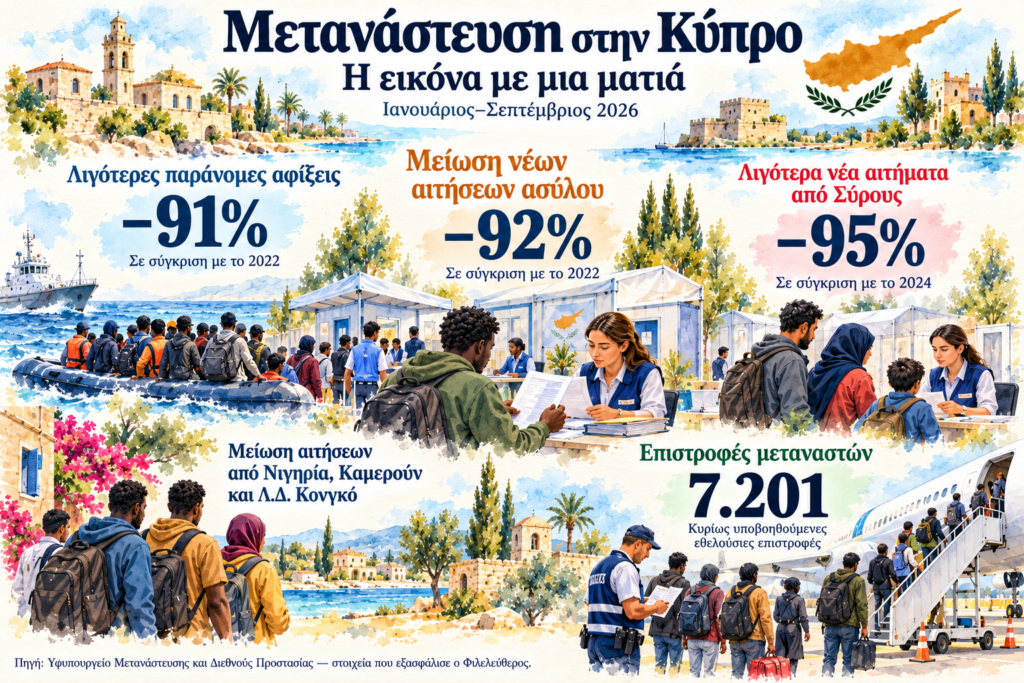
The 91% fall in arrivals and 92% decline in new asylum applications are striking, but they are not the only significant figures.
Data obtained by Phileleftheros from the Deputy Ministry of Migration and International Protection show that new asylum applications from Syrians have fallen by 95% compared with 2024.
The figures cover January to September of each year.
Irregular arrivals
Irregular arrivals stood at 13,600 in 2022, before falling to 7,619 in 2023 and 5,158 in 2024.
A steep decline followed in 2025, when arrivals fell to 1,912, before dropping further to 1,212 in 2026.
That represents a 91% reduction compared with the same period in 2022.
New asylum applications
There were 16,705 new applications in 2022.
The figure roughly halved to 8,092 in 2023 and fell to 5,652 in 2024.
A much sharper decline followed in 2025, when 2,206 applications were submitted, with the downward trend continuing this year to 1,347.
New applications have therefore fallen by 92% compared with the same period in 2022.
New applications from Syrians
Between January and September 2021, Syrians submitted 1,967 applications.
That number rose sharply to 3,148 in 2022 and continued climbing to 3,393 in 2023, before peaking at 3,919 in 2024.
The trend reversed in 2025, when just 743 applications were submitted. This year, the figure has fallen to 200.
That represents a 95% decline compared with 2024.
Decisions involving Syrians, 2021-2026
Decisions involving Syrian applicants have increased significantly since 2021.
Rejections rose particularly sharply in 2026, almost tripling compared with 2025 despite covering a shorter period.
In 2026, authorities recorded 2,266 revocations or discontinuations, 1,713 rejections, 1,160 explicit withdrawals and 398 implicit withdrawals. Another 41 cases concerned refugee matters and 25 were recorded as supplementary.
Despite this, 8,730 Syrian cases remain pending this year, compared with 11,793 last year, 13,793 in 2024 and 12,801 in 2023.
New applications from sub-Saharan African countries have also fallen.
In 2023, Cyprus received 934 applications from Nigeria, 397 from Cameroon and 391 from the Democratic Republic of Congo.
In 2024, those figures fell to 193, 71 and 166 respectively. Last year they stood at 108, 48 and 88, while this year Cyprus has received 73 applications from Nigeria, 31 from Cameroon and 42 from the Democratic Republic of Congo.
Returns reached 7,201 in 2026. Of these, 64% – 4,614 people – were assisted voluntary returns, 25% – 1,819 – were forced returns and 11% – 768 – were voluntary returns.
Over the corresponding periods, returns numbered 9,458 in 2025, 7,602 in 2024, 6,553 in 2023 and 4,627 in 2022.
Lebanon agreement becomes a model
In less than a decade, Cyprus has followed a path few EU member states have taken.
It went from a country seeking relocations and exemptions through letters and appeals to one that played a substantive role in shaping a common European policy.
It did so without fanfare, but through sustained pressure within the appropriate framework.
The agreement with Lebanon has become a model for linking European assistance to results. Nicosia’s persistence helped open the debate over Syria at a time when such a discussion appeared impossible, meaning Europe was prepared when the regime in Damascus changed.
The revised concept of a safe third country was formally approved during the Cypriot presidency, while agreement on the Returns Regulation was reached with a Cypriot negotiator.
Both were measures Nicosia had called for alongside its partners in letters it had co-signed.
In 2021, acting alone and seeking an exemption, Cyprus secured only financial support.
From 2024 onwards, decisive domestic measures, alliances abroad and the institutional role provided by the EU presidency helped Cyprus shape the rules themselves.
The experience suggests that within the EU, the size of a member state matters less than its ability to connect its own interests with the needs of its partners.

