


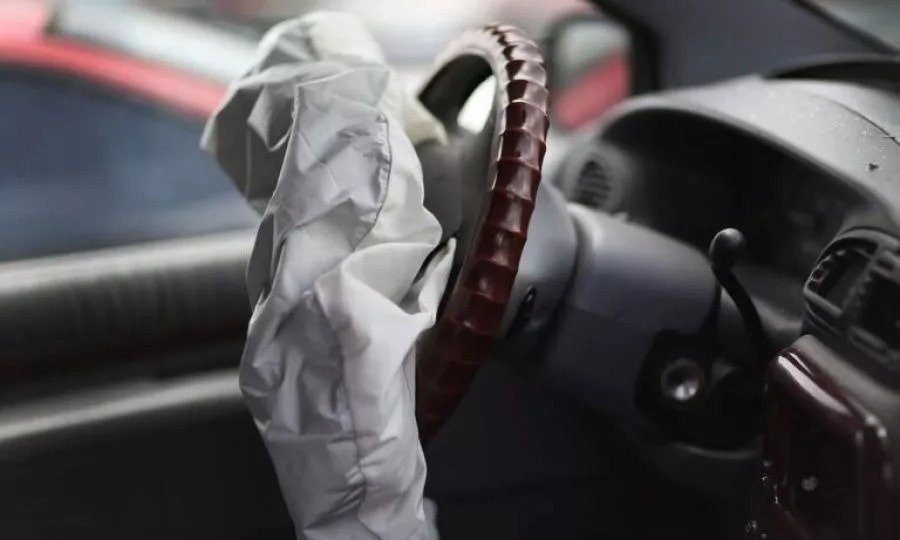
Criminal liability may arise not only for individuals but also for two companies operating in the Cyprus vehicle market, according to the findings of the investigative committee appointed to examine the Takata airbags case.
The report, which has been with the Crime Combating Department since yesterday for study regarding potential criminal offences, reveals serious omissions, possible crimes and a chain of responsibilities that allegedly contributed to a series of accidents, including two fatal crashes and one serious injury.
The committee investigated four serious incidents in Cyprus, all involving the explosion of defective Takata airbags that fired metal fragments when activated.
The incidents:
- 24 January 2023: 24-year-old Kyriacos Oxynos was killed when his vehicle’s airbag exploded, firing metal objects into his chest.
- 21 October 2024: 19-year-old Styliani Giorgalli lost her life under similar circumstances.
- 30 July 2017: Alexandros Loungou suffered serious injuries when his car’s airbag exploded and wounded him with fragments after a collision.
- September 2010: A car airbag opened without cause.
Despite the fact that the accidents were caused by airbag explosions rather than the severity of the collisions, the competent state services allegedly failed to activate any prevention or public information mechanism, according to the report.
Criminal charges outlined
The investigative committee refers to articles 205, 210 and 231 of the Criminal Code, which concern the offences of manslaughter, causing death through reckless or dangerous acts, and grievous bodily harm.
According to the committee, the chain of omissions and negligence may constitute these offences for individuals and companies that:
- Had or should have had knowledge of the risk from defective Takata airbags
- Had a duty to take measures to prevent or reduce the risk
- Failed to warn users or take appropriate measures
The causal connection between the acts/omissions and the accidents, according to the committee, resulted in “two young people losing their lives and a third suffering serious injuries”.
Company involvement
A company representing the vehicles in Cyprus, as well as the European company itself, are involved in civil lawsuits related to the replacement or non-replacement of defective airbags. In some cases, vehicle owners were not informed or did not attend the scheduled recall. In another case, representatives had committed to cover replacement costs, acknowledging that the problem was already known in a series of models.
State service failures
The investigative committee criticises the stance of the Road Transport Department and other state services, which, although aware of the global recall of millions of vehicles due to dangerous airbags, did not take adequate public protection measures, limiting themselves to forwarding information to distributors.
The committee notes that criminal offences may have been committed including “manslaughter (article 205 of the Criminal Code) and/or causing death due to reckless, thoughtless or dangerous acts (article 210 of the Criminal Code) concerning the fatal injuries of K. Oxynou and St. Giorgalli, as well as the offence of causing grievous bodily harm under article 231 of the Criminal Code concerning A. Loungou”.
The committee states that those potentially involved in these offences include those who “(a) had awareness or should have had awareness of the risk (Road Transport Department and Manufacturer’s Distributors) faced by users of vehicles equipped with Takata airbags, and (b) who had a duty to act to take measures to reduce or prevent the risk and (c) omitted and/or neglected and/or ignored fulfilling their duty to act, warning those at risk and taking measures to reduce or prevent the risk”.
Beyond family tragedies
The case gained public attention mainly after the tragic loss of K. Oxynou, when his family took initiatives and prompted mobilisation of the political system. In contrast, previous incidents such as A. Loungou’s case received no publicity nor any reaction from the state.
According to the committee, the circumstances under which the three accidents occurred are not disputed. “Just as the fact is not disputed that the involvement of the three vehicles in the aforementioned accidents was such that it did not justify the serious injury of the then 19-year-old A. Loungou and the fatal injuries of K. Oxynou and St. Georgalli. The cause of A. Loungou’s serious injury and the fatal injuries of the other two young people – aged 24 and 19 respectively – was the ejection of metal fragments due to the explosion of the airbags in the vehicles they were driving”.
Read more:

