


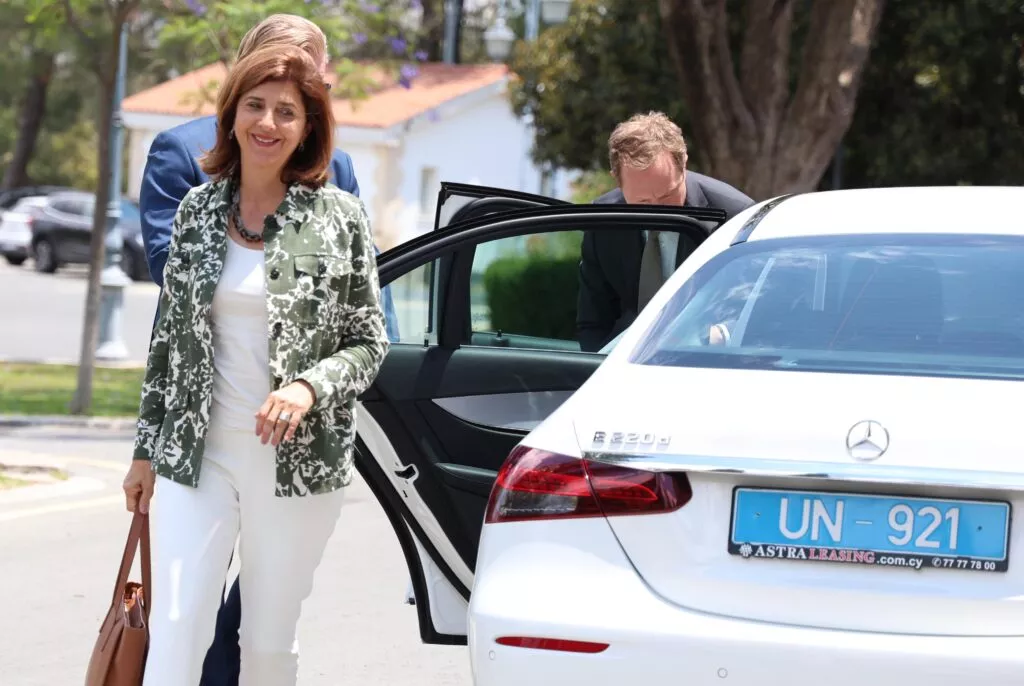
Ankara has shown a red light to the United Nations, blocking any move to record the convergences achieved during the negotiating process up to the Crans-Montana Conference. The intervention stopped what would have been the organisation’s next step on the Cyprus issue.
According to reliable information, the UN Secretary-General’s Personal Envoy, María Ángela Holguín Cuéllar, and her team had decided to push the idea of drafting a document that would set out the convergences reached so far. The idea closely resembles, and may even be identical to, what President Nikos Christodoulides proposed during his joint meeting with Tufan Erhürman and Holguín: the well-known five-point proposal announced by Christodoulides.
The UN’s thinking was to use such a document as a basis for discussion in a renewed negotiating process. That plan never even reached the joint meeting. Information indicates that Turkish ambassador Burak Özügergin, who holds technocratic responsibility for the Cyprus issue at Turkey’s foreign ministry, travelled to the occupied areas on the eve of the Christodoulides–Erhürman–Holguín meeting. Some described the visit as a farewell or even “touristic” stop, since the Director General for Bilateral Relations (North-East Mediterranean) is moving to a new post as Turkey’s ambassador to Denmark. In reality, the visit was anything but routine. It was substantive, and in that context, he met the UN Secretary-General’s Personal Envoy. During the meeting, Ms Holguín reportedly presented her intention to propose recording the convergences in a document. The Turkish side, through Ambassador Özügergin, vetoed the idea. The move froze any potential momentum and also blocked the prospect of convening an informal five-party conference.
Ankara’s actions confirm it does not want developments on the Cyprus issue at this stage. At the same time, it does not want to shoulder responsibility for another deadlock. Within that framework, it manages the leader of the occupation.
The so-called “Tufan code” at the Turkish foreign ministry defines the tactical framework guiding Ankara’s approach to Cyprus. The tactic took shape after the change of guard in the leadership of the occupied regime.
According to reliable sources, Turkish officials tell foreign interlocutors that Ankara’s position on two states has not changed. They argue this stance stems from decades of failed talks. From Ankara’s perspective, “two states” now appears as the only option that could work, since all other discussions have run their course. The same sources say that, regarding the new Turkish Cypriot leader, Ankara tells its partners that he has been told he “can try” on Cyprus, while stressing that the terms he has set out are clear. This suggests that while Tufan Erhürman may attempt a new effort on the Cyprus issue, he will do so within a strictly defined framework. That framework rests on four conditions already tabled. Those terms were shaped in Ankara and carry an element of impression management.
So far, the dynamic of the “good Erhürman” and the “bad Tatar” is working. Foreign governments argue that Erhürman has the characteristics needed to move talks forward. He himself says that discussions are not advancing because, to a large extent, he does not respond to all initiatives, whether from the UN or President Christodoulides, adding that he “needs time”. He does not explain what that means. It likely relates to Turkey, which is not about to change its policy because it might be persuaded by the leader of the occupied areas. The opposite seems more likely, though Ankara may not find it difficult, given that Erhürman’s positions do not stray far from what the occupying power seeks. It is no coincidence that his stance has also sparked murmurs among his own supporters, particularly those from his party base.
Erhürman is clearly not Tatar, nor is he Akinci. One difference with his predecessor is that he wants the European Union, in the sense that he sees value in the country’s participation in the organisation. He does not want that participation to take place through the Republic of Cyprus, but through a settlement of the Cyprus problem.
On Wednesday, 11 February, as announced, the Greece–Turkey High-Level Cooperation Council will meet in Ankara under Kyriakos Mitsotakis and Recep Tayyip Erdoğan. It will be the first meeting since September 2024, when the two leaders last spoke. Against a fluid international backdrop, and with Ankara having abandoned the policy of “calm waters”, Mitsotakis and Erdoğan will meet and talk, with no prospect of substantive agreement.
Interest now focuses on whether the Greek Prime Minister will raise the issue of the Crete–Cyprus electricity interconnection, given that the occupying side is systematically trying to obstruct the project. Athens has not moved ahead with implementation, which it has postponed, because Ankara is acting as a deterrent through force. Logically, Mitsotakis will raise Turkish behaviour and make clear to Erdoğan that the project will go ahead. The Cyprus issue is also expected to be mentioned, even if only in passing.
Meanwhile, Turkish Cypriots in Britain have launched a curious campaign to record Turkish Cypriot properties in the free areas. The move raises obvious questions about its purpose and aims. The Turkish Cypriot NGO “Freedom and Fairness for Northern Cyprus (FFNC)” has begun an initiative to create a “Register of Property Owned by Turkish Cypriots in Southern Cyprus”. According to the group, the initiative seeks to document what it describes as a deep imbalance under international law and to expose the absence of effective legal protection for thousands of victims. The register will be used to promote the Turkish side’s positions in Britain, targeting both government and parliament. The core claim is that while the Immovable Property Commission (IPC) is internationally recognised, there is no equivalent mechanism for Turkish Cypriots whose properties lie in the south. As a result, it says, thousands remain without access to restitution, compensation, or justice. It also argues that Turkish Cypriots, whose properties in the “south” were confiscated, destroyed or denied to them after the events of 1963 and 197,4 remain excluded from any reciprocal framework and lack access to any recognised domestic or international process.
According to a related report, by 23 January 202,6 the “IPC” had awarded more than £610 million in compensation for properties in the occupied areas to 2,187 Greek Cypriots, while a further 6,356 have filed applications and are awaiting decisions.
A competent government source, asked about the Turkish campaign, said all property ownership data is already held by the Land Registry of the Republic of Cyprus. The source stressed that any legal action or political pressure effort would be meaningless if that is what the occupying side intends. The same source underlined that only Turkish Cypriots who can prove they lived outside Cyprus before 1974 can claim their properties, noting that there have been several such cases.
At the same time, the National Federation of Cypriots in the United Kingdom has announced the creation of a register to record properties in the occupied areas owned by British citizens of Cypriot origin. The initiative forms part of a broader awareness campaign aimed at public opinion and, more importantly, British politicians. According to the federation’s statement, the goal is to clearly document the number of British citizens of Cypriot origin who lost their properties after the Turkish invasion of 1974. The ultimate aim is to exert pressure on the British government and MPs to take specific action.

