


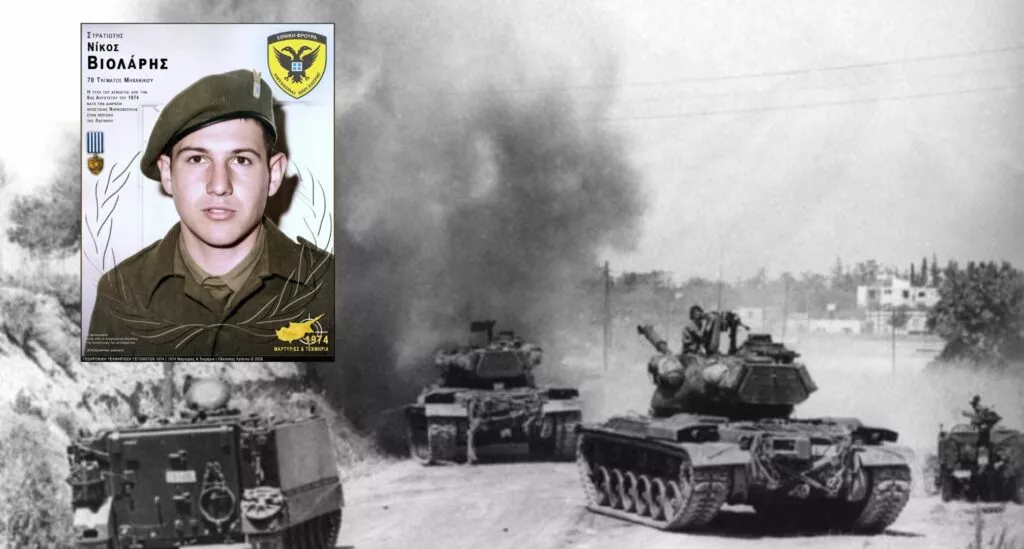
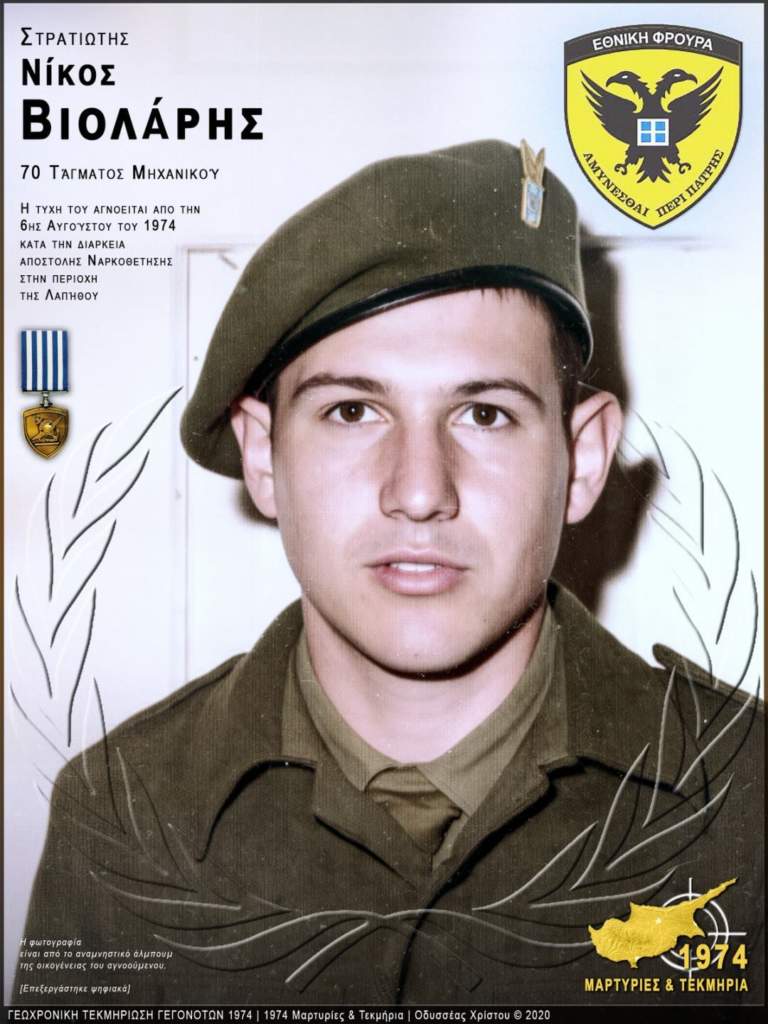
How much pain must a father carry for his hair to turn white on the drive from Skarinou to Alambra, with the thought that his son may have been killed during the Turkish invasion? The shock is overwhelming. The account of the missing man’s twin brother, Andreas Violaris, says everything: “I’m telling you honestly, from Skarinou until we reached Alambra, my father’s hair turned white like cotton.” They had just been told by his unit, the 70th Engineer Battalion, that Nikos had joined a group of soldiers who went on a mine-laying mission in Lapithos on 6 August 1974 and never returned.
Nikos’s remains were identified recently, and the funeral will take place on 15 March. At first glance, choosing the day of your burial to be your birthday sounds almost like a blessing. But when you are missing, and your twin chooses to bury your remains on the day you once celebrated your birthdays together, it becomes tragic and deeply moving.
Nikos’s body was riddled with bullets. He was shot in the back, apparently as he tried to escape after an ambush. There are also indications of a possible mortar strike.
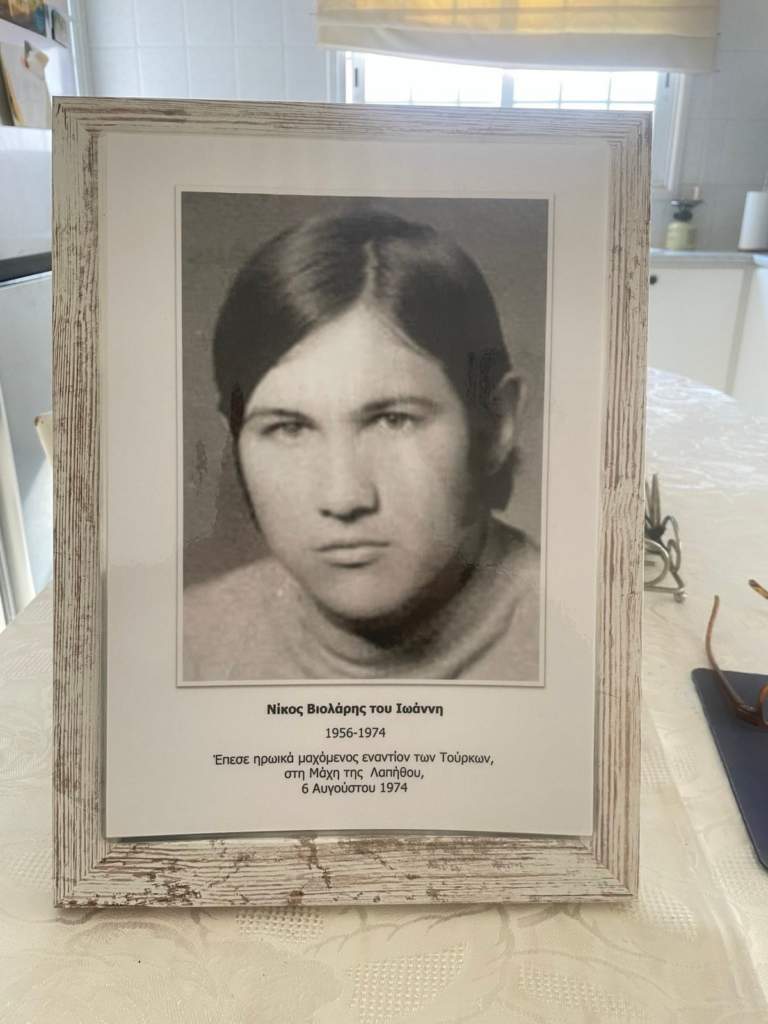
Now you rest in peace, awaiting the final farewell. You and your brother Andreas were more than what people call “best mates” in every sense of the word. You were twins. The bond ran so deep that when you got engaged at the age of 15, your parents rented a room for Andreas near yours so you could remain inseparable. Then came the Turkish invasion of 1974. Your brother searched for you, asking anyone who might offer a clue, a scrap of information, a sign, a shred of hope, even when everything later proved illusory. He insisted your remains would be found in a specific place. It was as if you were telling him, “I’m here.” And indeed, your bones were found 50 metres from where his finger pointed and his twin’s intuition led him. Satellites can miss by 50 metres too. They found you with part of your face missing, part of your right jaw gone, part of your right foot gone, and your entire life gone. Your brother was called to the Anthropological Laboratory of the Committee on Missing Persons and identified you as clearly as one would recognise oneself in a mirror.
After the identification, your brother phoned me and said he had never experienced anything so overwhelming. I understood him because I had been through that process before. Even though it was not a relative of mine, I felt the pain of death and the sanctity of the moment, the anguish and the waiting of decades. I also fully understand what my father once said, when I replied lightly, “I understand.” He simply said, “It’s one thing to say you’re in pain, and another thing to be in pain.”
I find myself thinking more and more that, as a state, especially for those who fell fighting, we should not simply escort them with honours but lay their bones out for public veneration. Time passes. The hour of the great, the longest departure approaches, the journey towards eternal return. You deserve prolonged applause from us, the spectators of a story with a sorrowful ending.
As stated above, the funeral will take place on the day of your birthdays, yours and your brother’s, 15/3/2026 at 14:00, at the Church of Saint George in your birthplace, Kalo Chorio Klirou. The burial will take place at the Tomb of Makedonitissa. He feels you belong there, beside other fallen friends. As for us, we borrow the blessing of the funeral service and whisper, “May your memory be eternal, blessed and ever-remembered brother of ours.”
The Turkish invasion
Let us take things from the beginning. During the Turkish invasion, Nikos was a six-month conscript. He had the misfortune to leave school, which brought him into the National Guard six months earlier. Misfortune, in the sense that had he enlisted normally, together with his twin brother, it would have been after the invasion and he would obviously not have lost his life.
When Makarios ordered Greek officers staying at the Cleopatra Hotel to leave Cyprus, Nikos, who was a carpenter, was instructed to make crates for the officers from Greece to pack their personal belongings. He worked on Elias’s wood-cutting machine on Tseriou Avenue.
We leave the account to his brother Andreas, who recounts what he remembers from that time:
“When my brother got engaged, they rented me a room next to where he lived because we were inseparable. On 19 July 1974, one day before the Turkish invasion broke out, my sister-in-law prepared two sandwiches and told me, ‘Go and take them to your brother.’ Nikos was at the entrance of the old hospital, where the guard was, giving information about who had been injured in the coup. When I handed him the sandwiches, he told me, ‘Go to Paphos Gate. They’ve arrested our brother, who was serving in the reserves, the EOKA B men have, and take him the sandwiches. And go and tell my fiancée and my in-laws that the Turks have started and are coming.’ I went and informed them.
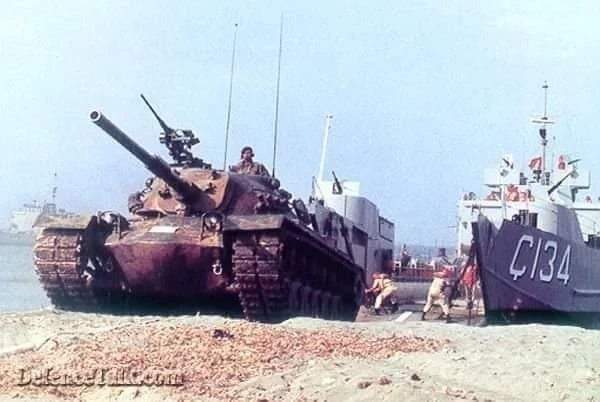
“The next day, 20 July, when the Turkish invasion began, because our family was marked by the coupists, we stayed at home. I was due to enlist on 17 July, but the coup stopped it. When the marches started on the radio announcing the invasion, a neighbour of ours who was a coupist knocked on our door and said, ‘The radio has called you to enlist at the local recruitment offices.’ Together with villagers who would have enlisted if the coup had not happened, we boarded my uncle’s bus and went to Ayios Georgios in Athalassa to enlist. When we arrived, the place had been bombed. In the end, they took us to the Deryneia police station, gave us weapons, and sent us under eucalyptus trees in Psimolofou, and from there to the Dikomo–Synghari area. All of this without any training.
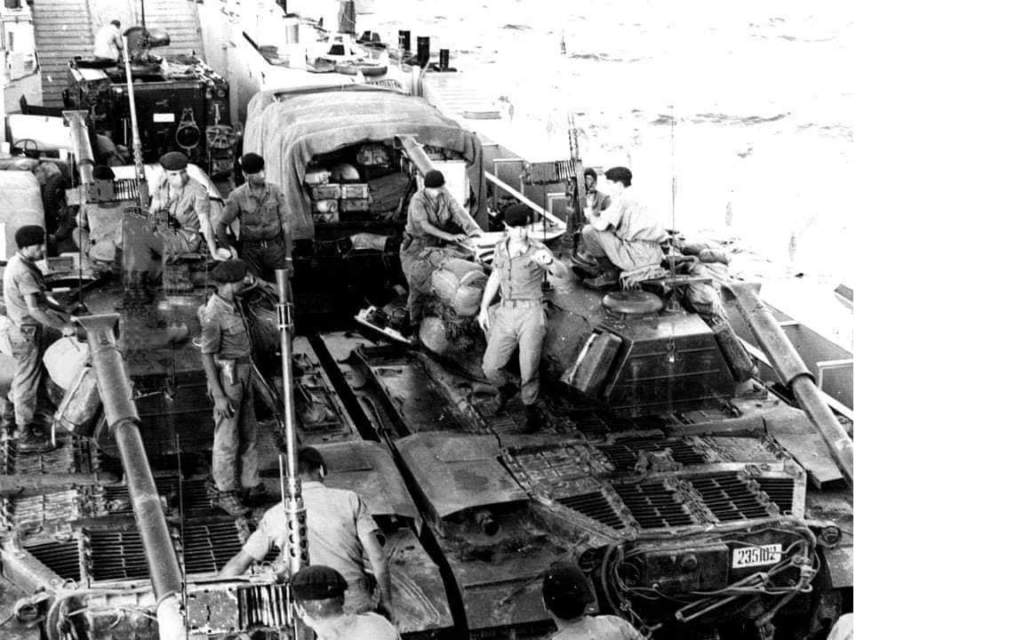
“At some point, we lost all contact with my brother, who was involved wherever mines were being laid, from Xero to Bogazi, at points considered critical for a Turkish landing. One of the places they mined was an area past Kazivera, where the Turks tried to land with transport ships and later created something like a monument.”
The search at BMH
Between the first and second invasions, on what I remember as 24 or 25 July, my father and I went to the BMH camp to gather information about where Nikos was. They did not let us enter because at that moment, the deposed Metropolitan Gennadios was arriving.
We left empty-handed for Kalo Chorio. In Klirou, we saw an army lorry coming towards us. To this day, I see that moment clearly: my brother sitting on the back of the truck. I saw a hand wave at us, but did not realise it was my brother. I understood later, when my father and I went home, from the signs he left. We found leftovers of dried anari cheese on the table, which our mother had made. I left the house and went to the village square. There, the late Nikolas shouted to me and said, ‘Where were you? Your brother Nikos came and couldn’t find you.’ I asked if he had seen him and he said yes. I told him, ‘Why didn’t you make him get down, when you know everything is betrayed, and let him go to slaughter?’ The late Nikolas told me, ‘I said to him, my boy, where are you going? Get down, my boy, everything is betrayed.’ As he told me, Nikos replied, ‘If one doesn’t go and another doesn’t go, in the end the Turks will catch us all. My duty is to serve my homeland.’ He left and went to the camp.
Mine-laying at Bogazi and Lapithos
Chronologically, we reach 6 August, when they had laid mines at Trikomo. The late Yiasoumis, a villager of ours who was then a reservist, came and told us, ‘Don’t worry, the lad is fine. We met at Bogazi and I even gave them a pound.’
After that, we calmed down somewhat. But after 6 August, we had no further news. We learned that his unit had moved to the dispersal area in Skarinou. My father and I went there to meet Nikos. At the gate, when we asked, they told us, ‘Unfortunately, we have no news. We sent a mine-laying team to Lapithos and none of them returned.’
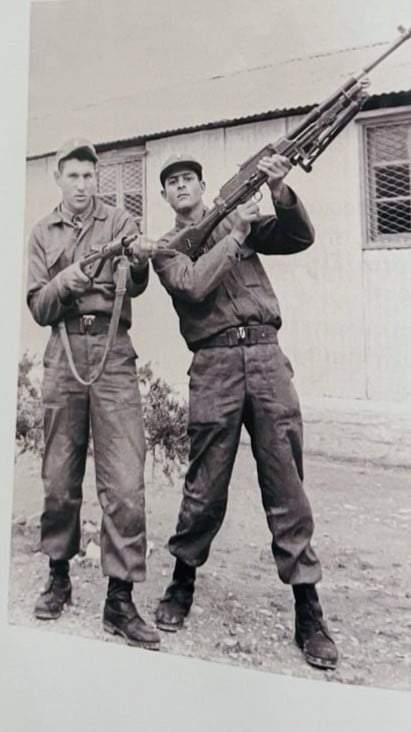
“I’m telling you honestly, from Skarinou until we reached Alambra, my father’s hair turned white like cotton.” We knew he was in the team that never showed signs of life.
From that day, a personal Golgotha began for me as I tried to learn what happened to Nikos. In the meantime, I enlisted in the National Guard in November 1974 and served in the 32nd Commando Squadron. After legislation was passed, many were discharged as the only remaining male in each family, and I was discharged with them.
I then left for abroad, but because I was also the youngest child, I returned, got engaged, and stayed in Cyprus for my parents’ sake. From then on, I tried to learn what happened to my brother. I was a member of the Pancyprian Committee of Missing Persons from its foundation. Years passed. My son was due to marry on a Saturday in July 2008. On Friday, my mother phoned me in tears. I asked what was wrong, and she said a priest had called and said my brother had been found and was looking for me. I told her that if they found him, they would phone me, because only I had given DNA. She gave me the priest’s number. I told my wife not to say anything to anyone until the wedding was over. When it ended, I told my son, whom we named Nikos in memory of my brother, to forget the trip he was planning, because there was information that his uncle had been found. I told him I had information that he was buried at a specific location in Lapithos, where there was a mass grave of more than 200 people. We had information that Nikos was in that grave.

