


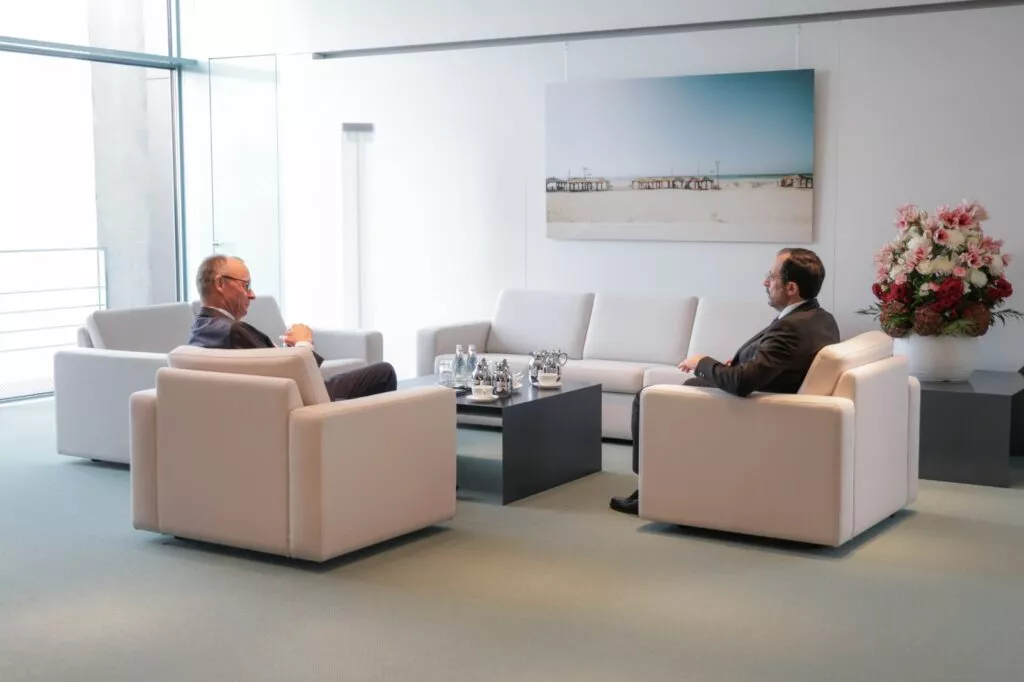
German Chancellor Friedrich Merz made his position perfectly clear: he wants Turkey as close to the European Union as possible. His strategy aims to advance EU-Turkey relations step-by-step, with Berlin taking a leading role.
These moves by Chancellor Merz insert Germany into the equation surrounding efforts on the Cyprus issue. The German initiative will focus on two tracks: EU-Turkey relations and the Cyprus problem.
Well-informed sources indicate that during yesterday’s meeting with Nikos Christodoulides, Chancellor Merz briefed the Cypriot President on his recent trip to Ankara. The German side holds that Recep Tayyip Erdoğan keenly seeks progress in EU-Turkey relations.
This context brings the Cyprus issue into play. After his discussion with Nikos Christodoulides, Chancellor Merz committed to conveying a message to the Turkish side: a resolution on Cyprus remains impossible if Turkey insists on actions outside the established framework.
President’s Proposals Garner Special Interest
Sources report that the German Chancellor showed particular interest in the Cypriot President’s recent remarks to the Financial Times. Merz sees that these proposals could also facilitate the improvement of EU-Turkey relations.
Highly reliable sources mentioned that, as part of promoting EU-Turkey ties, issues of mutual interest to the EU and Turkey could similarly be directed towards Cyprus. For example, lifting visa requirements for a category of Turkish citizens (specifically businesspeople) could correspond to a revised policy allowing Cyprus-flagged ships access to Turkish ports.
Furthermore, Merz believes that inviting the Turkish Foreign Minister to the next Gymnich meeting constitutes a positive step that could launch further progress. This framework could then support the effort to restart talks from the Turkish side.
In his post-meeting statements, President Christodoulides stressed that Germany plays a significant role and can assist with the Cyprus issue. He added that the EU, more broadly, possesses the tools and can offer the incentives for a mutually beneficial development regarding both EU-Turkey relations and Cyprus.
Chancellor Merz, in his own remarks, referred to EU-Turkey relations, noting the need for closer cooperation with Turkey. He said they discussed how they could «move towards a rapprochement with Turkey,» adding that he understands Cyprus’s concerns about Turkey.
Answering reporters’ questions later, Chancellor Merz sent a clear message: if Turkey wants contact with the EU, it must adhere to the Copenhagen criteria. President Christodoulides, in his response, made it clear: if Turkey insists on a two-state solution, it will not move closer to the EU. He reiterated the basis for a Cyprus settlement and the position supported by both the UN and the EU itself.
Both leaders’ statements highlight that the imminent Cypriot EU Presidency dominated their talks at the Chancellery. Merz underlined the importance Germany attaches to achieving results during the upcoming six months on modernising the Multiannual Financial Framework (MFF) and Competitiveness. A special European Council will convene on the latter topic during the Cypriot Presidency.
Behind the Chancellery’s Closed Doors
Regarding the Cypriot EU Presidency, Germany, according to highly informed sources, invests heavily in it to advance key priorities. Germany considers the MFF negotiations the most important issue the Cypriot Presidency will manage.
The President informed the German Chancellor of the Cypriot Presidency’s goal—depending on progress made under the Danish Presidency—to continue intensive negotiations to prepare a full negotiating package (full NEGO BOX). By the end of June 2026, Cyprus expects to deliver a sufficiently mature framework to the incoming Irish Presidency for finalisation (the European Council President wishes to conclude consultations by December 2026).
Germany views enhancing competitiveness as the central axis of all other European policies. Chancellor Merz took the initiative before the October European Council, resulting in a letter from 22 leaders (including President Christodoulides) to the European Council President (ECP) on simplification. The letter also requested an extraordinary European Council (EC) meeting on the matter.
Sources indicate President Christodoulides informed Chancellor Merz that preparatory work had begun, in coordination with António Costa’s office, for the extraordinary EC scheduled for February 12.
On Ukraine, the German side insists strongly on sanctions and Russian assets. The Cypriot side focused on Turkey’s actions that circumvent sanctions. Sources say President Christodoulides presented specific evidence regarding companies in Turkey that play a significant role in bypassing sanctions.
Regarding the Middle East, the President explained the importance the Republic of Cyprus attributes to more active EU, and especially German, involvement in the region. The Pact for the Mediterranean fits into this framework and will be implemented during the Cypriot Presidency. The first programs under the Pact will also be presented during the Presidency.
Bilateral Relations Praised
The Merz-Christodoulides discussions highlighted the excellent level of bilateral relations across fields such as defence, security, tourism, shipping, education, and migration. The following points were recorded at the bilateral level:
-Germany’s participation with observers in the multinational exercise “ARGONAUT”.
-The signing of a “Joint Declaration of Intent” between the two countries’ Ministries of Defence in November 2023.
-An agreement concerning emergency civilian evacuation operations.
-Cooperation in the area of search and rescue.
-Germany consistently ranks as the 4th to 5th largest tourist market; 2024 marks a milestone as arrivals from Germany increased by 8.1% compared to 2023 (228,355 vs 211,216).
-In the shipping sector, relations date back to the 1980s and remain excellent. Companies with German interests operate in Cyprus and manage approximately 170 Cyprus-flagged vessels; roughly 6.5% of the Cypriot fleet belongs to German nationals.
Education: The Ministry of Education launched an initiative to implement a German language learning program in public Gymnasiums and Lyceums (secondary schools).
On migration, the German Chancellor showed he was fully aware of the actions Cyprus has taken in this area. He also told President Christodoulides that Berlin intends to send a specific team to Cyprus for further briefing on the whole issue.
Cyprus’s effort to join the Schengen Area was also on the agenda. President Christodoulides expressed thanks, both privately and publicly, to Germany, which agreed to represent the Republic of Cyprus for Schengen visa purposes in seven countries. Notably, Germany was the first state to accept this representation. Nicosia interprets this stance as a clear and practical indication of German support for the Republic of Cyprus’s entry into the Schengen Area.

