


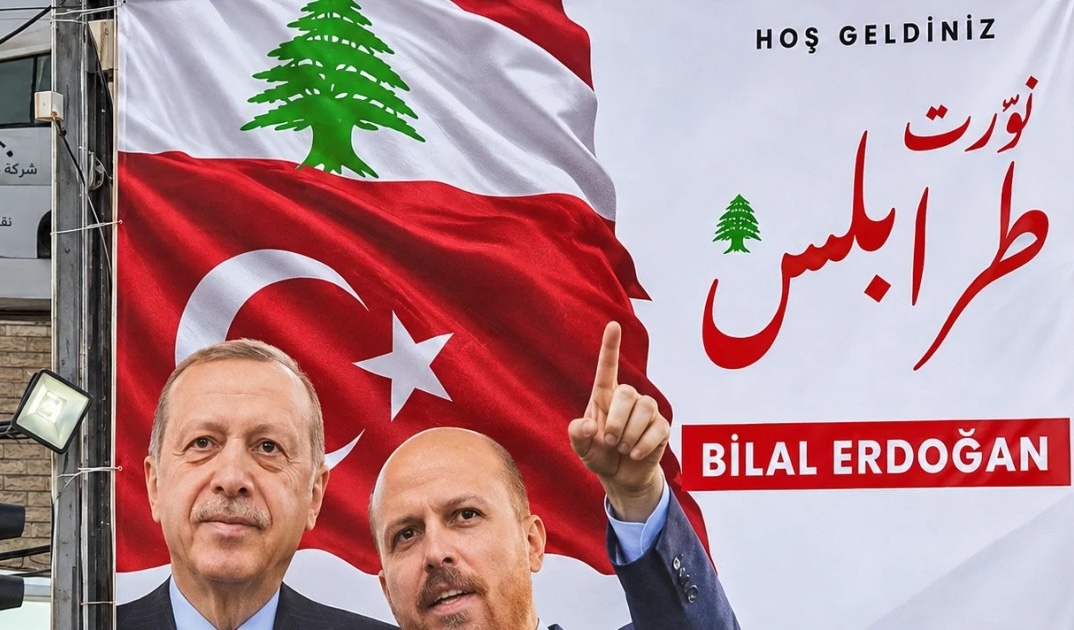
Turkish President Recep Tayyip Erdogan’s son, Bilal, is in Lebanon for a three-day visit that amounts to a display of soft power on his father’s behalf. The push to expand Turkey’s presence in Lebanon through economic, political and military means comes as Ankara is pressing on every front for a greater role in the Eastern Mediterranean, as well as in Lebanon and neighboring Syria.
The developments are of particular interest to Cyprus, not least because of Turkey’s objections to the Cyprus–Lebanon maritime delimitation agreement. There are other reasons for concern, too, given Cyprus’s close ties with Lebanon and the situation in the neighboring country, where the leadership is struggling to bring Hezbollah, Iran’s terrorist proxy, under some sort of control.
The visit, which began on Thursday, coincides with the Lebanese parliament’s approval of a defense cooperation agreement with Turkey. Ankara has also expressed interest in joining a future international force in southern Lebanon after UNIFIL’s mandate ends at the end of the year. This ambition is hardly unrelated to Turkey’s broader efforts to establish a foothold in areas closer to Israel.
Erdogan himself expressed Turkey’s willingness to participate in a new international mission during a meeting with Lebanese President Joseph Aoun in Ankara last July.
However, according to Israeli media reports, such a move is expected to face opposition from Israel, given the increasingly strained relations between the two countries and Israeli concerns about the prospect of Turkish troops being deployed near Israel’s northern border.
Bilal Erdogan has already met President Aoun, who expressed hope for a new chapter in bilateral relations, particularly in investment, reconstruction, trade, tourism, and infrastructure. Erdogan’s son assured him that Ankara supports the Lebanese state’s efforts to extend its sovereignty across the country’s entire territory through the Lebanese Armed Forces.
Although Bilal Erdogan holds no government position, he has also met Parliament Speaker Nabih Berri, Druze leader Walid Jumblatt, and a range of political and religious figures. He heads the İlim Yayma Foundation, which is officially involved in education and maintains close ties with organizations within Turkey’s pro-Erdogan civil society network.
He also attended a Turkey–Lebanon strategic dialogue in Beirut, which brought together government officials and business representatives, where he argued that stability in Lebanon and Syria directly serves Turkish interests.
Lebanon’s parliament approved an agreement that provides approximately $3 million in funding over five years, along with provisions for transferring equipment, expertise, and other forms of support to the Lebanese Armed Forces.
Military cooperation between the two countries is nothing new. A framework agreement has existed since 2010. Sixteen years later, however, the regional landscape has changed beyond recognition. Few would seriously believe that Turkey’s renewed involvement is simply a gesture of goodwill between two friendly countries.
Nor is it a coincidence that, beyond the meetings in Beirut, much of Bilal Erdogan’s visit focuses on predominantly Sunni northern Lebanon, particularly the area around Tripoli, where Turkey has long maintained strong ties with the Sunni community.
Tripoli also has a major commercial port that could serve as a transport hub linking Turkey and Lebanon to Arab markets via Syria.
For years, the Turkish Cooperation and Coordination Agency (TİKA) has been funding what are ostensibly educational, healthcare, and cultural programs, along with the restoration of Ottoman-era monuments. Behind this façade, it has completed more than 170 projects. Over time, however, links to Hamas have come to light, along with the agency’s involvement in channeling funds to the terrorist organization in Gaza and other murky activities.
For Cyprus, one of the most significant and potentially troubling aspects of this growing Turkish involvement is the question of the Exclusive Economic Zone (EEZ).
After years of waiting, partly due to the unresolved maritime delimitation dispute between Lebanon and Israel, Cyprus finally secured the signing of its EEZ agreement with Lebanon roughly a year ago.
Turkey responded with the familiar refrain that the agreement disregarded the rights of Turkish Cypriots, even while acknowledging that the maritime area concerned lies outside Turkey’s continental shelf.
So far, there is no indication that Beirut is considering reopening or revising the agreement. Nevertheless, the deepening relationship between Ankara and Beirut introduces another factor into the regional balance of power, one that matters directly to Nicosia.
Bilal Erdogan’s visit concludes with a trip to Akkar, in northern Lebanon, home to communities of Turkmen descent, followed by a meeting in Beirut with Prime Minister Nawaf Salam.
All indications are that this is only the beginning.

