


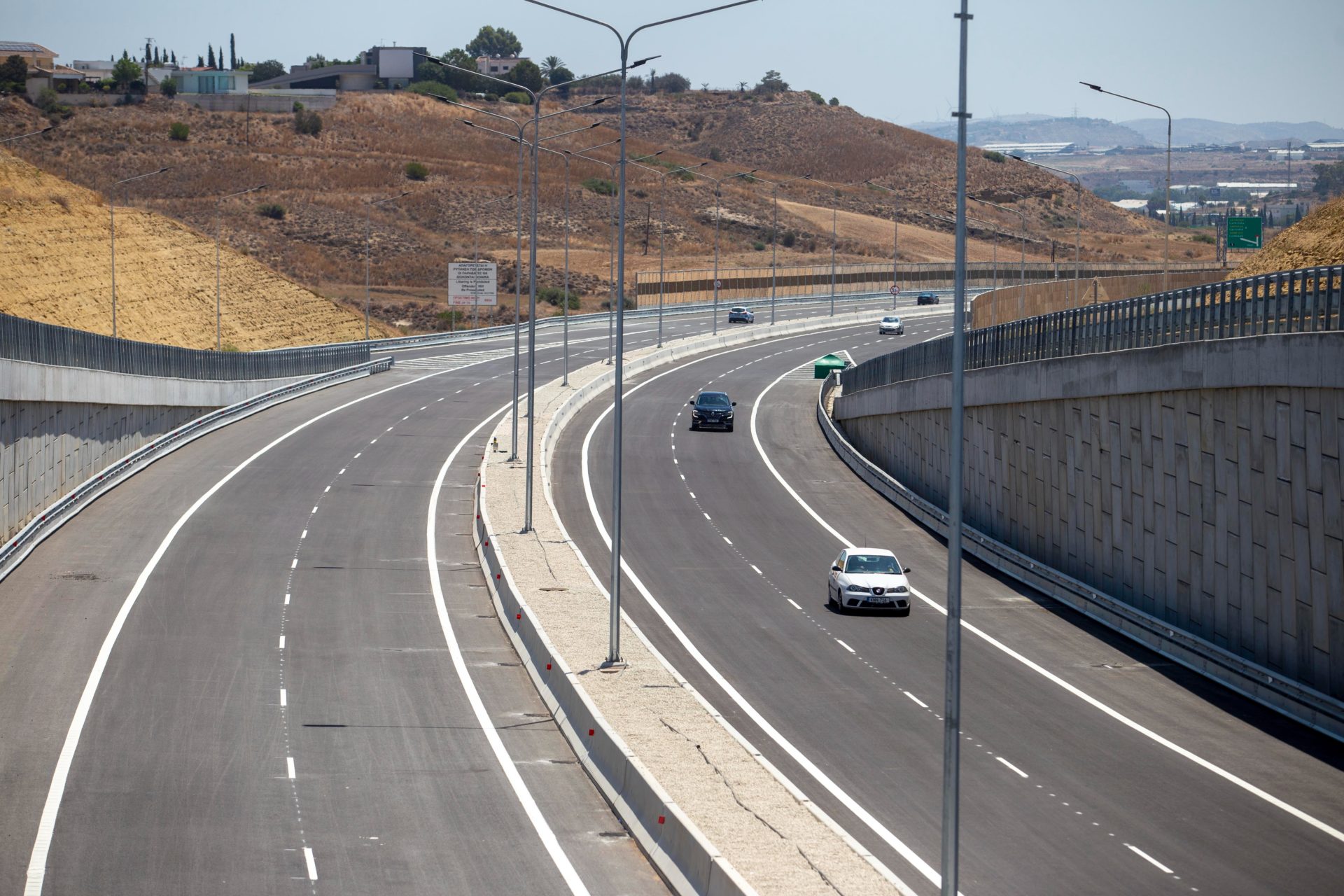
The government has opened tenders for Phase C of the Nicosia ring road motorway, a 9.4-kilometre section worth €95 million excluding VAT that will connect Anthoupoli to Anagyia village.
The Department of Public Works announced the tender on 10 October, with expressions of interest due by 21 November 2025. Construction will begin in June 2026 and take 40 months to complete.
The European Union will co-finance the project with €43.4 million through the Connecting Europe Facility. The scheme forms part of the Trans-European Transport Network’s Core Network.
The project includes new four-lane motorway sections with a 2.6-metre elevated central reservation featuring emergency openings. Engineers will construct a full cloverleaf interchange where the ring road crosses the Nicosia-Palaichori motorway.
The works encompass three grade-separated junctions, one roundabout, a 200-metre valley bridge, five overpasses and 12 underpasses with connecting local roads. The contract includes extending Agios Georgios Avenue in Lakatamia by 1,150 metres with three roundabouts.
Phase C will link to Phase B3 of the motorway, currently under construction at the south-eastern boundary of the project.
The tender uses open procedure with the lowest price as the award criterion. The defects liability period runs for 18 months. Only Class A technical works contractors meeting the tender document requirements may participate.
The complete 32-kilometre Nicosia ring road will connect three motorways terminating in the capital—the Nicosia-Limassol, Nicosia-Troodos and Nicosia-Palaichori routes—and serve as a bypass for the Nicosia urban area.
The Department of Public Works said the ring road will improve Cyprus’s connectivity with mainland Europe by completing critical missing sections of the Trans-European Transport Network. The project will create a basic motorway network covering the national territory and linking Cyprus’s entry points, including airports and ports.
Additional benefits include improved accessibility for the Nicosia urban area and dozens of regional municipalities and communities, reduced travel times, higher average speeds, and enhanced road safety for all users.
The motorway will support multimodal transport combining public and private passenger vehicles, including buses. It will facilitate freight transport with fast, safe goods movement connecting major activity centres such as industrial and agricultural areas whilst bypassing residential zones.
The ring road offers potential for increased sustainable economic activity and development in supported areas. Environmental benefits include reduced through-traffic in residential areas, cutting air pollution, noise and nuisance.
The project includes sustainable rainwater management and digital transport development through intelligent transport systems installation.
Read more:

