


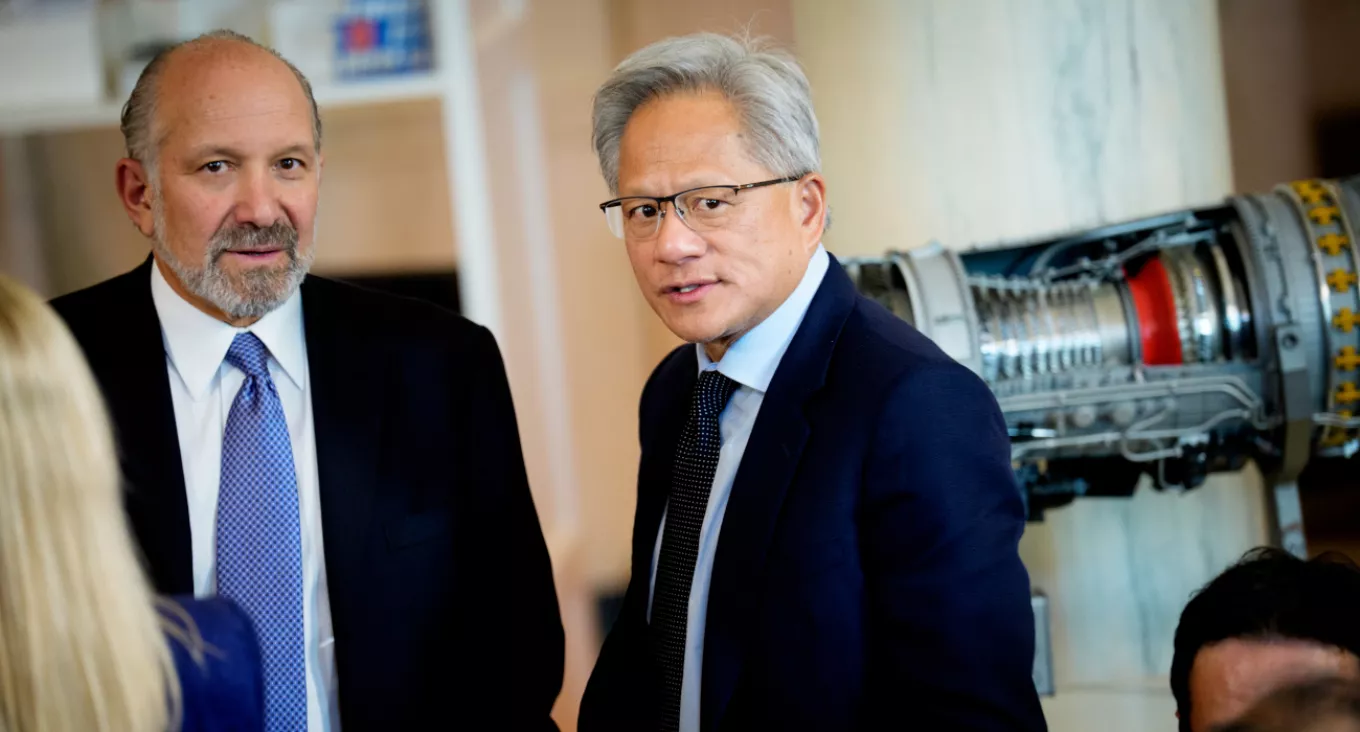
Howard Lutnick, the businessman who helped open the doors of the White House to Jensen Huang, now faces the prospect of paying the political price for the Nvidia scandal.
The US commerce secretary is facing growing pressure from officials within President Donald Trump’s administration and from Republicans and Democrats in Congress, amid mounting questions over his decision not to impose restrictions on a company suspected of channelling advanced American microchips to China.
According to a new CNN investigation based on interviews with more than a dozen sources in the US government and technology industry, Lutnick played a central role in building the close relationship between Trump and Nvidia’s recently departed chief executive.
That relationship became one of the administration’s most important channels of communication with the artificial intelligence industry, influencing decisions on advanced processor exports, trade relations with China and Washington’s strategy in its technological rivalry with Beijing.
The problem for Lutnick is that while he was cultivating those ties, other US government agencies were warning of potential national security risks.
At the centre of the controversy is Megaspeed International, a Singapore-based company and major Nvidia customer that is under investigation over possible attempts to circumvent US restrictions on exports of advanced chips to China.
One of its former executives is Alice Huang, a Chinese businesswoman who allegedly had an extramarital relationship with Jensen Huang and is being scrutinised by US intelligence agencies over possible links to Chinese intelligence services.
Huang’s resignation from Nvidia on Thursday, 12 November, brought the controversy to the forefront of Washington politics.
According to US media reports, some Trump advisers are now discussing the possibility of removing Lutnick as commerce secretary.
From the first phone call to access to Trump
Lutnick’s relationship with Huang began to take on particular importance early in Trump’s second presidential term.
Speaking on Joe Rogan’s podcast last December, Huang described the first telephone call he received from Lutnick as the latter prepared to take over the Commerce Department.
According to the then Nvidia chief executive, Lutnick described both him and his company as national treasures and made clear that Huang could contact the administration whenever necessary.
Huang recalled Lutnick telling him:
“Whenever you need access to the president or the government, give us a call.”
The approach was particularly significant because Trump knew relatively little about Nvidia or its founder when he returned to the White House.
Trump later acknowledged that he had initially wondered who Huang was and what exactly his company did.
Their first meeting took place just 11 days after Trump’s inauguration in early 2025.
From that point onwards, Huang gained increasingly direct access to the US president, with Lutnick playing a central role in facilitating the relationship.
The $1 million dinner and the battle over AI chips
One of the defining moments came at a dinner at Mar-a-Lago in April 2025.
According to CNN, Lutnick helped arrange Huang’s attendance at a fundraising event for the political organisation MAGA Inc., where participation cost $1 million per guest.
At the event, Nvidia’s chief executive sought to persuade Trump not to impose restrictions on sales of the company’s H20 processors to China.
The chips had been designed to meet some of the Chinese market’s requirements without incorporating all the capabilities of America’s most powerful AI processors.
Nvidia argued that shutting it out of the Chinese market entirely would strengthen domestic Chinese competitors and accelerate the development of alternative technologies.
Huang had publicly said that restrictions had already cost his company approximately $15 billion in sales.
The initial attempt to prevent tighter restrictions did not produce a lasting result, as the US government eventually introduced special licensing requirements for H20 exports.
Nevertheless, Huang continued his contacts with the White House.
The August deal and the 15% share of China sales
In July 2025, Huang returned to the Oval Office accompanied by Lutnick and David Sacks, the White House’s AI adviser.
This time, his argument centred on a broader geopolitical objective.
If China continued using American chips and AI systems, the United States would retain a significant advantage in the global technology market.
Five days after the meeting, Nvidia announced that the US government had provided assurances allowing H20 sales to China to resume.
Lutnick publicly defended the decision, arguing that the aim was to keep China’s technology industry dependent on the American ecosystem.
The agreement was finalised in August 2025, with Trump personally involved.
Its most unusual feature was Nvidia’s agreement to pay the US government 15% of revenue from the relevant sales to China.
The arrangement raised serious questions in Washington about the relationship between national security policy, commercial negotiations and government revenue.
Critics of the administration argued that China’s access to advanced technology should not be subject to a financial bargain.
Trump and supporters of the agreement, by contrast, argued that preserving US technological influence in the Chinese market offered a strategic advantage.
Nvidia’s $25 million contribution to the White House ballroom
Huang’s relationship with Trump also developed another dimension.
According to The Washington Post, Nvidia pledged $25 million towards the construction of the White House’s new ballroom.
The amount appeared in internal fundraising documents obtained by the newspaper, while Nvidia had requested that the size of its contribution remain undisclosed.
The company confirmed the donation, maintaining that its support for the project was unrelated to its business interests.
However, the timing of the contribution, alongside favourable decisions concerning chip exports, prompted further questions from the administration’s political opponents.
There is no evidence establishing that the donation was linked to any specific government decision.
Nevertheless, Nvidia’s financial contributions to initiatives associated with Trump have become part of the wider political controversy.
Intelligence warnings that failed to trigger restrictions
As Huang’s relationship with the administration grew closer, US intelligence agencies were examining a different concern.
Their attention focused on Alice Huang, a former senior executive at Megaspeed International.
The company had become a major purchaser of Nvidia processors, with estimates putting the value of its purchases at more than $4 billion.
US authorities had been investigating Megaspeed since 2024 over suspicions that it could be used to circumvent restrictions on chip exports to China.
According to CNN, FBI officials briefed members of Congress in late 2025 that Jensen Huang might have been targeted in an attempted approach by a foreign intelligence service.
The suspicions were linked to his personal relationship with Alice Huang.
US agencies were examining, among other things, the businesswoman’s professional background.
She had worked for a Chinese state television organisation before entering the business sector.
According to the reports, the intelligence was shared with senior US government officials.
Trump had been briefed about the intelligence agencies’ concerns by late 2025, while the Commerce Department had reportedly received a related classified memorandum.
Despite the warnings, Megaspeed was not added to the Commerce Department’s export restrictions list.
It is important to stress that there is no proof that Alice Huang acted as a Chinese intelligence agent or that Jensen Huang passed on classified information.
Beijing has rejected the allegations, while Megaspeed denies violating US law.
Bessent and Lutnick clash over Megaspeed
Tensions within the Trump administration reached a peak last week.
According to CNN, Treasury Secretary Scott Bessent confronted Lutnick during a meeting in the White House Situation Room.
Bessent reportedly demanded an explanation for why Megaspeed had still not been added to the list of companies subject to strict restrictions on access to American technology.
Sources cited by CNN said Lutnick responded that he did not know why and would look into the matter.
The disagreement subsequently spilled into public view.
On Friday, 13 November, Bessent told CNBC that the Treasury Department, State Department, Pentagon and Office of the United States Trade Representative had supported imposing restrictions on Megaspeed for months.
He stressed, however, that the final decision rested with the Commerce Department.
“The Commerce Department has the authority. You’ll have to ask them about their internal processes,” he said.
Bessent also expressed frustration over indications that advanced American chips might have reached China despite government restrictions.
According to CNN and Axios, administration officials claim that Trump himself had repeatedly requested an examination of tougher restrictions, but the Commerce Department had failed to take the action those officials considered necessary.
The precise sequence of internal instructions and decisions remains unclear.
Calls for Lutnick’s removal, but Trump stands by him
The revelations have made Lutnick a target of criticism even within the administration.
According to CNN, Axios and The Wall Street Journal, some Trump advisers have discussed removing him as commerce secretary.
Those discussions intensified after Jensen Huang’s resignation, as administration officials began examining responsibility for the handling of chip export controls.
The pressure is not coming solely from Democrats.
Republican senators and conservative commentators have also questioned Lutnick’s actions, with some calling for him to testify before Congress.
So far, however, Trump has not withdrawn his support.
The White House said the president retains full confidence in Lutnick and his ability to carry out his duties.
That remains the administration’s official position despite the public disagreement between senior cabinet members.
The Commerce Department, meanwhile, has dismissed as inaccurate reports suggesting that Lutnick systematically obstructed efforts to impose restrictions.
Lutnick’s financial interests and past business ties with China
The controversy has also renewed scrutiny of Lutnick’s previous business activities.
Before joining the administration, he was chairman and chief executive of Cantor Fitzgerald, one of Wall Street’s best-known financial services firms.
According to CBS News, Cantor Fitzgerald held approximately $1.2 billion worth of Nvidia shares around the time Lutnick joined the government.
Another company with which he had business ties, BGC Group, held a 33% stake in a joint venture with the Chinese state-owned China Credit Trust.
Cantor Fitzgerald had also helped Chinese companies list on US stock exchanges.
These business relationships had already attracted questions during Lutnick’s Senate confirmation process in 2025.
At the time, Lutnick maintained that he approached China with considerable caution and would protect American technological interests.
Before taking office, he resigned from his executive positions in the businesses, transferring control to his children.
The existence of past financial relationships does not, in itself, establish a conflict of interest or unlawful interference in government decisions.
Nevertheless, his critics argue that these connections reinforce the need for full transparency over his contacts with Nvidia and his handling of export licences.
Congress demands answers from Lutnick and Huang
Political pressure is now shifting to Congress, where lawmakers from both parties are calling for a detailed investigation.
Republican Senator Tim Scott, chairman of the Senate Banking Committee, has called on both Howard Lutnick and Jensen Huang to testify.
A hearing is being planned for 3 December, while other congressional committees are preparing their own proceedings.
Democratic Senators Elizabeth Warren and Chris Coons have also called for the preservation of all government documents, communications and records relating to Nvidia, Megaspeed and advanced chip exports.
The questions facing the administration are specific: what exactly did senior officials know about the suspected espionage activities, why were restrictions sought by other government agencies not introduced earlier, and to what extent did Nvidia’s contacts with political leaders influence the decisions?
Investigations are also continuing into whether advanced Nvidia processors were illegally supplied to Chinese companies.
Scandal erupts ahead of Trump–Xi meeting
The timing is particularly sensitive for the US administration, with Trump preparing to meet Chinese President Xi Jinping next week in Shenzhen, one of China’s most important technology centres.
Exports of advanced microchips are already a central issue in the economic and strategic rivalry between the two countries.
For Washington, maintaining its technological advantage in artificial intelligence is considered critical to both the economy and national security.
For Nvidia, the Chinese market remains particularly important, despite US restrictions and Beijing’s efforts to develop its own processors.
Trump therefore faces a difficult balancing act.
On the one hand, he wants to support American technology companies and their exports. On the other, he faces pressure to prevent the transfer of technology that could strengthen China’s military and intelligence capabilities.
Against this backdrop, Lutnick now finds himself at the centre of a crisis that began with revelations about Jensen Huang’s personal life but has developed into a serious dispute over government decisions, the effectiveness of export controls and the influence of technology giants within the White House.

