


Copper has been closely linked to Cyprus since ancient times. Even the metal’s name has its roots in the island.
In the ancient Roman world, Cyprus was probably the principal source of copper. The Romans therefore called the valuable metal aes Cyprium, meaning copper of Cyprus. The name later evolved into cuprum, eventually giving rise to various forms used in European languages, including copper in English, cuivre in French and Kupfer in German.
But the connection goes far beyond its name.
Copper was also central to one of the most important periods of development in Cyprus’s history, particularly around 1650 BC.
The Copper Age, or Bronze Age in the broader historical classification used here, was one of the defining periods of the island’s past. It extended from approximately 2500 BC to 1050 BC and is divided into three main phases: the Early Bronze Age (2500–1900 BC), the Middle Bronze Age (1900–1650 BC) and the Late Bronze Age (1650–1050 BC).
The final period, which lasted roughly 600 years, was arguably one of the most creative and remarkable chapters in Cyprus’s prehistory.
During those centuries, Cyprus became an important trading and political power in the Eastern Mediterranean, developing a sophisticated civilisation.
Copper production continued throughout antiquity, although activity fluctuated between periods of expansion and decline, until the early Byzantine era.
A Mediterranean trading powerhouse
With what may have been the region’s largest reserves of high-quality copper, Cyprus became one of the Mediterranean’s most important centres for producing and trading the valuable metal.
This brought the island considerable economic prosperity and cultural development.
Copper was among the most valuable metals of the period.
Its importance lay partly in humanity’s transition from the Stone Age to the Age of Metals, a development that transformed everyday life, warfare and economic activity.
It also became an essential raw material used in almost every aspect of life.
Copper was used to make:
- Weapons and military equipment.
- Everyday tools and production equipment.
- Household utensils and objects.
- Trade goods and ingots used as stores of value.
- Objects used in art and religious worship.
The discovery that copper could be mixed with tin to produce bronze gave people access to a much harder and more durable material, capable of replacing fragile stone tools.
These developments helped establish Cyprus as a major regional trading centre.
Its commercial networks extended eastwards and westwards, reaching as far as Italy and Sardinia.
Copper returns to the spotlight
But why begin with this history? And why revisit a period stretching back to 2500 BC?
After all, copper is no longer found in the same abundance beneath Cypriot soil. Most of the island’s mines have closed, and the modern economy depends primarily on services, tourism and construction.
Yet developments in the global economy are bringing copper back into focus.
The metal is essential for manufacturing electric vehicles, electricity transmission networks, solar panels, energy storage systems, artificial intelligence infrastructure and other low-carbon technologies.
As a result, global demand for copper is expected to increase significantly in the coming years.
So where does Cyprus stand amid these developments?
The country currently produces relatively small quantities of copper, but there is considerable potential for growth.
A Cypriot company pioneering new production methods could help create the conditions for the island to develop another significant source of revenue.
We recently visited the Skouriotissa and Apliki mines.
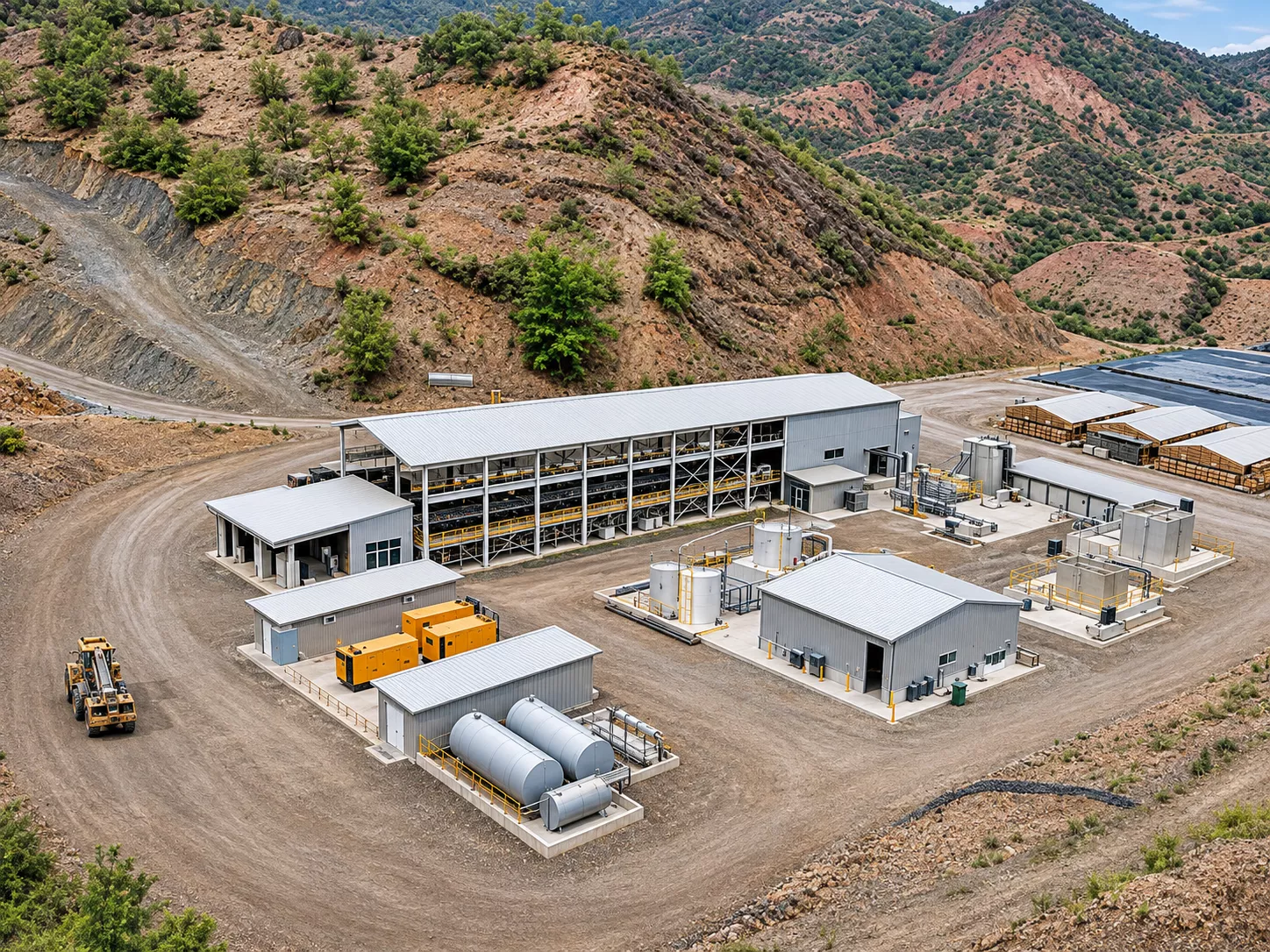
At Apliki, at the foot of the Marathasa region, surrounded by rock formations, waste heaps and unmistakable signs of earlier mining activity, SXEW Hellenic Cuprum Ltd has established an entirely new industrial operation.
More importantly, it has done so with a remarkably small carbon footprint.
Producing copper with 99.999% purity
SXEW Hellenic Cuprum Ltd is continuing Cyprus’s long history of copper production.
The company has developed a new approach to industrial production, combining high-purity copper manufacturing with renewable energy, innovative hydrometallurgical techniques and circular economy practices.
It can produce copper cathodes with a purity of 99.999%, meeting London Metal Exchange (LME) Grade A specifications.
Its production model focuses on reducing environmental impact while managing natural resources sustainably.
Through this approach, the company aims to contribute to Europe’s security of supply of strategic raw materials while strengthening the Cypriot economy by producing high-value goods for export.
All of its copper production is exported to international markets, helping Cyprus establish a stronger presence in the strategic raw materials sector.
Modern metallurgy without traditional smelting
A central feature of the company’s operations is its use of SX-EW technology, short for Solvent Extraction–Electrowinning.
This involves a series of modern hydrometallurgical processes that allow the production of high-purity copper without the smelting stages associated with conventional pyrometallurgy.
By combining hydrometallurgical techniques with renewable energy, the company has developed a production model designed to minimise carbon emissions.
This approach places Hellenic Cuprum among the more environmentally innovative operators in the copper industry.
A new approach to green industrial development
Green development might not be the first thing that comes to mind when discussing mining.
Yet it is central to Hellenic Cuprum’s operations.
Since June 2026, the company has covered a substantial share of its energy needs using renewable electricity generated by an independent solar power system installed within its mining concession.
The project includes a 2.5 MW photovoltaic park and an energy storage system with a total capacity of 5 MWh.
Together, these facilities support round-the-clock operations and greater energy independence.
The company’s objective is to meet all its electricity needs through independent renewable energy sources.
According to the company, it is already close to achieving that goal, which it considers entirely feasible.
The investment was financed exclusively through private funds, without any government grant.
The solar facilities were also installed on land requiring environmental rehabilitation, adding another environmental benefit to the project.
Planning began in 2023, followed by construction in August 2024.
Copper production and exports began in May 2025.
The new mining operation and its international exports are expected to contribute to the Cypriot economy, particularly by increasing exports of industrial products.
Restoring the environment while producing copper
The company’s environmental strategy follows the three principles of reduce, reuse and recycle.
Its approach covers four main areas:
1. Recovering existing mineral resources: Using material left from earlier mining operations alongside ore extracted through new mining activity.
2. Reusing equipment: Extending the life of existing equipment wherever technically feasible.
3. Recycling copper: Planning a new facility to recycle scrap copper using environmentally friendly technologies.
4. Restoring former mining sites: Carrying out environmental rehabilitation projects in areas affected by previous mining operations.
Through these measures, the company aims to combine industrial production with environmental improvement, restoring land damaged by earlier mining activity while developing a new source of economic value.

