


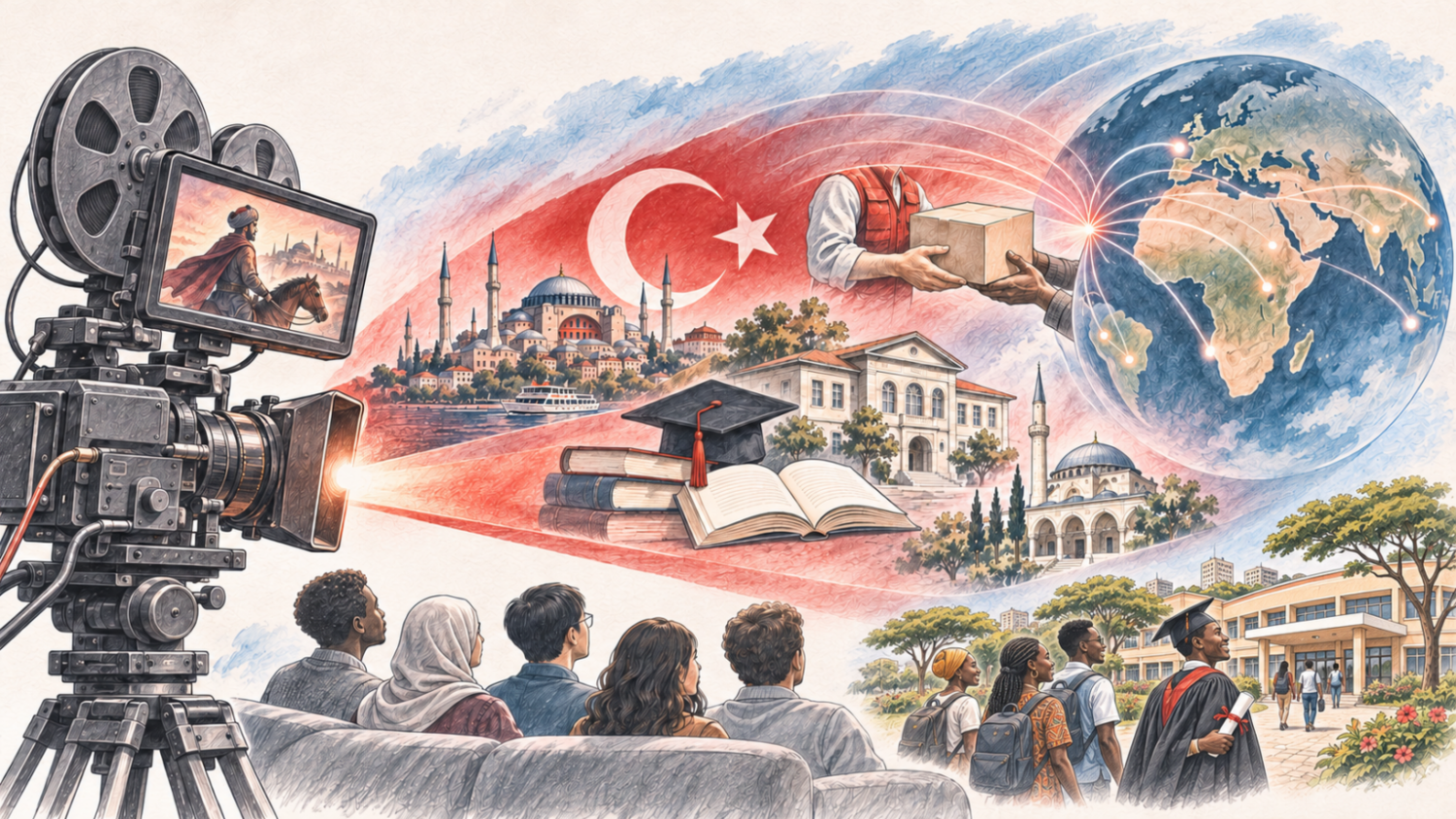
The European Commission’s latest report on Turkey paints a picture of a country moving towards an increasingly religious and nationalist model of education, while Ankara is building an extensive network to project its cultural and political influence abroad.
School curricula place such strong emphasis on national, moral and cultural values that these take precedence over scientific, evidence-based learning. Religious groups are gaining increasing influence in schools, while Turkey’s entertainment industry is reshaping the country’s history to fit the narrative promoted under President Recep Tayyip Erdogan.
The propaganda machinery is built at home before being exported across the world. Africa and Asia are the main priorities, but South America and Europe are also targets.
What the European Commission found
The Commission’s 2026 report may not use the word “Islamisation” to describe Erdogan’s Turkey, but its findings speak for themselves.
Education increasingly shaped by national and religious values
The “Century of Turkey Education Model”, a skills-oriented curriculum introduced in 2024, is being implemented gradually and already applies to grades two, six and nine.
The strong emphasis on national, moral and cultural values in the new curricula takes precedence over scientific and evidence-based learning.
Vocational education and training schools and religious schools account for approximately 40.6% of enrolments in Turkey’s upper secondary education, with persistent gender imbalances.
Religious organisations gaining influence in schools
The Ministry of National Education is increasingly allowing religious groups and structures linked to tarikats, or Sufi religious orders, to influence the education system.
According to the Commission, this trend threatens to undermine secular, high-quality education and weakens mechanisms for oversight and accountability.
A ministry circular issued in February 2026 concerning Ramadan activities in schools reignited debate about secularism and pluralism in education.
The education minister initiated legal proceedings against intellectuals and civil society organisations that had spearheaded a declaration supporting secularism.
The ministry also renewed a protocol with a youth foundation, allowing it access to thousands of state schools during the summer holidays to provide religious classes, despite Turkey’s Council of State having previously annulled a similar agreement.
Atheists and agnostics face discrimination, stigma, social pressure or restrictions on their right to education.
Turkey’s education system does not guarantee neutrality and impartiality towards different religions, denominations and beliefs.
No measures have been taken to address shortcomings identified by the European Court of Human Rights concerning compulsory religious culture and ethics classes.
During the reporting period, children from Protestant families were required to choose one of four optional Sunni religious courses, despite being entitled to an exemption.
Cultural diversity and independent voices under pressure
In the cultural sector, structural problems persist despite increased activities and festivals at national and local levels, as well as investment in infrastructure.
These problems particularly concern support for cultural diversity and institutional coordination.
The wider environment continues to undermine pluralism and leaves little room for independent organisations and critical voices.
Public spending on culture remains relatively low.
The Ministry of Culture and Tourism continued promoting large-scale events without ensuring transparent participation by stakeholders.
Political interference and arbitrary bans on events continued.
Implementation of UNESCO’s 2005 Convention on the Protection and Promotion of the Diversity of Cultural Expressions remains slow, with no substantial new measures.
Turkey does not participate in the Creative Europe programme for 2021–2027.
These are the developments taking place within Turkey itself.
But Ankara’s activities do not stop at its borders. It has built a well-organised propaganda apparatus designed to export Turkish “culture” in every direction.
The entertainment industry: Ankara’s first step
In the early 2000s, Turkish television series generated approximately $10 million a year in overseas revenue.
Today, export earnings exceed $1 billion, while Turkish productions reach more than one billion viewers in 170 countries, according to Ankara.
Turkey claims to have one of the world’s three largest television industries.
Interest in Turkish content increased by 184% between 2020 and 2023.
The industry operates along two parallel tracks.
The first is commercial: private studios selling melodramas to audiences in Latin America, the Balkans, Eastern Europe and Africa.
These programmes do not necessarily convey an ideology. Instead, they create familiarity with Turkish homes, Istanbul and the Turkish language.
The second track is state-driven.
Historical epics produced by the public broadcaster TRT, including Dirilis: Ertugrul, Kurulus: Osman and Payitaht: Abdulhamid, add an ideological narrative.
Ertugrul was sold to 71 countries and translated into 25 languages.
During Ramadan in 2020, more than 130 million people watched it on Pakistan’s state television network.
The series became a screen onto which an entire nation projected its dream of a transnational Muslim community.
Through these productions, Turkey is attempting to rewrite history as it sees it today, rather than as it actually happened. It is constructing its own narrative and promoting it internationally.
The state pays the bill
In February 2026, Culture and Tourism Minister Mehmet Nuri Ersoy announced subsidies of up to $100,000 per episode for television series sold abroad.
The eligibility criteria are revealing.
A series must have been broadcast in at least three continents and 10 countries.
It must contribute to promoting Turkey and spreading the Turkish language.
And it must be filmed in tourist destinations selected by the state.
The minister himself described Turkish television series as “the world’s biggest Turkish-language lesson” and said their leading actors would become “tourism ambassadors”.
In August, the Presidency’s Directorate of Communications organised an event titled “The global narrative of Brand Turkey: Turkish TV series”.
The institution accused by the European Commission of political bias is now openly claiming television dramas as one of its own instruments.
Turkey builds its own streaming platform
Ankara does not want to depend on Netflix.
In May 2023, TRT launched its own global streaming platform, tabii, with then-presidential communications director Fahrettin Altun attending the launch.
The languages offered in its first phase tell their own story: Turkish, English, Spanish, Arabic and Urdu.
In other words, the Americas, the Arab world and Pakistan — markets that had already embraced Ertugrul.
The entertainment industry is the first door.
It requires no permission, needs no agreements between governments and enters people’s living rooms before anything else.
And when Ankara’s narrative is challenged, it does not hesitate to apply pressure.
In 2024, following protests by Turkey’s Foreign Ministry, Netflix suspended the international release of Famagusta, a series about the 1974 invasion of Cyprus.
Ankara’s 17 arms of influence
Behind every Turkish school in the Sahel, every mosque in the Balkans and every Turkish television series broadcast in Pakistan stands a state institution.
There are at least 17 of them.
In 2026, the organisations operating abroad have a combined budget of approximately €475 million, excluding TRT’s international operations.
The entire Turkish Foreign Ministry has a budget of around €835 million.
In other words, Turkey spends more than half the equivalent of its diplomatic budget on soft power.
The schools: Training future generations
The Turkey Maarif Foundation was established in 2016 following the attempted coup, with one objective: to take control of schools abroad associated with the Gulen movement.
A decade later, it operates 524 schools in 66 countries, educating more than 75,000 pupils.
This year, it receives up to €134 million from Turkey’s education budget.
It is the same budget that, according to the Commission, leaves 804,000 children out of school within Turkey itself.
Africa is the main arena.
The method is straightforward, as the foundation’s own representatives have explained.
Identify the best pupils, immerse them in Turkish language and culture, and send them to study in Turkey.
There, the Presidency for Turks Abroad and Related Communities (YTB) awaits them with its Turkey Scholarships programme.
Around 5,000 scholarships are available each year. In 2026, some 200,000 young people from 164 countries applied.
The chain begins in a kindergarten in Nairobi and ends in a ministerial office where Turkish is spoken.
The imams: Religion as an instrument of influence
The Diyanet, Turkey’s Presidency of Religious Affairs, is the largest of these institutions, with a budget of approximately €3.1 billion, although most of the money goes towards salaries within Turkey.
Abroad, it has 77 religious counsellors, 54 religious attachés serving at embassies and more than 1,500 religious officials.
Its International Imam Hatip Programme brings almost 2,000 students from more than 110 countries to Turkey.
The most recent African summit of religious leaders organised by Diyanet in Istanbul attracted muftis and religious affairs ministers from 52 countries.
Religious communities, known as cemaat, operate alongside the state.
Organisations such as the Hudayi Foundation and the Suleymancilar run Islamic religious schools in Chad, Ethiopia, Ghana, Niger and Nigeria.
This is the international face of the trend the European Commission identifies within Turkey’s own schools: the state and religious orders working within the same framework.
Language and development aid
The Yunus Emre Institute, Turkey’s equivalent of Germany’s Goethe-Institut, has a budget of approximately €41 million this year.
It is opening new centres in Latin America despite a fraud scandal that led to the arrests of officials.
The Turkish Cooperation and Coordination Agency (TIKA) has around 60 overseas offices and, together with its development cooperation programme, manages approximately €165 million.
It builds hospitals and schools, restores Ottoman monuments and distributes food during Ramadan.
This year, its Ramadan food assistance reached 600,000 people in 89 countries.
Every project carries a Turkish sign and flag.
The occupied north of Cyprus as a testing ground
These organisations are already active in the occupied north of Cyprus.
TIKA opened an office in Nicosia in December 2019, with the leadership of the breakaway administration describing its projects as intended to “preserve and promote the Turkish presence”.
The Yunus Emre Institute also operates a centre in Nicosia.
In 2011, the Hala Sultan School opened as the first Islamic religious secondary school in the occupied part of Cyprus, despite objections from secular Turkish Cypriots.
Alongside it, the Diyanet Foundation built the Hala Sultan Mosque, modelled on the Selimiye Mosque in Edirne.
The mosque has a capacity of 7,500 worshippers.
It stands on the road from Tymbou airport, positioned so that every visitor can see it.

