


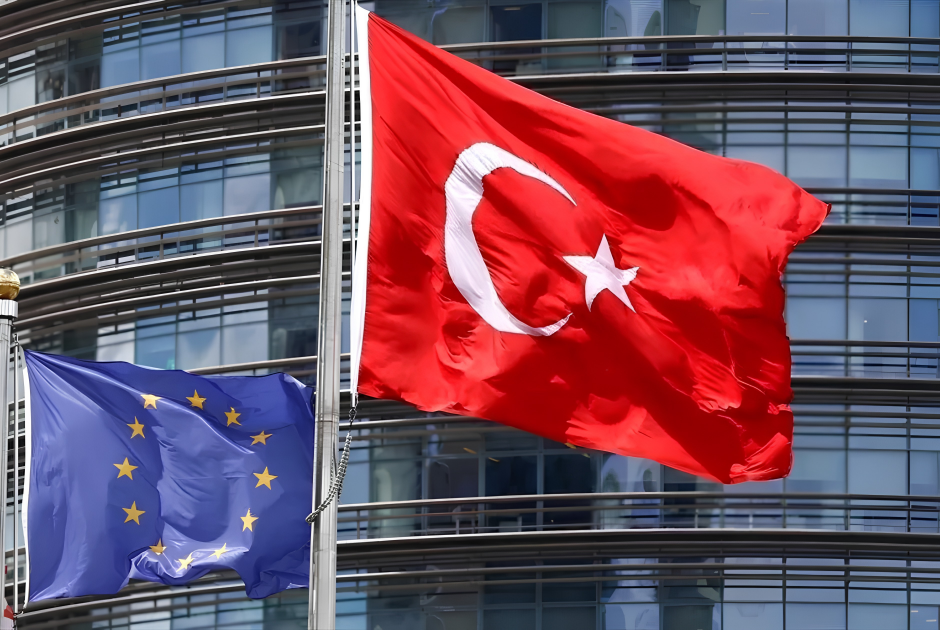
The European Commission called on Turkey on Wednesday to normalise its relations with the Republic of Cyprus and reverse its unilateral actions in Varosha, in a report on Ankara’s EU accession process that noted its insistence on a two-state solution, contrary to UN Security Council resolutions.
The report also records that Turkey signed a memorandum of cooperation in July 2026 with the internationally unrecognised entity in the occupied north on an undersea natural gas pipeline, without the consent of the Republic of Cyprus. It cites the strengthening of Turkey’s military presence on the island, drone flights and exercises in Cyprus’s maritime zones.
Cyprus
Turkey still neither recognises nor cooperates with the Republic of Cyprus, according to the Commission, which reiterated that the Republic is the only state entity on the island recognised by the EU. It called on Ankara to actively support a fair, comprehensive and viable settlement within the UN framework, and to avoid unilateral actions that raise tensions or make it harder to resume negotiations.
On Varosha, the Commission asked Turkey to reverse the unilateral actions announced in July 2021 and the measures taken since October 2020, in line with Security Council resolutions 550 and 789.
Energy and security
Turkey continued to obstruct survey work for the Great Sea Interconnector (GSI), the Greece-Cyprus electricity link that is an EU Project of Common Interest (PCI), the Commission said, placing the issue within wider problems affecting energy cooperation in the region.
The report also refers to Turkey’s reaction to the transfer of a Patriot battery to the Greek island of Karpathos to counter the Iranian missile threat, and to tension caused by the deployment of Greek F-16s to Cyprus after a drone attack on the British Bases.
Greece
Despite open channels of communication and the restart of Greece-Turkey dialogue, the Commission recorded a deterioration in some areas. Relations have improved overall since 2023 and there has been no unauthorised Turkish drilling in the eastern Mediterranean, but the picture in the Aegean remains complex, it said. Overflights of Greek islands by Turkish fighters have resumed, including over inhabited islands, with incidents recorded as late as September 2026, and violations of Greece’s airspace and territorial waters have risen significantly.
The Commission highlighted the casus belli declared by the Turkish parliament in 1995 should Greece extend its territorial waters in the Aegean to 12 nautical miles, a right it noted is provided for in Article 3 of the UN Convention on the Law of the Sea (UNCLOS), and said it continues to weigh on bilateral relations. It also listed Turkish claims that Greek islands should be demilitarised, Ankara’s navigational warnings and challenges which the report says indirectly target Greece’s sovereignty, sovereign rights and jurisdiction, and described the inclusion of the ‘Blue Homeland’ doctrine in Turkish school textbooks as a source of concern.
On the 2019 Turkey-Libya memorandum, ratified in October 2026 by the Benghazi-based House of Representatives after a long delay, the Commission restated the EU’s position that it infringes the sovereign rights of third states, is not consistent with the Law of the Sea and cannot produce legal effects for third countries.
The Commission concluded that Turkey must commit clearly to good neighbourly relations, international law and the peaceful resolution of disputes, if necessary through the International Court of Justice in The Hague. It called on Ankara to refrain from threats and actions that damage relations with member states, and to respect the sovereignty and sovereign rights of all of them.
(Information from protothema.gr)

