


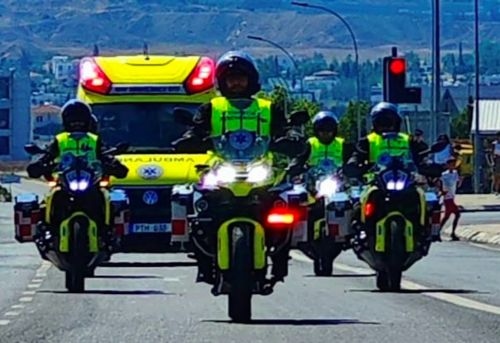
Nine of Cyprus’s 13 emergency response motorcycles remain out of service because of staffing shortages, despite the specialist units having attended 350 emergencies and the Ambulance Service having 22 internationally certified healthcare professionals trained in pre-hospital care.
Only four motorcycles are currently operational, two in Nicosia and two in Limassol, and even these depend entirely on staff working overtime, Ambulance Service chief Riana Constantinou told Phileleftheros.
The motorcycles, described as ambulances on two wheels, carry defibrillators, medicines and first-aid equipment, allowing trained paramedics and nurses to reach patients through heavy traffic and begin emergency treatment before an ambulance arrives.
Their speed can be crucial in cases involving cardiac arrest, stroke, serious injuries or severe bleeding.
“Even arriving three or four minutes earlier in cases of stroke or a cardiac emergency is valuable in saving a life. Those minutes can be lifesaving,” Constantinou said.
Faster treatment through congested streets
The motorcycle units operate primarily in city centres, where traffic congestion can delay conventional ambulances.
Their smaller size allows responders to navigate narrow streets, bypass traffic and reach crowded areas where larger emergency vehicles may struggle to gain access.
Constantinou said this flexibility is particularly important in urban centres, coastal and tourist areas during busy periods, and at major public events.
“We operate in city centres where traffic is heavy. Depending on instructions from the call centre, motorcycle crews are ready as soon as they receive a call, and response times have already fallen dramatically in the city centres where we have bases – Nicosia and Limassol, for now,” she said.
The emergency dispatch centre decides when to deploy the motorcycles based on the seriousness and location of an incident and the availability of emergency vehicles.
For critical emergencies, it can send motorcycles and a conventional ambulance simultaneously, allowing whichever team arrives first to begin treatment.
Although response times vary according to location and conditions, Constantinou stressed that even a few minutes can make a difference.
A mobile first-aid unit
The motorcycles are equipped to provide more than rapid transport for emergency personnel.
Each carries a defibrillator, medicines, certified medical equipment and supplies for treating injuries and controlling bleeding.
Responders work in pairs, using two motorcycles, and are trained to assess patients and provide initial treatment within their professional responsibilities.
On arrival, they assess the patient’s condition, administer appropriate care and report their findings to the emergency dispatch centre.
Once an ambulance arrives, its crew takes over treatment and transports the patient to hospital if necessary.
The motorcycles are not intended to replace ambulances but to bring specialist medical care to patients sooner.
Around 10 critical emergencies every day
The Ambulance Service handles emergencies of varying severity, with the most urgent incidents classified as red cases requiring an immediate response.
According to Constantinou, approximately 10 such emergencies occur each day.
“That is not a small number. If you manage to save 10 lives, you understand the significance,” she said, highlighting the importance of early intervention.
January records the highest demand
Ambulance Service figures show that January has the highest number of emergency motorcycle responses, with incidents reaching up to three times the levels recorded in some other months.
March and June follow in terms of demand.
The reasons for the January increase have not been investigated.
Constantinou suggested that colder weather, a possible rise in cardiac arrests and factors associated with the festive period could contribute to the pattern.
She emphasised, however, that these were possible explanations rather than conclusions supported by scientific research.
Nine motorcycles grounded by staff shortages
Despite having 13 motorcycles and 22 specially trained healthcare professionals, the service has yet to operate at its full capacity.
Nine motorcycles remain unused because of staffing shortages, while the four operating in Nicosia and Limassol depend exclusively on overtime.
“It is through overtime work, because of staffing levels, that we can provide a response,” Constantinou said.
Two operational bases have been established, one in Nicosia district and another in Limassol district, but permanent staffing arrangements remain unresolved.
The shortage limits the service’s ability to make regular use of equipment and trained personnel already available.
350 emergency responses recorded
The motorcycle units have responded to 350 incidents, according to Constantinou, who said the service had collected data demonstrating the need for the specialised response teams.
“We have recorded the incidents we respond to, and we can now demonstrate with evidence that emergency response motorcycles are an essential service,” she said.
Constantinou also raised the economic consequences of delayed emergency treatment, arguing that the loss of a human life carries substantial social and economic costs alongside its immeasurable human impact.
She referred to a €2 million valuation of human life, which she attributed to the World Health Organisation, and argued that the government should consider this dimension when deciding whether to invest in rapid-response emergency services.

