


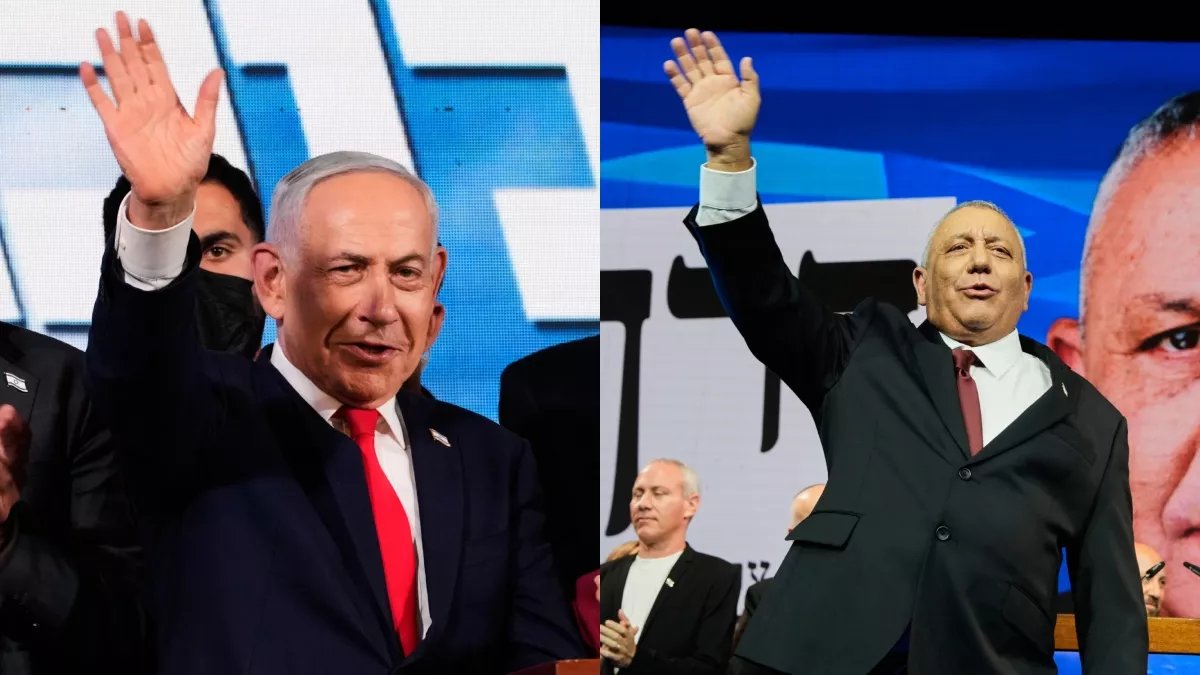
Prime Minister Benjamin Netanyahu and his rival Gadi Eisenkot offered competing claims to lead Israel after Tuesday’s election, Reuters reported. Netanyahu called for a right-wing government and Eisenkot said voters had rejected the long-serving leader, even as exit polls left their blocs deadlocked.
With vote counts trickling in, exit polls by Kan 11 and Channel 13 had the blocs tied at 51 seats each, while Channel 12 gave Netanyahu’s Likud-led bloc a narrow 52-49 lead. That left both sides short of the 61 seats needed for a majority in the 120-seat Knesset, and neither leader claimed victory.
The projected results would be a setback for Netanyahu and his nationalist-religious coalition. However, the deadlock could work in his favour, leaving the 77-year-old in office as caretaker prime minister during what are likely to be prolonged coalition negotiations, or even until another election can be held.
Tuesday’s vote was the first since the Hamas-led attack of October 7, 2023, and the wars in Gaza, Lebanon and Iran that followed.
Far-right religious parties led by Itamar Ben-Gvir and Bezalel Smotrich were projected to win a combined 13 seats within Netanyahu’s bloc, with no major gains for either.
Arab parties outside the two main blocs could hold the balance of power. But Eisenkot, leader of the Yashar party and a former military chief, has all but ruled out forming a government with them, which complicates his path to power.
Security fight sharpens
Addressing supporters at Likud’s election headquarters in Jerusalem after 3am (0100 GMT), Netanyahu called for the formation of “a strong, right-wing national government”.
He also highlighted Israel’s military successes and raised the prospect of renewed joint action against Iran with US President Donald Trump.
“Israel faces a singular historical opportunity, together with our partner President Trump, to remove the existential threat of Iran once and for all. But ulterior motives must not divert us from this sacred mission,” he said.
Eisenkot said the public had voted against Netanyahu remaining prime minister and called on him to retire from politics, warning him not to use Israel’s security for political purposes.
“Netanyahu is a caretaker prime minister, without a mandate or the people’s trust,” Eisenkot said. He called on the security establishment to “stand firm” against any attempt to put political interests ahead of Israel’s security.
Turnout was 77.7 per cent, the highest in more than two decades and about seven percentage points higher than in 2022, Israel’s Central Election Committee said.
Final results are expected on Thursday or Friday. Israel’s fragmented political system makes smaller parties potential kingmakers in coalition negotiations, which have run to weeks or months after past elections. If neither bloc can form a government, another vote may need to be held, which Eisenkot opposed given the high turnout.
Yohanan Plesner, president of the Israel Democracy Institute, called the exit polls a major defeat for Netanyahu’s coalition. He cautioned, however, that Eisenkot had not emerged as a clear winner and that much could change as votes were counted.
The Israeli shekel weakened modestly on the indecisive result.
Netanyahu setback, no clear winner
If the exit poll projections hold, Netanyahu’s right-wing bloc, which at its height held 68 seats, would fall far short of the 61 needed to govern, leaving him with no clear path to forming a government.
Eisenkot, 66, who lost a son and two nephews in the Gaza war, emerged as Netanyahu’s strongest challenger, stressing his security credentials while positioning himself as a centrist on domestic issues.
He entered politics only four years ago and joined Netanyahu’s war cabinet after the 2023 Hamas attack, but quit eight months later, criticising the prime minister’s leadership.
Eisenkot offers a break with Netanyahu’s leadership and far-right allies, but not with the hawkish approach to security that has become more entrenched since the attack. He opposes Palestinian statehood and says Hamas’s military wing must be destroyed or dismantled.
He says Israel’s response, a war that has killed more than 74,000 Palestinians according to Gaza health authorities, was a failure because Hamas remains in charge.
The headquarters of the Joint List, an alliance of several Arab parties, erupted in whistles and applause when the exit polls were released, on a historic night for turnout among Palestinian citizens of Israel.
“We refuse the occupation and racism, and we will remain here,” Faten Gattas, a Joint List candidate, said in a speech at the alliance’s headquarters in Nazareth. Candidates hoped high Arab turnout would allow them to play a decisive role in blocking Netanyahu’s coalition from returning to power.
A wartime verdict
Voters grappled with the trauma of Israel’s deadliest day, when Hamas killed 1,200 people and took 251 hostage, and of the wars in Gaza and with Lebanon’s Hezbollah and Iran that followed.
Netanyahu was criticised for the country’s biggest security failure, but argued that he had made Israel and the world safer by killing top leaders of Hamas, Hezbollah and Iran.
The policies of his right-wing coalition have been divisive at home and deepened Israel’s international isolation, but he has portrayed himself as the leader with the mettle to face down Israel’s foes.
Netanyahu has served as prime minister for nearly 19 of the past 30 years and has repeatedly survived political crises. His opponents have managed to take the premiership from him only once since 2009, after four inconclusive elections in two years. Eighteen months later, he was back.
He entered the election facing long-standing corruption charges, which he denies, and criticism over intelligence failures that allowed Hamas-led militants to carry out their attack.
(Reuters)

