


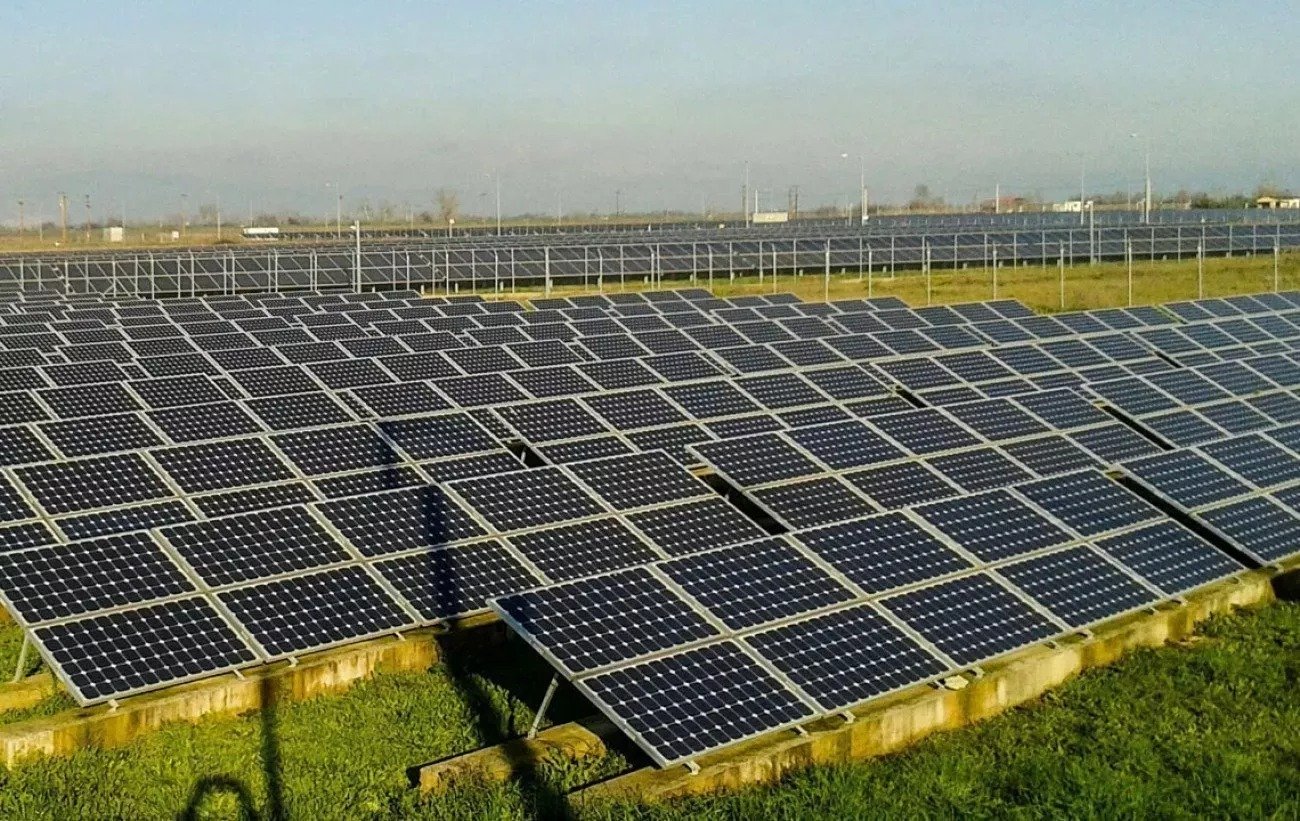
Parliament members and farmers’ and environmental groups clashed with the government and the Law Office on Tuesday over a planning circular that lets older applications for solar parks on fertile farmland be assessed under the rules in force before a new ban.
The row came at parliament’s Agriculture and Natural Resources Committee, which examined how the law protecting fertile farmland and land consolidation areas from solar parks is being applied. The committee decided to call the interior, agriculture and energy ministers to a future session.
The amending law was passed unanimously by parliament, signed by the President and published in the Official Gazette on May 5, 2026. The director of the Department of Town Planning and Housing then sought a legal opinion from the Attorney General and, as Phileleftheros reported, sent a circular on August 5 to all District Local Government Organisations (DLGOs). Under the circular, complete applications submitted at least three months before the law was published, by February 8, 2026, are assessed under the old rules.
Committee chairman Giannakis Gavriel, of AKEL, asked how parliament could have spent six years trying to persuade the executive while solar parks were “springing up like mushrooms”. He said the circular ended up cancelling the very law the President had approved, and accused the government of finding ways to get around it.
A Law Office representative said no constitutional grounds had been found to block publication of the law when it was vetted, but there had been serious issues with its transitional provisions and with protecting the reasonable expectations of citizens. The office had weighed the principle of legality under the law on the general principles of administrative law. Under that principle, an application is examined under the rules in force when the decision is issued or when a reasonable period expires, unless the applicant caused the delay.
Local authorities
DLGO representatives and deputy mayors described the situation in the countryside as chaotic, particularly in the Famagusta district.
The deputy mayor of Frenaros, who also represented Paralimni-Deryneia municipality, said farmers were in despair. In the Frenaros municipal district alone, planning applications have been submitted for a total of 173 megawatts on about four million square metres, or four square kilometres, of farmland. That is close to 50 per cent of Frenaros’s area, he said. He added that the Department of Lands and Surveys had issued 19 certificates on state land, and concerns were raised about specific companies monopolising studies and applications.
The deputy mayor of Avgorou alleged that although the municipality and the Famagusta DLGO’s board had both opposed a planning permit, the development director had overruled them and approved the application through the DLGO.
The Famagusta DLGO’s representative, who is also deputy mayor of Sotira, said they were fighting to have solar parks rejected on state land and good farmland, describing the soil as “sacred”. He said the DLGO had recently rejected two solar parks on farmland in the Sotira municipal district.
Speaking for the Larnaca DLGO, which also represented the Limassol and Paphos DLGOs, a representative said the complete absence of transitional provisions in the law had created huge practical problems. This was especially so for applications that had a planning permit before the law took effect but were struggling to secure a building permit afterwards.
Farmers and environmental groups
Panikos Hambas of the farmers’ union EKA spoke of a “betrayal of the land” and warned that no farmland would be left to grow food. Michalis Lytras of the farmers’ union PEK said some people were committing crimes against the state and that “money buys consciences”. He called for all applications on arable land to be rejected immediately.
Tasos Giapanis of the Panagrotikos farmers’ union called for strict European rules on agrivoltaic parks, with permits withdrawn immediately where dual use of the land could not be shown.
Kleitos Papastylianou of the environmental organisation Terra Cypria said existing planning and environmental rules had already treated good, fertile and irrigated farmland and land consolidation areas as case-by-case areas, and Natura 2000 sites as exclusion zones. Under the countryside policy statement, development outside community boundaries should be discouraged, so such applications should be rejected rather than approved, he said.
A representative of OPOK drew attention to energy storage parks appearing on farmland, which he said are not covered by the current legal framework.
Government departments
Makis Avraam of the Department of Agriculture said the department examined the fertility of plots strictly, but environmental approvals and planning permits continued to be issued despite its objections.
The Electricity Authority of Cyprus (EAC) said there was enormous pressure to find land because of energy targets and saturated substations in rural areas. The Commerce Ministry agreed with banning solar parks on fertile and irrigated farmland but supported agrivoltaic parks.
The Department of Lands and Surveys said state land was no longer being granted for solar parks, and applications to lease state land and for planning permits on fertile and irrigated farmland were being rejected.
The issue was registered by AKEL parliament members Giannakis Gavriel, Efraim Christou and Valentinos Fakontis and ELAM parliament member Linos Papagiannis.

