


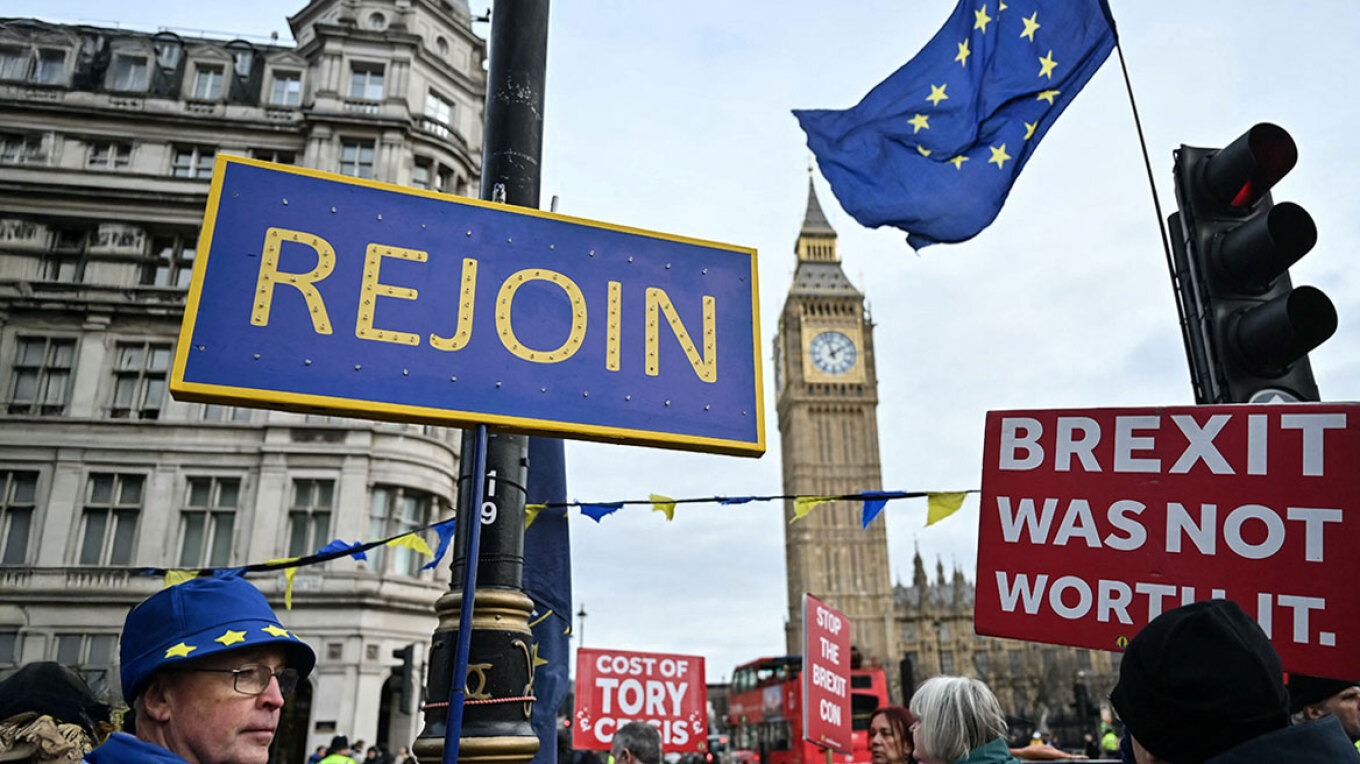
Nearly half of UK voters now want the country to rejoin the European Union, according to a major new poll showing a marked shift in public attitudes towards Brexit.
The Messina Group (TMG) survey of 11,461 people found that 49% support rejoining the EU, compared with 28.5% who oppose it. Some 52.4% said Britain was wrong to vote to leave in 2016, while 29.7% still believe the decision was right.
The findings come at a significant moment for the Labour government, with Prime Minister Andy Burnham publicly reopening the debate over Britain’s future relationship with the EU and leaving open the possibility of eventually rejoining the bloc. Reuters reported this week that Burnham had said Britain should examine a range of options, including EU membership, the single market and a customs union.
Burnham puts Brexit back on the table
In his first Labour conference speech as party leader and prime minister, Burnham announced a review of the options available for Britain’s future relationship with Europe.
He later made clear that full EU membership could be among those options, alongside joining a customs union or returning to the single market. Burnham has said Brexit caused “more harm than good” and wants a clearer picture of the choices available to Britain ahead of the next UK-EU summit.
The new polling is likely to strengthen the hand of those inside Downing Street who believe Labour could go into the next election promising at least to negotiate a different relationship with Brussels.
TMG found that, under the hypothetical scenarios it tested, policies bringing Britain closer to the EU increased Labour’s stated vote share by between 4.3 and 7.4 percentage points. The findings are based on polling scenarios and are not a forecast of an election result.
How could Britain return?
Voters are divided over what process Britain should follow if it decided to seek EU membership again.
Almost one in three said another referendum should take place first, while more than one in six said a clear mandate at a general election would be sufficient. A similar proportion said parliament itself could make the decision.
On timing, 25.9% said they wanted Britain to rejoin immediately, 22.9% favoured doing so within the next three years and 8.4% within the next decade. By contrast, 23% said they did not want a closer relationship with the EU at all.
Support extends beyond full EU membership
The poll suggests that support for closer ties with Europe is not confined to full membership.
Some 48.2% supported keeping the current relationship while removing as many trade barriers as possible, while 47.1% backed a customs union.
Single-market membership was supported by 45.1%, while 45.5% backed a form of associate membership.
Only 27.9% said Britain should move further away from the EU, while 41.2% opposed that option.
Reservations inside government
Despite the shift in public opinion, several senior government figures remain cautious about reopening a major political battle over Brexit.
Concerns are particularly strong among ministers and MPs representing constituencies that voted Leave in 2016.
The Guardian reported that some cabinet ministers believe Brexit failed to deliver what was promised but argue that any policy shift must be handled carefully to avoid reopening old divisions.
Home Secretary Shabana Mahmood has said rejoining the EU is “not a simple, straightforward thing”, while other senior figures have raised questions over the terms Britain could expect if it sought membership again.
Labour’s political dilemma
The debate also carries the risk of giving Nigel Farage’s Reform UK fresh political momentum if Brexit once again moves to the centre of British politics.
Farage said Burnham’s decision to reopen the Europe debate had given him “the biggest boost in my career”. Downing Street officials, meanwhile, have been examining polling and think-tank research to assess how deep the change in public attitudes really is, according to British media reports.
TMG’s figures show broad dissatisfaction with the outcome of Brexit. Some 54.9% described it as a failure and 12.2% as a success, while 23.2% said it was neither.
More than two-thirds of respondents also said trade with the EU was more important to Britain than trade with either the United States or China if the country were forced to choose.
At the same time, the poll found that two of the arguments that dominated the 2016 Leave campaign — immigration control and national sovereignty — still resonate with a significant section of the electorate.
A decade after the referendum that reshaped Britain’s relationship with Europe, the issue is again moving to the forefront of national politics, this time against a backdrop of polling that shows markedly different public attitudes from those seen in 2016.

