


Lawyers representing a former soldier who was seriously injured by a grenade said two of the 73 grenades supplied by the National Guard to the Hellenic Force in Cyprus (ELDYK) had been withdrawn after cracks were found. The lawyers disclosed the information following a court hearing in Athens last Friday.
The former ELDYK soldier, now 25, is suing the Greek state for hundreds of thousands of euros in compensation. He was seriously injured in February 2024 while throwing a grenade from the batch during an exercise at a firing range in the Stavrovouni area. His right palm was amputated, and he lost his right eye 20 months later.
A three-member panel of the Administrative Court of First Instance in Athens heard arguments from both sides last Friday and reserved its decision.
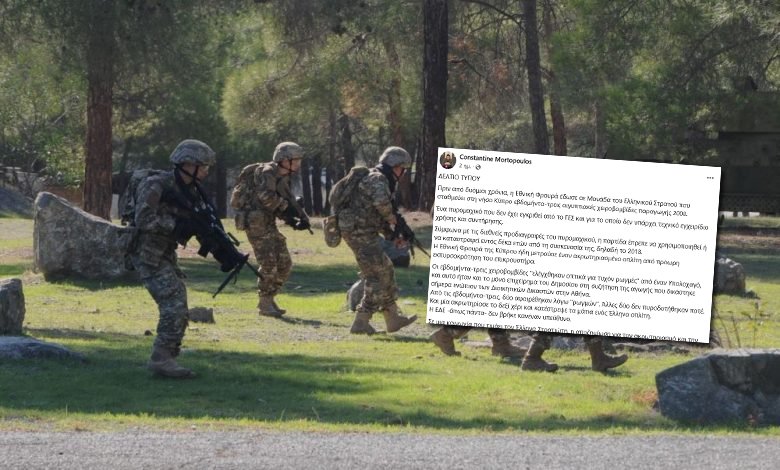
In a press release issued shortly after the hearing, the law firm of Konstantinos Mortopoulos, which represents the former soldier, said testimony presented to the court showed that the grenade that exploded was among 73 grenades from a batch manufactured in 2008.
According to the law firm, the Greek state acknowledged that a lieutenant had visually inspected the grenades for cracks. The firm said this was the state’s only argument during the hearing.
It added that two other grenades from the batch were not used after cracks were detected. The National Guard had previously recorded another case involving an amputation following the premature activation of a grenade’s firing mechanism, the firm said.
The lawyers also alleged that the ammunition had not been approved by the Hellenic Army General Staff and was not accompanied by a technical manual governing its use and maintenance. They said the applicable specifications required the batch to be used or destroyed within 10 years of packaging.
Phileleftheros contacted relevant National Guard officials in February 2024 and again last Friday. None acknowledged that there was a problem with the military equipment, although details reported by the newspaper about the procurement contract were not disputed.
A military official who spoke to the newspaper on 26 February 2024 said “the issue is not so simple”, referring to military equipment supplied in separate batches under a single contract. The official appeared to suggest that material procured under one contract could be delivered in several batches.
Phileleftheros reported on 27 February 2024 that the National Guard had concluded a contract with an Egyptian company for more than 75,000 DG 270/2 grenades. The grenades were manufactured in 2008 and received by the National Guard in April 2009.
A clause in the contract stipulated a five-year guarantee and a shelf life of 10 years from the year of manufacture. Shelf life refers to the period during which a product remains safe and effective when stored under the prescribed conditions.
Phileleftheros also reported that the batch should have been withdrawn after its shelf life expired but remained in use. The grenades were transferred to ELDYK at its request in 2023.
Alpha Cyprus published a document on 22 February 2024 showing that the National Guard General Staff had issued a warning to relevant parties in 2016. The message said that liquefied explosive material had blocked the opening in the body of a DG 270/2 grenade while its detonator was being fitted during a training exercise on 24 August 2016.
“In view of the above, use of this type of grenade should be avoided,” the message said.
Questions about the suitability of the same type of grenade had also arisen in 2014. Andreas Doulappas, then a trainee with the Underwater Demolition Unit, lost his right hand after being injured by a DG 270/2 grenade on 3 April that year.
The law firm representing the former ELDYK soldier said an administrative inquiry into the 2024 incident had not assigned responsibility to any individual.
The revised version is cleaner, but the 2018/2019 discrepancy and the precise meaning of “premature firing of the firing pin” should be checked against the underlying documents before publication.

