


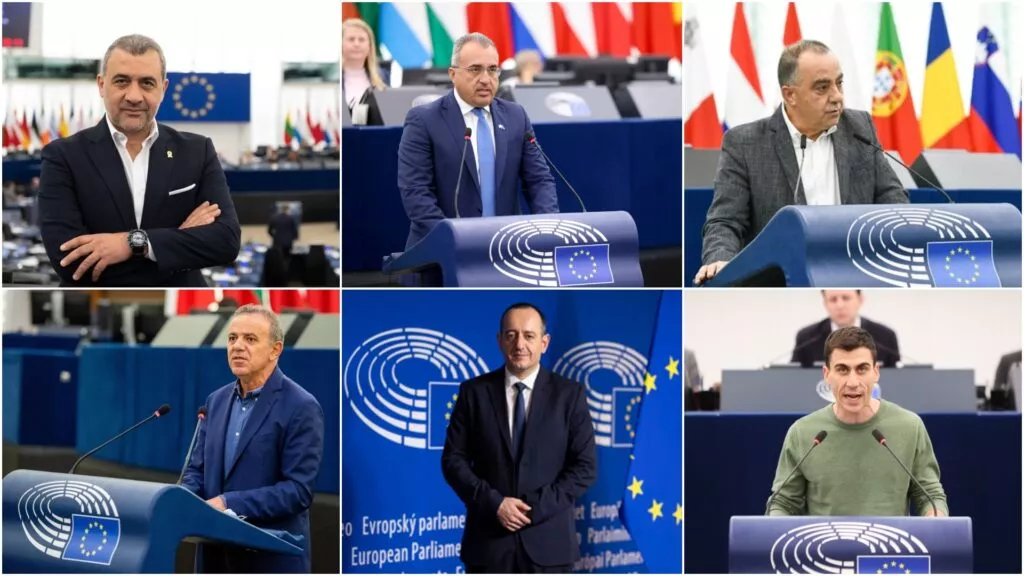
More than two years into the European Parliament’s 2024–2029 mandate, Cyprus’ six Members of the European Parliament have had ample opportunity to move beyond election promises and establish their roles in Brussels and Strasbourg.
Cyprus, alongside Malta, has the smallest national delegation in the 720-member Parliament, with six MEPs. Namely, Giorgos Georgiou of AKEL and the Left (GUE/NGL) group, Fidias Panayiotou who was elected as an independent, Loucas Fourlas and Michalis Hadjipantela of DISY and the European People’s Party (EPP), Costas Mavrides of DIKO and the Socialists and Democrats (S&D) and Geadis Geadi of ELAM and the European Coonservatives and Reformists (ECR).
That makes individual influence particularly important: each Cypriot representative accounts for one-sixth of the country’s parliamentary delegation, even if their formal influence within Parliament varies considerably according to committee assignments, political-group support and responsibility for individual legislative files.
Measuring an MEP’s performance, however, is not straightforward. Attendance can indicate participation, but does not necessarily measure political influence. Speeches demonstrate public engagement, but not necessarily success in shaping legislation. Rapporteurships and shadow-rapporteurships offer stronger evidence of involvement in legislative negotiations, but they too provide only one measure of influence.
Legislative influence
One of the clearest indicators of an MEP’s involvement in Parliament’s legislative process is whether they are appointed as a rapporteur.
A rapporteur is appointed by the responsible parliamentary committee to draft a report on a legislative, budgetary or other issue. The rapporteur is responsible for developing the committee’s position, negotiating compromise amendments and working with shadow rapporteurs representing the other political groups.
A shadow rapporteur, meanwhile, is appointed by a political group to follow a legislative file, negotiate with the rapporteur and other groups, and help shape the eventual compromise. Shadow rapporteurships therefore provide an important, although different, measure of influence.
On this measure, Michalis Hadjipantela of the European People’s Party (EPP) has established one of the strongest legislative portfolios among Cyprus’ six MEPs.
Hadjipantela has served as rapporteur on Parliament’s estimates of revenue and expenditure for 2027, a report on tax rules and fragmentation in relation to European competitiveness, and a proposal concerning access by the European Public Prosecutor’s Office and OLAF to VAT information.
His responsibilities extend beyond those reports. He has also held rapporteur and shadow-rapporteur responsibilities on opinions, including files concerning the EU’s long-term budget and the future Multiannual Financial Framework (MFF).
However, Hadjipantela is not the only Cypriot MEP to have secured a rapporteurship, as an earlier version of this assessment suggested.
Loucas Fourlas, also from the EPP, became rapporteur for a report on an EU health workforce crisis plan, covering the sustainability of healthcare systems and employment and working conditions in the sector. The report was adopted in June 2026 and involved both the Employment and Social Affairs Committee (EMPL) and the Public Health Committee (SANT).
Giorgos Georgiou of The Left (GUE/NGL) has also served as rapporteur, including for a 2026 SANT report, while simultaneously accumulating a substantial number of shadow-rapporteur assignments in the Foreign Affairs Committee (AFET). His shadow responsibilities have included files concerning Bosnia and Herzegovina, North Macedonia, Montenegro, Türkiye and Uzbekistan.
Costas Mavrides, Socialists and Democrats (S&D), has developed a particularly broad shadow-rapporteur portfolio. During the 2025/26 period, his responsibilities have included the 2025 Commission report on Montenegro, macro-financial assistance to Jordan and the implementation of the Recovery and Resilience Facility, alongside earlier work on Egypt and other international economic files.
Fourlas has also held shadow-rapporteur responsibilities, particularly through the Committee on Women’s Rights and Gender Equality (FEMM), Committee on Culture and Education (CULT) and the Committee on Civil Liberties, Justice and Home Affairs (LIBE). His recent assignments have included opinions concerning EU budget discharge, the EU-UK Trade and Cooperation Agreement and gender equality policy.
Geadis Geadi of the far-right ELAM, who belongs to the European Conservatives and Reformists (ECR) political group, has placed particular emphasis on foreign affairs and the EU’s relations with neighbouring countries. In this context, he has served as shadow rapporteur on a number of files, including the 81st session of the United Nations General Assembly, Armenia, EU–UK relations, the rights of persons with disabilities, EU–Syria political relations, and the European Commission’s report on Georgia.
He has placed particular emphasis on Türkiye, including by submitting a large number of amendments to the European Parliament’s report on the country. Overall, he has tabled 1,415 amendments. He has also made a series of interventions in the European Parliament’s plenary sessions, addressing both international and domestic issues.
Committees
Much of the European Parliament’s detailed legislative work takes place in its specialised committees. These bodies examine Commission proposals, prepare reports, debate amendments and establish Parliament’s negotiating position before matters reach the plenary.
Committee assignments are consequently important because they determine the policy areas in which an MEP has the greatest opportunity to build expertise and influence. Cyprus’ delegation has developed a relatively broad distribution of responsibilities.
Hadjipantela is a full member of the Committee on Economic and Monetary Affairs (ECON), the Committee on Public Health (SANT) and the Subcommittee on Tax Matters (FISC). He is also a substitute member of the Budget Committee (BUDG), the Environment Committee (ENVI) and the Industry, Research and Energy Committee (ITRE). This gives him a particularly strong position on economic governance, taxation, public health and budgetary matters. His committee portfolio also corresponds closely with his legislative responsibilities, particularly his work on taxation, competitiveness and the Parliament’s budget.
Mavrides has one of the delegation’s broadest committee portfolios. He is a full member of the Committee on Foreign Affairs (AFET), the Committee on Security and Defence (SEDE), where he is also rapporteur for the “Horizon Europe” legislative file, and the Committee on Economic and Monetary Affairs (ECON). His responsibilities therefore span a wide range of areas, including foreign policy, defence, security and the economy. He is also a substitute member of the Committee on International Trade (INTA) and the Committee on Petitions (PETI).
Geadi is a full member of AFET, the Foreign Affairs Committee, and participates in several external-relations delegations, including the EU-Türkiye Joint Parliamentary Committee and delegations dealing with Armenia, Azerbaijan, Georgia and the wider Mediterranean region. He is also a substitute in the Employment and Social Affairs and Civil Liberties committees. His profile is therefore strongly oriented towards foreign policy, the EU’s neighbourhood and relations with Türkiye and other countries in the region.
Fourlas is a full member of AFET and chairs the European Parliament’s delegation to the EU-Serbia Stabilisation and Association Parliamentary Committee. His current committee profile is therefore broader than simply public health. His appointment as rapporteur on the EU health workforce crisis plan nevertheless gives him a significant role in health-related policy during the period under review.
Georgiou’s parliamentary work is strongly centred on foreign affairs. His shadow-rapporteur assignments include a series of reports on EU enlargement and neighbouring countries, including Bosnia and Herzegovina, North Macedonia, Montenegro and Türkiye. He has also taken on responsibilities relating to health policy, including a rapporteurship in the SANT committee and shadow-rapporteur work on health-related files.
Fidias Panayiotou’s position is structurally different from that of the other five MEPs because he sits as a non-attached member, rather than as part of a political group. That matters because political groups are central to the organisation of Parliament’s work and to the allocation of many legislative responsibilities. Being non-attached can make it more difficult to obtain the same committee and negotiating roles available to members of the larger groups.
Overall, the committee structure suggests that Cyprus’ delegation has achieved reasonable policy diversification. Economic affairs, foreign policy, security, taxation, public health and social policy are all represented, although the delegation is particularly concentrated around ECON and AFET-related work.
Participation and voting
Attendance provides another possible measure of parliamentary participation, but it needs to be interpreted carefully.
The European Parliament uses different types of voting procedures, and not every vote produces an individual voting record for every MEP. A roll-call vote is particularly useful for assessing participation because it records individual members’ presence and vote.
The independent tracker WheresMyMEP measures roll-call attendance over the preceding 180 days, rather than attendance over an entire parliamentary year, but its figures should not be described as an MEP’s “percentage of votes”. Instead, they should be understood as a measure of recorded attendance at roll-call votes during a defined period.
On the latest available 180-day measure, Geadi has the highest with an 87.8% attendance, whilst Panayiotou ranks last with just 60%. Hadjipantela stands at an 81.9%, Mavrides at 70.7%, Georgiou at 69.1% and Fourlas at 66.0%.
Attendance, however, should not be confused with effectiveness. An MEP can attend almost every roll-call vote without securing a major legislative role. Conversely, a high attendance rate does not tell voters whether an MEP consistently voted in accordance with their stated priorities.
So, who is performing best?
There is no single statistic capable of answering that question.
If the primary criterion is lead legislative responsibility, Hadjipantela currently has the strongest case. His rapporteurships cover important economic, tax and budgetary files, while his committee assignments place him at the intersection of economic policy, taxation and public health.
If the measure is foreign-policy engagement and shadow-rapporteur activity, the picture is more competitive. Mavrides has a substantial portfolio spanning foreign affairs, security, economics and international trade, while Georgiou has accumulated extensive shadow-rapporteur responsibilities on enlargement and the EU’s eastern and southern neighbourhood.
Fourlas has combined his AFET responsibilities with a significant new rapporteurship on Europe’s health workforce crisis, while Geadi has built a profile heavily focused on Türkiye, the EU’s neighbourhood and foreign affairs.
Panayiotou presents a different model altogether. As a non-attached MEP, he lacks the political-group infrastructure enjoyed by the other five, making direct comparisons based purely on committee roles or rapporteurships less straightforward.
Cyprus’ delegation cannot yet be reduced to a simple league table. But the parliamentary record does show that some MEPs have already secured substantially greater formal legislative responsibilities than they had at the beginning of the mandate, providing a clearer picture of where Cyprus has accumulated influence in the European Parliament.
Read more:

