


The extreme rhetoric adopted by Ankara, which maintains a constant threat toward Greece and Cyprus, creates a climate of tension that appears to be the intended goal of the occupying side. Within an unstable international environment, the Ankara regime chooses to become more aggressive to serve its geostrategic designs, seeking to create suffocating pressure against Nicosia and Athens.
It is obvious that this climate aims at intimidation. The Turkish side wants to keep Athens and Nicosia constantly on edge, attempting to send the message that its ambitions will be imposed by any means. It seeks to ensure its goals through the tactics of intimidation, threats, and warmongering rhetoric.
The Turkish side considers that during a period of instability, while a redistribution of power is underway, it must highlight its role, have a say in developments, but primarily secure geopolitical gains. Simultaneously, it develops various conspiracy theories to support its aggressive tactics. It puts forward the well-known theory that moves are being made by the Greek side, Greece and Cyprus, in cooperation with third parties for the “encirclement” of Turkey and the neutralization of its designs. It promotes the narrative that it is being threatened and is in danger, and therefore it reacts.
In other words, while it projects power and strength, it simultaneously appears to be possessed by a “hunted” syndrome.
It is clear that this tactic, which was formed and is coordinated by the presidency in Ankara, is manifested by exponents of Turkish policy at various levels. What is observed, however, is that in the recent period, the Turks have escalated threats through public statements and provocative enforcement actions.
Within this framework, various moves are recorded, both on the ground and through public statements.
Rehearsal for occupying the buffer zone
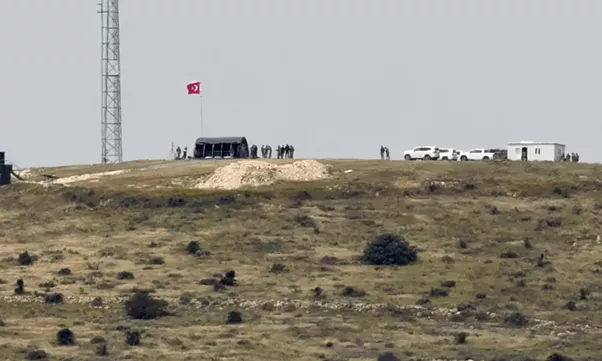
Firstly, the recent incidents in Pyla can only be integrated into the design of the occupying side regarding the buffer zone and its ambitions for its occupation and the exercise of “sovereignty” in the area. It is recalled that incidents occurred between the occupying army and UNFICYP in August 2023 as well. The crisis of 2023, like the current one, was provoked as a test for the endurance of Nicosia and the international community, primarily for the imposition of new accomplished facts. Based on what is stated by the occupying regime, this specific area is considered, according to its claim, “TRNC territory.” It is noted that regarding Pyla, the expansion of the occupation offers a military advantage as, among other things, Turkey’s forces will be very close to the Larnaca-Famagusta highway and the sea. In the past, there was talk that the occupying forces aimed to cut off the two provinces. These, however, are designs on paper, the implementation of which is by no means an easy undertaking.
The presence of armoured vehicles and reinforced forces of the occupying army in the Pyla area was a choice intended to send messages in every direction. At the same time, it had been mentioned to the United Nations at some stage that it was an exercise. The placement of a flag is also significant.
It should be mentioned that the occupying side does not focus only on Pyla. Moves are recorded in other areas of the buffer zone along the ceasefire line. Such moves are recorded at the Wayne’s Keep cemetery, which is located in the buffer zone in Agios Dometios and is British. There were moves by the occupying army to support the claim that it is located in the occupied area. Furthermore, moves are being made in the area of Deneia and Avlona, and Strovilia. Also, in the area of Ledra Street, at the Ledra Palace, and at the well-known “Maria’s house” in Agios Dometios. Consequently, the challenge concerns the entire line, the buffer zone.
Secondly, the Turkish Foreign Minister, Hakan Fidan, in a recent interview with the state news agency Anadolu Agency, highlighted the “danger” the country faces from the cooperation of Greece, Cyprus, and Israel. He argued that “the cooperation between Greece, the ‘Greek Cypriot Administration,’ and Israel does not bring more trust, it brings more distrust. It brings more problems and war.” Hakan Fidan further argued that “Israel may seek to characterize Turkey as a new rival after Iran, as it cannot survive without an enemy.”
Why does he refer to this cooperation? The reference to Israel, especially at this phase, seems related to the fact that Netanyahu’s actions provoke reactions from Arab states and Europeans. Turkey deliberately attempts to identify Greece and Cyprus with the actions and designs of Tel Aviv, which obviously is not the case.
Thirdly, Hulusi Akar, former Minister of Defence of Turkey and current President of the Defence Committee of the Turkish Grand National Assembly, unleashed threats of war in a post about Cyprus. Erdogan’s former right-hand man stated that “in the homeland of the Turkish Cypriots, those who dream of Easter… will live their last Easter.”
At the same time, the Turkish Minister of Defence, Yaşar Güler, launched threats stating that his country is determined to protect the security of the puppet state and the rights of the Turkish Cypriot “people.” Güler, in an interview with the Italian newspaper Il Messaggero, referred to the support of European partners toward the Republic of Cyprus, saying that “we believe that the development of defence systems around Cyprus by the EU constitutes an attempt by the ‘Greek Cypriot administration’ (i.e., the Republic of Cyprus) and Greece to increase their military presence on the island and escalate tension.” Erdogan made the same statement regarding the forces of third countries located in the region at Nicosia’s request when he met the occupying leader, Tufan Erhürman, in Istanbul.
Fourthly, the occupying regime has also entered the game of creating a climate of tension, seeking to provoke a confrontation with the Republic of Cyprus through its rhetoric and “complaints.” The occupying leader, Tufan Erhürman, chose to highlight two minor issues recently—isolated incidents—to feed the logic of tension. The first case concerns a group of individuals from the free areas who “threw stones and explosives (i.e., firecrackers) at citizens who were at the Roccas Bastion.” The second concerns the burning of flags of Turkey and the secessionist entity during the Easter days. Both issues were promoted with the aim of provoking a crisis and maintaining a climate of tension at a time when efforts are being made to resume negotiations on the Cyprus problem. From the beginning of his leadership of the secessionist entity, the occupying leader chose to be aggressive toward the Greek side. This is a stance also linked to Erhürman’s attempt to constantly provide credentials of loyalty and alignment with the occupying side.
Nicosia’s initiatives
On the other side, Nicosia monitors the Turkish moves and the tactics of the occupying power, while simultaneously implementing a plan at the political and diplomatic level to remain permanently in the equation of processes. Both now, while presiding over the E.U., and afterward (as before), it seeks to utilize its relations with states in the region and to restart others based on current data. The example of Qatar is indicative. Bridges have been built through the initiatives of the President and the Foreign Minister, whereas relations were merely formal in the past.
Linking new military infrastructure with frequent violations
Nicosia links the Turkish violations—the “almost daily violations by the Turkish occupying forces of the military status quo on the island”—with the reinforcement of military infrastructure in the occupied areas. This is mentioned in the latest letter from the Republic of Cyprus to the UN Secretary-General, which was circulated as a Security Council document under the number S/2026/240. In this letter, the Republic of Cyprus denounces a series of new violations of national airspace, international air traffic regulations within the Nicosia FIR, as well as its territorial waters by Turkey’s aeronautical forces during the January–February 2026 two-month period.
The linking of violations with upgraded military infrastructure is not accidental. It is based on data before Nicosia and the assessment made regarding Turkish moves. It is a design that combines the gradual reinforcement of the occupying forces with new infrastructure, a fact that consolidates and upgrades Turkey’s presence. This is done through actions manifested on the ground. As stated in the letter from the Permanent Representative of Cyprus to the UN, Maria Michael, the violations are frequent and increased.
According to the four annexes accompanying the letter, a total of “305 air and 33 naval violations” were recorded during the period under review. Of the air violations, “81 out of 305 were carried out by Turkish military unmanned aerial vehicles (UAVs),” while “44 were by Turkish armed military fighter aircraft.” It is recalled that the military airport in occupied Lefkoniko is used as a base for unmanned aircraft. Furthermore, at sea, repeated violations of territorial waters by Turkish warships and auxiliary vessels are listed.
New runway for F-16s?
Beyond the documented complaints submitted to the United Nations, various pieces of information circulate in the occupied areas regarding the reinforcement of the occupying forces. Some of these are true, others are not. A few days ago, a news report was published claiming that an F-16 landing runway is being constructed at the Tympou “airport.”
According to the publication, following the deployment of Turkish F-16 fighter aircraft at the illegal Tympou airport, “work has begun for the full adaptation of the existing airport runway for continuous and long-term use by fighter aircraft, as well as for the construction of an alternative military runway. The project is being implemented by technical teams from Turkey. Groups of experts recently arrived in the ‘TRNC’ and have begun detailed field research and technical studies around the airport.” Without knowing the validity of the information, it should be noted that this discussion has occurred in the past, but it concerned the construction of a runway at the so-called Lefkoniko airport, which is also military. A runway for fighter aircraft at Lefkoniko has not been constructed to date.

