


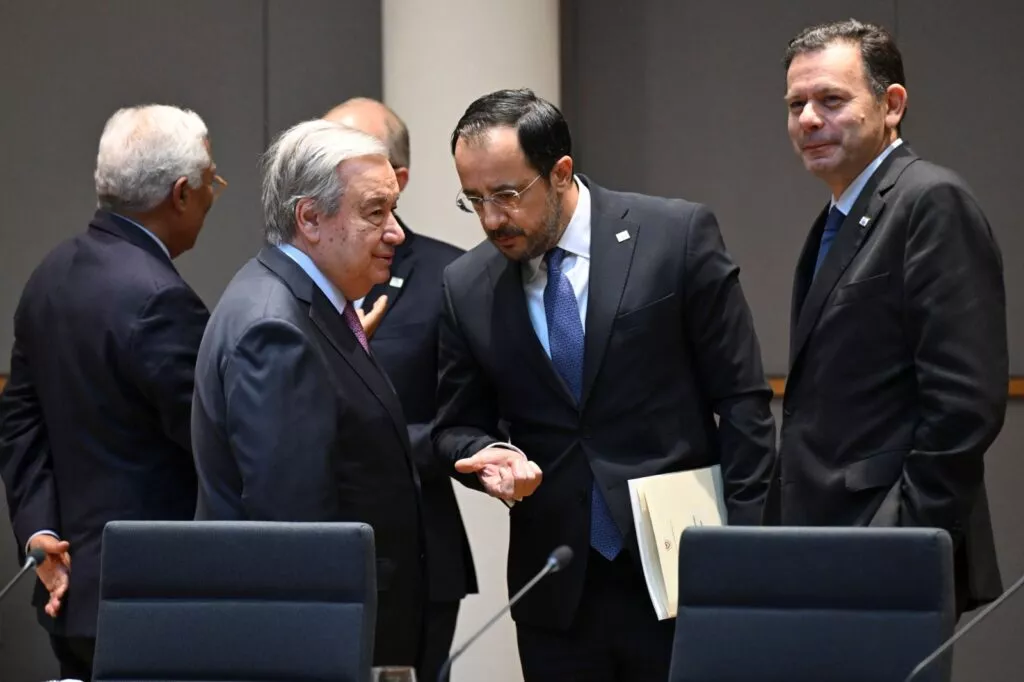
U.N. Secretary-General Antonio Guterres appears ready to pursue new steps on Cyprus even without Turkey’s consent, according to information relayed to Cyprus’s political leadership, as he seeks to leave behind a framework for talks before his term ends in December.
The effort rests on three specific steps, while President Nikos Christodoulides is described as the only willing interlocutor at present. Tufan Erhurman has aligned himself with Ankara’s line and is acting as a brake on any attempt at progress.
Guterres is willing to work with the parties involved in the Cyprus issue in an effort to break the deadlock and move the process forward. But his reported goal of leaving a settlement framework on the table by the end of his term appears difficult to achieve, with Christodoulides the only side currently presented as ready to return to negotiations.
The latest discussion between Christodoulides and Guterres took place in Brussels on March 18, on the sidelines of the European Council. It was the third time the two had met there in recent years, with last year being the exception because an informal enlarged meeting had already taken place in Geneva.
According to people familiar with the March 18 meeting, it was one of the best encounters Christodoulides has had with the U.N. chief. The lack of an immediate public statement from Nicosia did not reflect any negative outcome.
The United Nations later said Guterres had met in Brussels with “the President of the Republic of Cyprus and leader of the Greek Cypriot community, Nikos Christodoulides”, and that they had discussed the next steps on Cyprus as well as the situation in the Middle East.
What emerged from the Brussels meeting and from the subsequent briefing of Cyprus’s National Council is that Guterres wants to prepare a settlement framework that could serve as a starting point for his successor.
That framework is expected to be a short document without extensive detail, according to the same information. Its chapters are expected to broadly mirror those of the 2017 Guterres framework, though the U.N. chief is said not to intend to present it under that name.
Guterres wants the document to include the three “singles” – one sovereignty, one citizenship and one international personality or representation – as well as the powers of the central government, set out in greater detail than in the framework he presented at Crans-Montana in 2017.
It would also include a provision on the withdrawal of troops from the island, though without spelling out exactly how or when such a withdrawal would happen. The 2017 framework presented at Crans-Montana covered security and guarantees, territory, property, governance, political equality and effective participation.
The methodology now being attributed to Guterres rests on a three-step approach.
First, he wants the convergences reached at Crans-Montana to be reaffirmed, at a time when the Turkish Cypriot leadership and Turkey reject anything linked to the 2017 conference in Switzerland.
Second, he wants agreement on the three singles: one sovereignty, one citizenship and one international personality.
Third, if those two points are accepted, he is said to be ready to convene a new international conference and announce the resumption of negotiations.
Both Guterres and Christodoulides agree that the convergences achieved up to Crans-Montana should not be erased. However, Turkey remains firmly opposed to the preparation of any document recording those convergences, citing what María Ángela Holguín Cuéllar said in her latest meeting with Christodoulides.
Since the start of Christodoulides’s presidency, he and Guterres have broadly moved in the same direction on the need to restart talks. That shared approach helped lead to two multilateral meetings in 2025, in Geneva and New York.
After the March 18 meeting in Brussels, Christodoulides said he was pleased because “we have a common goal with the Secretary-General and that goal concerns the substance of the Cyprus issue, that is where our focus lies”. He added that Guterres also shared the view that there should be substantive progress before the end of his term.
A week later, Christodoulides spoke of the Secretary-General’s “clear political will” and of a plan for “how to move forward”. He said he hoped for a positive response from the Turkish side so that the intention could turn into “a specific substantive initiative” leading to the resumption of talks from the point where they broke off.
There is still no clear timetable from Guterres, according to sources close to the discussions. He has not specified when he might table the proposed framework or when he might call a new conference on Cyprus.
A preparatory stage could begin in the early summer months, regardless of what is being described as the current pause in Holguin’s role, which could end with the close of the Cypriot EU presidency on June 30.
A possible window for a new Cyprus conference could come in the autumn, immediately after the work of the U.N. General Assembly.
That, however, would depend on the stance of the Turkish side, which continues to play for time. Christodoulides is said to have made that point directly to Guterres in Brussels.
Those involved in the Cyprus issue broadly agree that Turkey does not want progress at this stage and instead wants to delay any move towards talks, while avoiding saying so publicly. Instead, Ankara is following its usual practice of using the Turkish Cypriot leader to block the process.
Ankara has instructed Erhurman to keep insisting on the rotating presidency as a precondition before any broader Cyprus discussions can begin, on the assumption that such a demand would prevent progress.
Over time, Erhurman has arrived at each meeting with Christodoulides in a harder and more negative mood than before, suggesting he is there to block movement rather than help reopen negotiations.
At their latest meeting, Erhurman was not only negative but confrontational, making clear that he was prepared to discuss only confidence-building measures.
On crossing points, Erhurman is angry because the Greek Cypriot side keeps pressing for the opening of a crossing point at Athienou, while Christodoulides is not discussing Mia Milia.
Erhurman may have been frustrated because his own meeting with Guterres did not go as well as he had expected, or because he did not get what he wanted.
According to information from various sources, Guterres appears to differ from Erhurman on two points.
The first concerns crossing points. The source says Erhurman’s insistence on opening only Mia Milia puts him at odds with Guterres, who had put forward a compromise proposal on the issue.
The second concerns confidence-building measures. Erhurman sees them as the only issue now on the Cyprus agenda, while Guterres does not believe they can by themselves lead anywhere, especially not to breaking the deadlock. On that point, he appears closer to the Greek Cypriot position that such measures can help but cannot become a substitute for a settlement.
Furthermore, Guterres made clear to Turkish Foreign Minister Hakan Fidan that references to a two-state solution on Cyprus should be removed from the discussion. It was not known what response, if any, he received.
What has also been noted for some time is Erhurman’s position that he does not speak of a bizonal, bicommunal federation, but neither does he openly advocate a two-state solution.

