


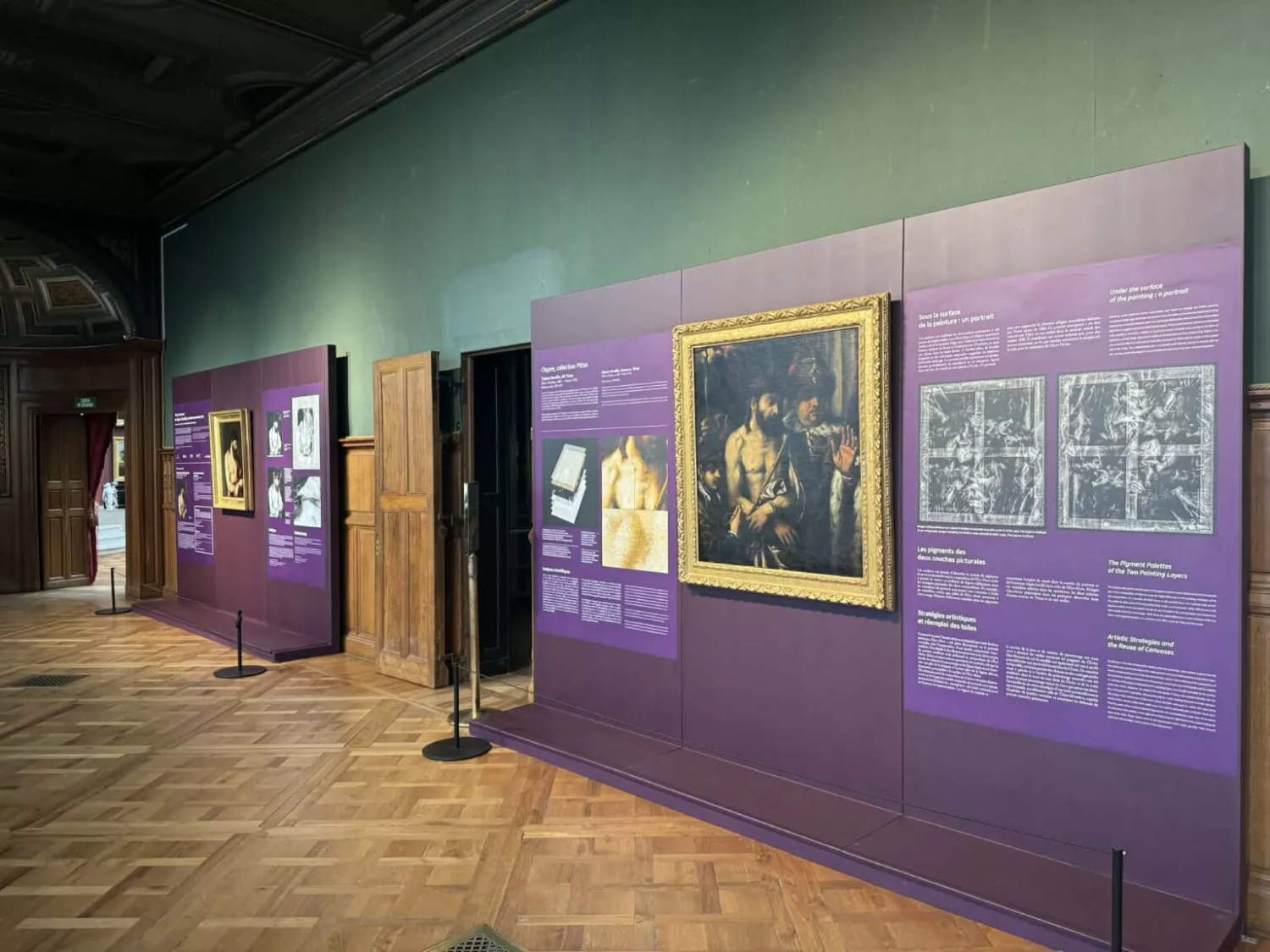
Research by the Cyprus Institute is at the heart of a major international exhibition at the Musée Condé in the Château de Chantilly near Paris, where scientific analysis of two Titian paintings has uncovered a hidden portrait and shed new light on the Renaissance master’s working methods.
The exhibition, titled “Titian, Ecce Homo: From Cyprus to Chantilly – Science in the Service of Art“, opened on 7 March and runs until 14 June 2026 at the Musée Condé, which holds France’s most significant art collection after the Louvre.

At its centre are two works by Titian (Tiziano Vecellio, c.1480–1576), both depicting the Ecce Homo — the moment Christ is presented by Pontius Pilate to the crowd before the crucifixion. The first, showing Christ alongside Pilate and two guards, comes from the Pitta collection; the second, depicting Christ alone, belongs to the Musée Condé.

Advanced imaging and materials analysis carried out by the Andreas Pittas Art Characterisation Laboratories (APAC Labs) at the Cyprus Institute, together with France’s Centre for Research and Conservation of French Museums (C2RMF), revealed previously unknown aspects of Titian’s technique and his Venice workshop.
Among the findings was a concealed portrait beneath one of the paintings, executed in a different orientation — a discovery that illuminates the practice of reusing canvases in Titian’s studio.

The final phase of the research employed a new multimodal scanner developed by APAC Labs in collaboration with C2RMF, the Foundation for Cultural Heritage Sciences (FSP) and France’s National Centre for Scientific Research (CNRS), enabling comprehensive material mapping of both works.

Speaking at the opening, Musée Condé director and chief curator Dr Mathieu Deldique said the collaboration with the Cyprus Institute opened new avenues for interdisciplinary research in art history. Dr Michel Menu, an associate researcher at APAC Labs and former head of research at C2RMF, highlighted the importance of scientific and technological methodology to understanding the work of artists such as Titian.
The exhibition has drawn strong interest from French audiences and media, with Le Monde publishing an extensive piece on the scientific findings. Guided tours led by researchers are planned throughout the run. Further collaborations with French research institutions are in the pipeline, with the support of the French Embassy in Cyprus.

