


Within hours of the drone strike on RAF Akrotiri, the phones started ringing. Within days, some of the most capable warships in Europe were heading towards Cyprus. What has assembled in the Eastern Mediterranean is not just a show of solidarity — it is a layered, combat-ready defensive force unlike anything seen in these waters in decades.
Greece moved first, deploying frigates and fighter jets before the smoke had cleared. France, Spain, and the Netherlands followed. Italy, Germany, and the United States are weighing further contributions. Britain is reinforcing its own fleet to protect the bases that were struck. Here is what is now out there — and what each asset can do.
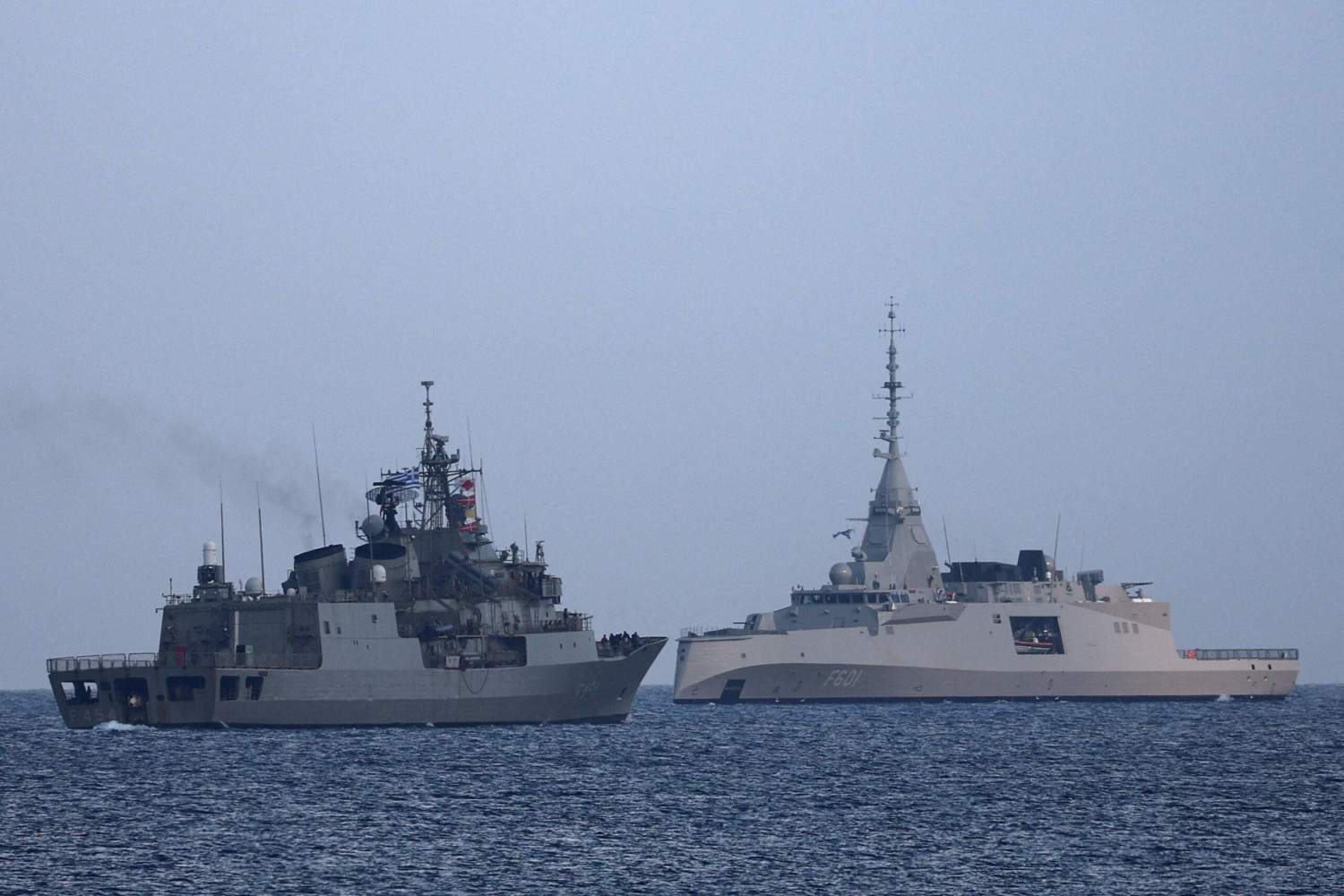
Frigate Kimon — Greece’s most advanced air defence platform
The Hellenic Navy’s Kimon (F601) is a Belharra-class frigate and one of the most capable anti-aircraft platforms in the Greek fleet. Its Sea Fire AESA radar — the same family of technology used in the most advanced Western fighter jets — can track multiple aerial targets simultaneously across a wide area. Its 32 vertical launch cells carry Aster 30 missiles, giving it the reach to engage threats at long range before they get anywhere near the coast. The Kimon is not just a warship; it is a floating air defence network designed to protect everything around it.
Frigate Psara — the drone killer
If the Kimon is the long-range shield, the Psara is the scalpel. What makes this MEKO 200HN-class frigate particularly relevant to the current threat is the Centaurus system — a Greek-developed electronic warfare solution that does not shoot drones down but switches them off. By jamming their communication and guidance signals, Centaurus neutralises UAVs without firing a round. It has already been tested in combat during Operation ASPIDES in the Red Sea against Houthi drones. In a conflict defined by cheap, hard-to-detect unmanned aircraft, the Psara may be the most tactically significant vessel in the fleet.
Spanish frigate Cristóbal Colón — Aegis power and humanitarian reach
Commissioned in October 2012, the Cristóbal Colón is the newest and most advanced frigate in Spain’s Álvaro de Bazán class. At 6,391 tonnes and approximately 146 metres long, she carries the same Aegis Combat System used by the US Navy, paired with AN/SPY-1D(V) radar capable of detecting and tracking airborne, naval, and missile threats simultaneously. Her 48 vertical launch cells carry SM-2 and ESSM missiles; eight Harpoon missiles handle surface threats. She can hit 28 knots and carry a Seahawk or NH90 helicopter. Built for international deployments, she also has dedicated capacity for humanitarian operations and civilian evacuations — a capability that may prove as important as her weapons.
HMS Dragon — Britain’s aerial threat specialist
The Type 45 destroyer HMS Dragon (D35) is one of the Royal Navy’s most formidable air defence platforms. At around 8,000 tonnes, she is the heaviest vessel in the assembled force. Her SAMPSON radar can detect threats at extreme range, feeding targeting data to her Sea Viper missile system — which fires Aster missiles capable of intercepting everything from ballistic missiles to low-flying drones. HMS Dragon regularly escorts aircraft carriers into contested waters. Her arrival next week signals that Britain is treating the protection of its bases in Cyprus as a serious military commitment, not a diplomatic gesture.
French frigate FS Languedoc — combat-proven cruise missile carrier
The FS Languedoc (D653) is an Aquitaine-class FREMM frigate and one of the few vessels in this fleet with a confirmed combat record in the region. In 2018, she became the first French frigate to fire MdCN cruise missiles in anger, striking targets in Syria alongside American and British forces. Built in 2011 and launched in 2014, she specialises in anti-submarine warfare but is capable across multiple roles. Her presence — alongside the redeployment of the aircraft carrier Charles de Gaulle to the Eastern Mediterranean — signals the depth of France’s commitment to the operation.
Dutch frigate HNLMS Evertsen — Aegis-equipped fleet defender
The HNLMS Evertsen (F805) arrived in the Eastern Mediterranean after being redeployed from the Baltic Sea, where she had been operating with the French carrier Charles de Gaulle. The fourth and final vessel of the Dutch Navy’s De Zeven Provinciën class, she was commissioned in June 2005 and displaces around 6,050 tonnes. Like the Spanish Cristóbal Colón, she carries the Aegis Combat System with 48 vertical launch cells for SM-2 and ESSM missiles, and Harpoon anti-ship missiles. She is designed to defend an entire fleet formation — and she is doing exactly that.
F-16V Viper — mobile air cover
The four F-16V Viper jets now based at Andreas Papandreou airfield are not standard F-16s. Configured to Block 72 standard — the most advanced version in the Hellenic Air Force — they carry the AN/APG-83 SABR AESA radar, which can track multiple targets at once while the pilot is already engaging one of them. Armed with AIM-120 AMRAAM beyond-visual-range missiles and AIM-9 Sidewinder short-range missiles, they are built for interception. Where the frigates provide a naval shield, the Vipers provide the speed and reach to intercept threats before they reach Cypriot airspace.
Wildcat helicopters — eyes and weapons at sea
Operating from HMS Dragon, the AgustaWestland AW159 Wildcat helicopters extend the fleet’s reach beyond what radar alone can see. Used by British forces for surveillance and anti-submarine warfare, they carry advanced maritime sensors and can be armed with Martlet and Sea Venom missiles for use against fast boats and naval targets. An evolution of the Westland Lynx, the Wildcat is fast, manoeuvrable, and capable — the eyes of the fleet when the horizon is not enough.
Read more:

