


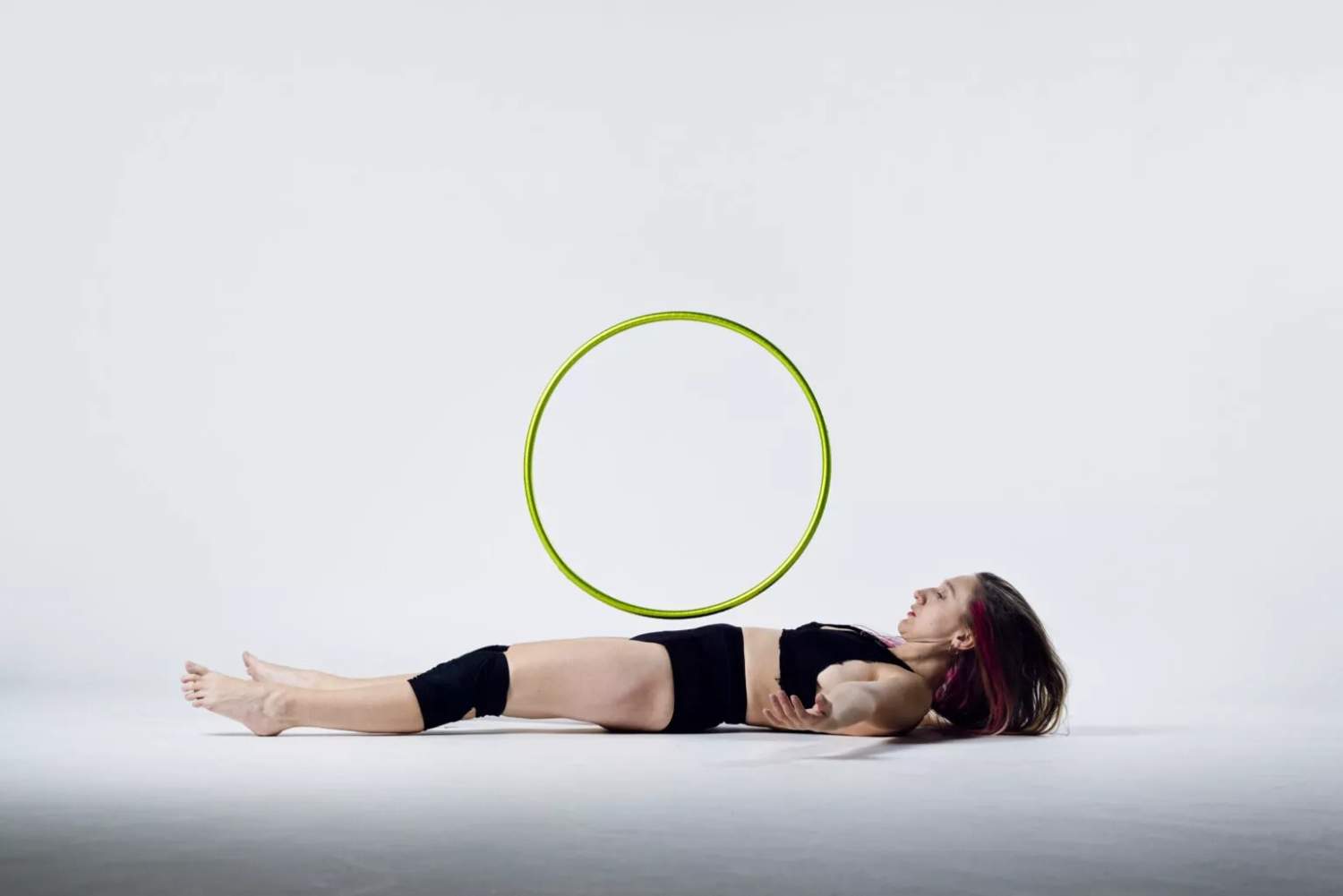
Using circus, spoken word, humour, tragicomedy and raw physicality — and with her own daughter on stage as a living part of the theatrical reality — award-winning performer Marianna De Sanctis comes to Cyprus for the first time to present her signature show Mother. Woman. Artist., as part of the 3rd Cyprus International Theatre Festival (CITF).
A pioneer of contemporary circus who is based permanently in France, De Sanctis stands on stage simultaneously as mother, woman and creator, in a work that dismantles the boundary between life and art.
The stage operates as a universal existential statement and an act of awakening, with De Sanctis making clear that motherhood and work are not competing demands to be “reconciled” — they are a single, unified reality. Perhaps, too, a reminder that art is not made in sterile environments.
When and how did you realise that fragility could be a position of power rather than exposure to danger?
Fragility became very clear to me the moment I accepted that I was fragile. I found myself constantly pushing to appear strong, resilient, to hide mistakes, imperfections, and the harm I had suffered. In the country where I was born, people are ashamed even to admit they are ill. Shame is the enemy of fragility. For me, it became clear when I decided to speak up, to find my voice, and especially when I started doing circus. There, I realized that my physical and artistic expression was not a technique — it was simply what was happening inside me. I never moved for the pleasure of physical activity. I don’t like working out, running, or all those things you do at the gym. I moved to bring out the emotions that filled me. At a certain point, it became clear that emotional fragility, or any fragility, could become a source of strength. Furthermore, once you expose yourself, danger no longer makes you fragile. People may look at you with pity or respect, but they notice you. Being noticed gives you value.
Do you feel that contemporary art is under pressure to explain, heal or resolve?
I’m not sure if contemporary art itself is under pressure, but the artist certainly is. Art, whatever its form, has always aimed to communicate something. Whether you create work dealing with hard themes or soft ones, there is always a political message behind it. Contemporary art shows what exists in society, highlights problems, and suggests what could be done. Even behind a children’s show, this can exist — a performance can entertain, be fun, make people dance, and still carry a political message. One of the best examples is what Bad Bunny did at the Super Bowl.
Under what terms?
It was an incredible show, one of the best I’ve personally seen, and it was political, even while being outstanding entertainment. The artist is under pressure simply by taking a position. Going on stage and expressing your perspective puts you in a position of fragility. Everyone watching can have an opinion, positive or critical, and that forces you to constantly reassess and recreate yourself — which is, in the end, the beauty of being an artist. I believe anyone can be an artist if they have something to say and want to express it. The artist is not inherently special; they are someone who has become aware of something. Contemporary art can lose its authenticity when the artist must navigate institutions, grants, residencies, or write what is expected rather than what they truly believe. The risk is losing one’s own ideas, becoming a patchwork of others’ expectations.
What is more frightening for an artist today: hiding behind form, or standing on stage without it?
For me, both are frightening. Exposing yourself is a risk, but staying behind codes to meet society’s expectations is equally difficult. It is extremely challenging to be on stage, exposed, while respecting existing codes. I am often told: “You can’t say this,” “You can’t do that,” “This isn’t politically correct,” “This is too direct, too aggressive, unclear, or boring.” Whatever an artist does, it will be criticized. So what’s the point of being afraid of form or exposure? Both are risky. What scares me most is taking a position and being responsible for the impact of what I communicate. That is one of the greatest — and scariest — parts of being an artist.

What turns lived experience into political speech rather than confession?
Politics is about causes, often discrimination or violence. Most news stories focus on negative events; positive political stories are rare. My experience is a life, and my life is not unique. What I’ve lived through is common, and that has given me strength to speak. Taking a voice and saying, “I’m not special, this happens to many people,” and allowing the audience to hear it and recognize themselves, is witnessing. Witnessing is political. It’s like declaring before a judge that you’ve experienced violence or discrimination. On stage, it becomes collective sharing; the audience, even silently, can recognize themselves and identify with it. Change is collective but begins individually. I transform something in myself, communicate it, it becomes collective, and spreads. Changes are never made by one person alone — even powerful leaders have teams, delegations, spokespersons. Without collective support, no political change is possible.
Your daughter appears on stage with you. Is there a line, ethical or artistic, that you refuse to cross when life and performance overlap so directly?
This is a question I’ve never been asked before, though it’s implied whenever I bring my daughter on stage. Children should not be exploited, used, or mistreated. I never asked my daughter to come on stage. I asked her to record an audio for me to use in the performance, because the show is about my life, and my children are naturally part of that. I never force her to attend rehearsals or performances. Her life is her priority — not because she’s a child, but because she is a person with her own desires and expectations. She is free, with her own opinion. She has every right to say no. Her presence has always been voluntary. There are many ways for her to participate: appearing on stage, joining via Skype, sending a video, or simply providing an audio I play. Life and performance inevitably overlap, because I can only create from my own experience. All my creations — painting, music, text, poetry, or circus — come from what I know and feel.
Is the idea of “reconciling motherhood and career” fundamentally misleading?
I love provocative questions. For me, a mother can and should work. I am both at once. It’s absurd to categorize life into boxes: “Today I am this, tomorrow I am that.” We are multidimensional, full of good and bad sides. The idea of “reconciliation” exists because society separates things. Within me, they are not separate. My aim is to show that I am many things at once. Why should I make a show about reconciling something that is natural? We gained rights — we didn’t just stay home with children, we also went to work. But we continue managing almost everything at home, often more than our partners. Equal rights are meaningless if responsibilities aren’t shared. Fathers often work but do nothing at home. This is the double trap. I’ll turn the question around: is the question of “reconciling fatherhood and career” ever raised? For me, these are one and the same thing.

Who is actually disturbed by children in the theatre: the performance, or the rules we’ve internalised?
Children are noisy, unpredictable, uncontrollable. Everyone fears a little human who doesn’t follow the norms. Society boxes us in and demands we be predictable, controllable. What frightens me most is that children are disciplined to fit codes, to behave like adults, not to be themselves. Even I sometimes catch myself repeating comments I’ve internalized from films, advertisements, and repeated social messages. Children cannot fully adhere to the rules of a theatre — they are unpredictable. It worries me that theatres haven’t adapted to allow children freedom without disturbing the show. Society has imposed constant control; there’s no space for growth or understanding. This is also why I became an artist: I love unpredictability.
Your work balances between documentary and poetry. Do you ever fear being read as a “case study” rather than as an artist?
I love this idea. I am an artist, and I feel like one. People may interpret me differently — that’s fine; interpretation is subjective. Everything can be studied. Life itself is a study. Humans always try to make sense of what they see, categorize it, understand it. For me, a “case study” is a natural defensive mechanism of the mind: a way to intellectualize what is incomprehensible. But how I feel is clear — I feel like an artist. I don’t need to justify that. People can see me however they want. If they imagine I’m a victim or crazy, that doesn’t matter. My purpose is achieved if they think, imagine, or feel something. Understanding can be a trap. If we fully understood death, it would drive us mad. Not knowing allows us simply to live. For me, art and creation should be seen as a whole life: you don’t know where you are going, but you are living.
Do you think audiences today are willing to accept “shared responsibility” or do they prefer the safety of passive spectatorship?
I’m not sure if audiences are willing to accept shared responsibility. In any case, we are already part of it. Motherhood illustrates this: having children is a shared responsibility. They grow, interact with the world — and with me. It’s utopian to think we are not collectively responsible in life. If a spectator chooses passivity, that is their choice. But passivity doesn’t remove responsibility.
What is the biggest lie we still tell about what it means to be an artist?
Two things. First, being told you are an artist can make you feel you have access to special places, people, and opportunities. This is the trap. The biggest lie we tell ourselves is that we are special. Feeling special leads to feeling privileged, different, free to do as you wish — even to hurt others. That is not the case. Artists have the duty to take care of themselves first, and then to try to take care of the rest of the world.

