


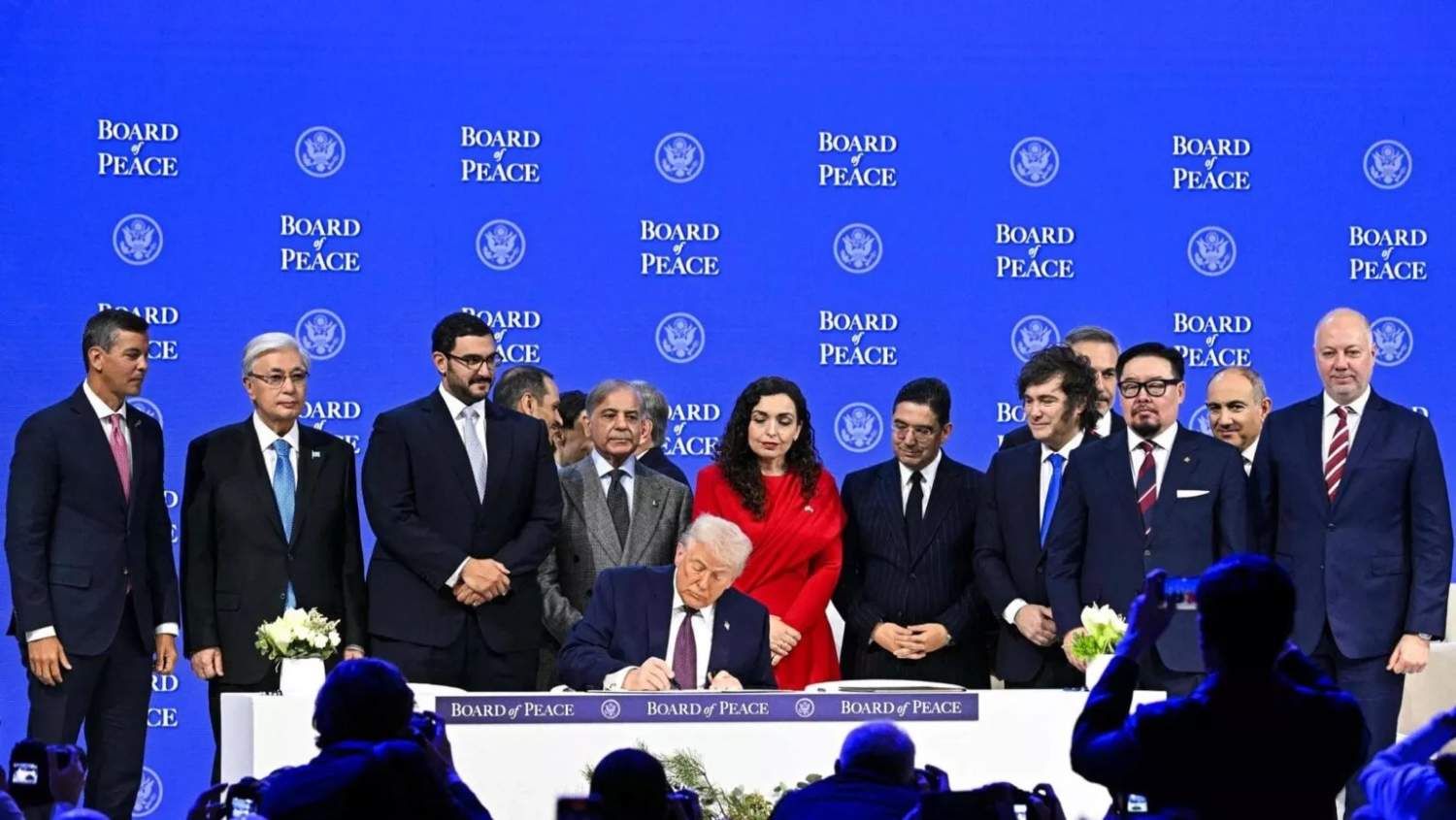
The invitation from the Oval Office was attractive, particularly since other countries in the region had received similar invitations.
But President Nikos Christodoulides’s decision not to attend the Davos ceremony that launched Donald Trump’s Peace Council underscored the difficult diplomatic poker Cyprus must play within a new geopolitical reality shaped by Trump’s actions.
Foreign Minister Constantinos Kombos’s statement last Wednesday revealed the scope of the diplomatic balance Cyprus must maintain.
The American initiative — a Peace Council born from the need to end the Gaza war but with broader ambitions — sits alongside European concerns about how it fits with international law and the United Nations.
Cyprus is caught in the middle. It is the EU member state closest to Gaza and currently holds the six-month rotating EU Council Presidency.
The response couldn’t be a simple yes or no. Nicosia had to weigh all the data before deciding.
Cyprus needed to consult European partners to understand their position, a requirement of both EU membership and the Presidency. It also had to speak with the Americans to gauge how a negative answer might damage bilateral relations.
Then there was Turkey. Nicosia had to consider how Ankara’s participation in the Peace Council might negatively affect Cyprus in future Gaza decisions. Cypriot diplomats know how Turkey operates in international forums to block Cyprus’s involvement.
All necessary contacts and consultations had to take place before any announcement. The complexity required time before the most advantageous decisions could be made under the circumstances.
Officials spent the week in continuous contacts in various directions. On Thursday, Christodoulides revealed at an extraordinary European Council meeting that he had been in contact with the heads of EU institutions and the prime ministers of Denmark, Italy, Croatia, Greece and other counterparts.
The Foreign Minister and Deputy Minister for European Affairs followed their own programme of telephone conversations with counterparts.
However, media outlets that strongly oppose the government’s foreign policy portrayed the consultations as an inability to make a decision. The same outlets had previously criticised Christodoulides over the invitation, suggesting he was following a “dangerous” foreign policy.
Avoiding a yes or no answer — because, as Kombos noted, things are not black and white — Nicosia chose to differentiate its approach.
Cyprus offered full support for the Gaza component, where UN Security Council Resolution 2803 provides an institutional framework, but said it would wait carefully for clarity on the broader Peace Council vision from both Washington and Brussels.
Through what the source describes as “dynamic caution” towards the Peace Council invitation, Nicosia did not treat the issue through static logic — either accepting or rejecting outright.
Instead, it ensured it remained in the dialogue and discussions about the region without isolating itself from an initiative that gathered significant regional players with whom Cyprus has developed strategic partnerships.
These strategic partners provided an additional safety valve for Nicosia’s decisions. With Israel, the UAE and certain other states inside the Peace Council, Turkey could not use this against Cypriot initiatives.
Turkey, despite President Recep Tayyip Erdoğan not attending Davos himself, ensured partner and satellite countries like Azerbaijan, Pakistan and even Kosovo were present.
Kombos was clear about Turkey’s role and importance, without ignoring or downgrading it. When asked whether there was concern about Turkey’s invitation and the role it might play within the Council, the Foreign Minister responded:
“It is not a matter of concern or anything else. It is a matter of the fact that the Republic of Cyprus, otherwise considered defunct by some, was included amongst these countries. Something happened which was evaluated on the basis of the logic I mentioned earlier, and we must also take another very serious parameter into account. That is the status of EU member state which, especially during this period, this semester, includes the Presidency of the Council. So these come once again to prove and highlight the reality on the ground in the international arena regarding the position and role of the Republic of Cyprus. Turkey is a large country which has the capacity for presence, a capacity which we also have following the invitation we received.”
As the Foreign Minister noted, “it is preferable to have to manage complex and delicate issues of this nature than to have been excluded in advance from such a process.”
This statement condenses the philosophy of current Cypriot diplomacy: presence at the table is a prerequisite for influence, and influence requires the ability to manage uncertainty without abandoning your values.
As the geopolitical order is being restructured, Cyprus finds itself in a position few could have predicted in the past: not as a passive observer, but as an active player in a region where every decision counts.
Costa vindicates Cyprus approach
Nicosia’s approach was indirectly vindicated by European Council President António Costa’s statements after the extraordinary summit in Brussels — the first since the Cypriot Presidency began.
Recording the EU’s common position, Costa said: “We have serious doubts about certain elements of the Peace Council’s charter related to its scope, its governance and its compatibility with the UN Charter. We are ready to cooperate with the US on implementing the Comprehensive Peace Plan for Gaza, with a Peace Council executing its mission as a transitional administration, in accordance with UN Security Council Resolution 2803.”
Costa’s statements show that Nicosia’s line was precisely within this framework. The European Council President also reminded the bloc that the EU is focused on implementing an ambitious agenda for its citizens: defence, competitiveness and building a more strategically autonomous Europe.
Costa had called the extraordinary summit in response to Trump’s threats regarding Greenland. Conveying the European leaders’ position publicly, Costa responded to Trump regarding his Arctic plans: “Europe and the United States have a common interest in the security of the Arctic region, particularly through NATO. The European Union will also play a stronger role in this region.”
Christodoulides, arriving at Thursday’s summit, stressed that escalation in relations benefits neither EU member states nor the US but is against everyone.
In his statements, Christodoulides focused on five points: the correctness of Costa’s decision to convene the extraordinary European Council; full respect for the sovereignty and territorial integrity of the Kingdom of Denmark; the exchange of views, information and collective decision-making at EU level; avoiding escalation because it is against everyone, both the EU and the US; and confirmation of the Cypriot Presidency’s goal for greater autonomy.
As events have shown, the European Union’s autonomy is no longer a slogan but an issue that has risen high on the agenda of discussions both within Brussels and amongst member states. This may be partly due to Donald Trump’s actions helping European partners take an important step towards maturity.
Read more:

