The Gaza war may have officially stopped, but it remains an open wound. Clashes continue sporadically, and the second phase of the ceasefire is proving far harder to implement than the first. It includes thorny issues such as Hamas’s disarmament and the deployment of foreign military forces in Gaza. Yet the conflict’s ripple effects extend far beyond: Lebanon, Syria, and the increasingly hostile Israel-Turkey relationship are all directly affected.
Rear Admiral (ret.) Alexandros Diakopoulos of the Hellenic Navy and honorary commandant of Greece’s National Defence College spoke to Phileleftheros about the seismic shifts taking place across the Middle East. He emphasised that whilst weakening Hamas is necessary, it’s meaningless without a political solution. The two-state solution, he argues, is theoretically essential but practically unattainable. “For this to happen, Israel would have to make enormous compromises and accept a Palestinian state in its midst—one it will never trust. Meanwhile, the Palestinians would have to accept reduced sovereignty, as Israel will never permit full autonomy on defence and security matters. The two-state solution is therefore almost impossible in practice. And if it doesn’t materialise, the alternative is ethnic cleansing,” he said.
The wider implications span the entire Middle East. Israel’s relations with the Arab world are being tested. Post-war Syria is a fractured state, difficult to govern, where major regional and international powers have a vested interest in preventing another collapse. Iran appears isolated, with limited options and no prospect of returning to its pre-2023 strength. Recent mass demonstrations have exposed just how fragile the domestic situation is.
Diakopoulos also addressed broader geopolitical realignments: the Turkey-Israel rivalry, the recognition of Somaliland, and what these mean for Cyprus and Greece. The trilateral cooperation between Cyprus, Greece and Israel, he noted, is evolving into a potential defensive and energy axis. Yet both countries must think carefully about how deeply they want to become entangled in the Middle Eastern turmoil, understanding that shared interests don’t mean identical goals, and that a strategic relationship doesn’t constitute an alliance with absolute commitment.

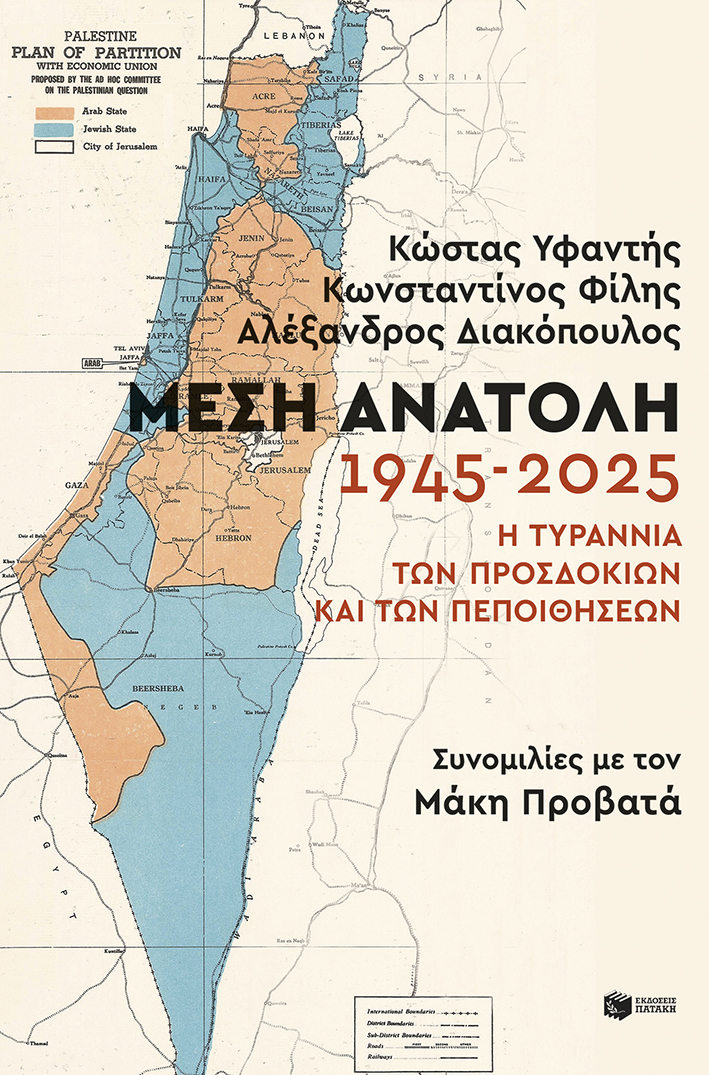
What does your book Decoding the Middle East (Patakis Publications) bring that’s new, and how does it reshape our understanding of the region?
The book doesn’t follow an academic discipline or linear thematic structure. It’s a series of discussions that unfolded in real time as the war in the Middle East was ongoing and evolving. Inevitably, as happens in live conversations, we often moved from one topic to another. This allowed us to cover not only the key regional issues but also a broad spectrum of international relations and the parameters shaping the emerging global order. I believe readers will benefit from the authors’ different perspectives and from seeing how our analyses evolved alongside events.
How is the situation in Gaza developing now, after this fragile ceasefire? Will the second phase of the American plan actually be implemented?
Despite the ceasefire, the situation remains extremely precarious and tense. Gaza may have dropped from the headlines, but the human consequences persist: hundreds of thousands of displaced people living in ruins and makeshift camps under harsh weather conditions. Both Israel and Hamas are reluctant to proceed to the next phase. The only reason the ceasefire hasn’t collapsed is American pressure. My assessment is that the second phase will begin with partial implementation—without complete Israeli withdrawal and without full Hamas disarmament. Reconstruction will start in Israeli-controlled areas to generate the necessary political momentum.
Let’s assume the American plan proceeds. As things stand, can Israelis and Palestinians actually find common ground? Can there be stability without a political solution or statehood for Palestinians?
Throughout our discussions for the book, my co-authors and I repeated, almost as a refrain, that long-term stability is impossible without the two-state solution. As I write on page 71: “For this to happen, Israel would have to make enormous compromises—removing hundreds of thousands of settlers and accepting a Palestinian state in its midst, one it will never trust. Meanwhile, Palestinians would have to accept diminished sovereignty, as Israel won’t permit full autonomy on defence and security. The two-state solution is therefore almost impossible in practice. And without it, the alternative is ethnic cleansing.”
Does weakening Hamas truly matter if the political and social conditions in Palestinian territories remain unchanged, especially given how many organisations are ready to take its place?
Weakening Hamas is necessary but insufficient. Remember, the organisation wasn’t created to build Gaza—it was created to destroy Israel. But it has deep political and social roots that can’t be eliminated through military means. As long as grievances persist, new organisations will emerge. Weakening Hamas creates a window of opportunity, but without a two-state solution, that window will eventually close.
The Syrian war has ended. How do you see things developing there, with the country having escaped Iranian influence and now led by a former jihadist?
The situation remains fluid and tense. After roughly 14 years of war, Syria is devastated: its economy destroyed, millions of refugees and internally displaced people, a mosaic of hostile religious and ethnic minorities. Governing it will be extraordinarily difficult, if not impossible. That said, apart from Iran, neither regional countries nor the US wants to see civil war reignite and the state collapse again. A regime similar to other Sunni states in the region would be welcomed by both Washington and Riyadh. There’s therefore strong interest in providing political and economic support to al-Sharaa. Despite his jihadist past, he’s systematically attempted to rebrand himself—and historically, he wouldn’t be the first former “terrorist” to become a “respectable” head of state. 2026 will be critical in determining whether he can keep Syria united and transition to a permanent political system.
Once again, there are mass demonstrations in Iran, this time over the cost of living. Is the Tehran regime genuinely at risk? What would it take for it to collapse?
These demonstrations differ from previous ones because they’re driven primarily by economics. Iran’s infrastructure is crumbling—as the 2025 water crisis showed—and the economy is in freefall. Everyone is suffering. That’s why the regime initially tried a more conciliatory approach. President Masoud Pezeshkian told Reuters: “We are to blame. Don’t look for America or anyone else to blame.” Much depends on whether the regime holds together: whether the regular army remains under Revolutionary Guard control, and which faction prevails in the succession race for Supreme Leader Ali Khamenei’s position. The stance of Iran’s minorities—Azeris, Kurds, Sunni Arabs—will also be crucial.
Iran has clearly been weakened since Hamas’s attack on Israel. What’s its position in the Middle East today? Can it return to its pre-2023 status?
It’s in a dire position and essentially isolated. During the 12-day war, it received no meaningful support from Russia or China, whilst its security services appeared to have been infiltrated by Israel. The “axis of resistance” has been severely weakened, along with the proxy forces that provided Iran’s so-called “forward defence”. Now there are two possible paths: either the regime hardens its stance and accelerates its nuclear programme—which will provoke US and Israeli retaliation—or it attempts controlled liberalisation. Either way, I believe the regime’s fate is sealed. The first path simply means more pain and destruction. But no, it won’t return to its pre-2023 strength.
Somaliland recognition: a dangerous precedent for Cyprus
Israel recently recognised Somaliland, a breakaway region of Somalia most people didn’t know existed. Do you see any connection to Cyprus, particularly regarding the Turkish-occupied territories?
Israel’s recognition of Somaliland—which declared independence in 1991—is fascinating but deeply concerning. It exposes both the geopolitical complexity of the region and the instability of the emerging international order. Regionally, it upsets the balance in the Horn of Africa and the Red Sea. Through Somaliland, Israel gains vital access to the Gulf of Aden, enabling more effective monitoring and countering of Houthi attacks and Iranian influence. It also strengthens ties with Ethiopia and the UAE, long-time Somaliland supporters. Conversely, it intensifies competition with Turkey, which backs Somalia and maintains a base there, and with Egypt, which has a fraught relationship with Ethiopia over the Grand Ethiopian Renaissance Dam. In short: Israel, the UAE and Ethiopia worry about growing Turkish and Iranian influence in the Red Sea, whilst Turkey and Egypt worry about Israel’s strategic Gulf of Aden presence.
Internationally, this recognition—combined with a potential Ukraine peace deal involving territorial concessions to Russia—sets a dangerous precedent for Cyprus. It undermines the foundations of international law on territorial integrity. These developments brazenly prioritise geopolitical expediency over international law, weakening the protection UN Security Council resolutions have afforded Cyprus.
The Turkey-Israel rivalry: a structural conflict
How is the Turkey-Israel crisis reshaping the region?
The Turkey-Israel rivalry has become structural, independent of individual leaders. The early 2000s wars and Arab uprisings severely weakened Arab states. Combined with America’s partial withdrawal and the decline of Pax Americana, this created a power vacuum no Arab state could fill. Iran initially capitalised on this. Its rivalry with Israel primarily, and the Sunni Gulf kingdoms secondarily, defined regional dynamics. Now that Iranian power has drastically diminished, space has opened for another non-Arab power: Turkey. Ankara is positioning itself as the chief defender of Muslim interests, portraying Israel as the greatest threat to regional stability.
Syria is the immediate battleground. Turkey backs al-Sharaa’s new administration to establish a Sunni axis, whilst Israel, wary of Turkish influence on its borders, supports minorities—Kurds, Druze—to prevent complete Turkish dominance. But the competition extends beyond Syria into energy and trade corridors: Turkey is promoting the “Development Road” (Iraq-Turkey) as an alternative to the Israeli-backed IMEC corridor (India-Middle East-Europe).
Interestingly, Israeli aggression has pushed Turkey and Egypt closer together. However, I don’t believe the Gulf states want Turkish regional hegemony, though they’d welcome a counterweight to Israeli power. Even al-Sharaa, careful not to antagonise Turkey, has no desire to see Syria become a Turkish protectorate—hence his courting of Saudi Arabia and the US. A new, extraordinarily complex geopolitical landscape is emerging, with direct implications for regional stability and alliances.
Following on from that, how does this affect Cyprus and Greece’s geopolitical planning in the Eastern Mediterranean?
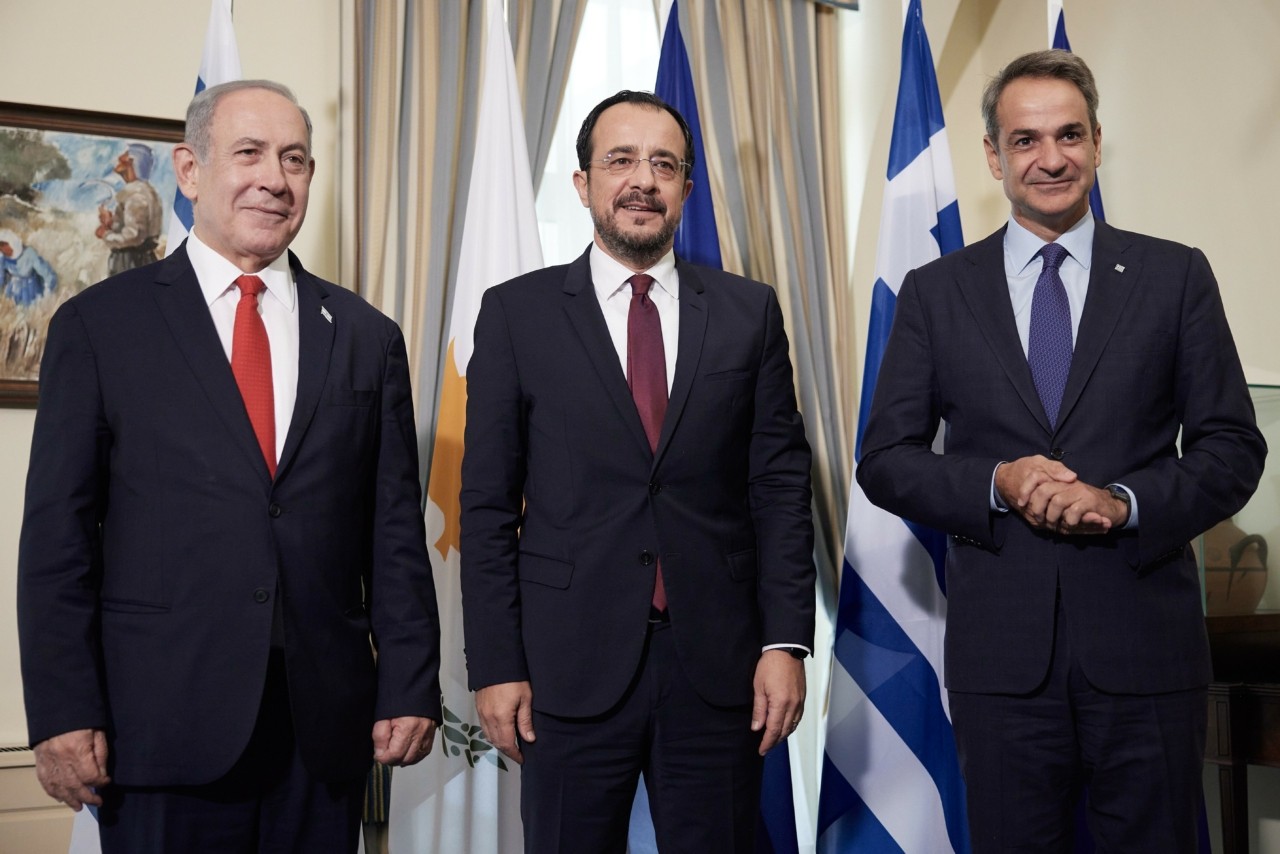
On one level, these developments favour Greek and Cypriot interests by strengthening their Eastern Mediterranean position. The trilateral cooperation with Israel is becoming a potential defensive and energy axis—a structural security arrangement that could redefine Western influence in the region. Common interests and a shared adversary form the foundation of strategic relationships. Greece and Cyprus provide Israel with much-needed strategic depth whilst serving as a bridge to Europe. Israel, in turn, supplies advanced weapons systems and connects both countries to the IMEC corridor and India.
But it’s not straightforward, and developments don’t occur in isolation. Greece and Cyprus must carefully consider how deeply they want to wade into Middle Eastern turbulence. The geopolitical landscape is immensely complex. Both countries must maintain balanced relations with the Arab world—Egypt, Jordan—which, despite energy cooperation, face domestic pressure over Israeli policy. Moreover, converging interests don’t mean identical goals, and a strategic relationship isn’t a formal, binding alliance. Both countries are EU members; Greece is also in NATO, a separate security architecture that includes Turkey. Then there’s the American factor. Finally, neither Israel nor Turkey benefits from pushing their rivalry to breaking point. They’ll likely remain competitors but achieve a pragmatic coexistence.