


All issues can be handled better through EU-US cooperation, European Parliament President Roberta Metsola told Phileleftheros, on the backdrop of a growing crisis over the control of Greenland and Trump’s tariff threats against Europe.
“We know that every serious global issue we must address is better faced when Europe and the United States act in sync with each other,” Metsola told Phileleftheros. “Each in our own way, with our disagreements, but guided and anchored in the values, freedoms and principles that will always define our relationship, that offer stability”.
Trump’s actions are occupying EU decision-making. Despite the de-escalation that appears after the US President’s more conciliatory mood in Davos, the issue continues to concern diplomatic circles across Europe.
Brussels-Washington relations stand at a critical crossroads during a period when Cyprus holds the EU Council Presidency.
EU seeks common line on Greenland
Different approaches exist within the EU, but there is common belief that Europe must have a common line and show determination over Trump’s proposals on Greenland, whilst simultaneously seeking to de-escalate the crisis.
EU-US relations were the main discussion topic in Strasbourg last week during the European Parliament session, which President Nikos Christodoulides attended to present the Cypriot Presidency’s priorities.
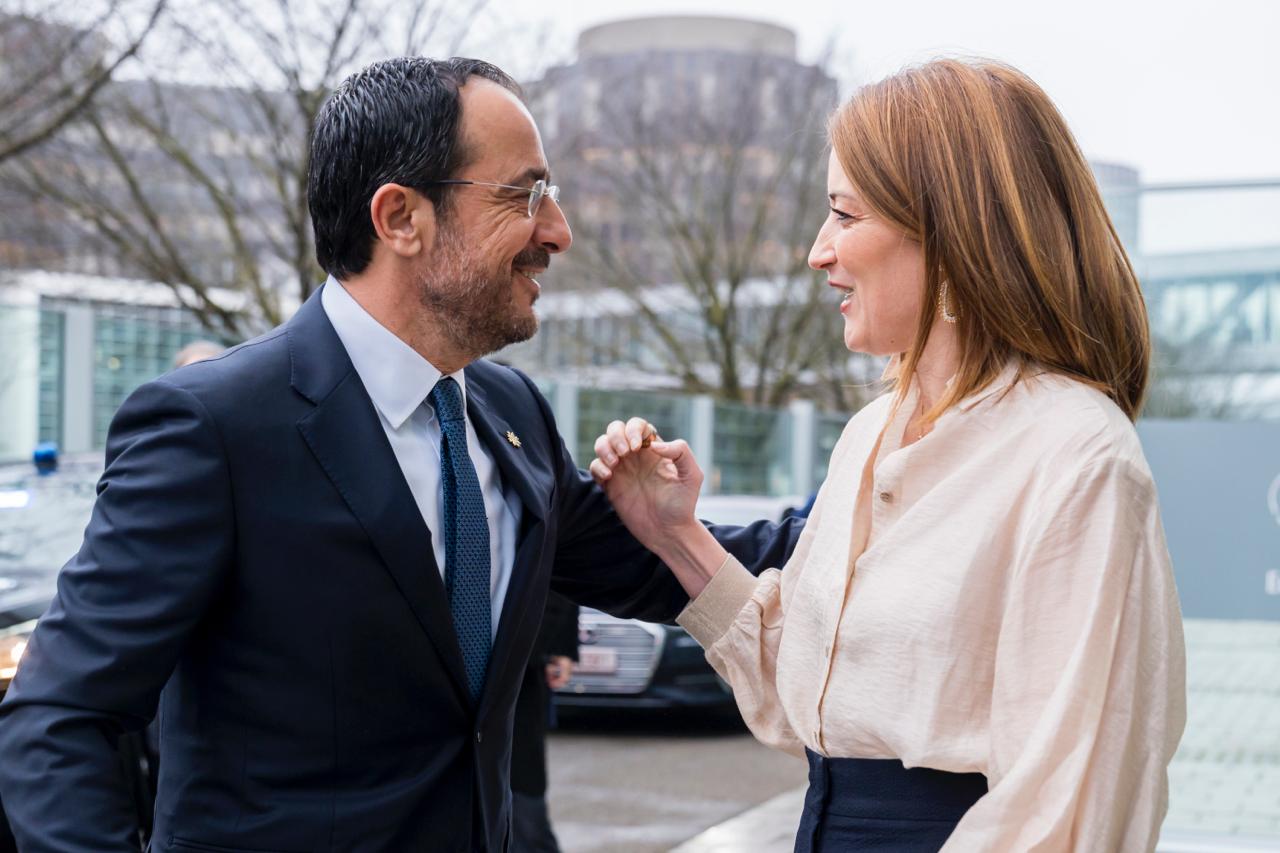
Christodoulides had a private meeting with the EP President, during which the Greenland issue was referenced. Almost all MEPs from all political groups addressed Trump’s threats and the issue raised regarding US policy towards the EU.
France and the Scandinavian countries are in favour of a more ‘hardline’ response to Trump. The French President Emmanuel Macron is particularly annoyed by the treatment he received from the US President.
Germany follows a more conciliatory line, though different views exist within the European Parliament depending on political groups.
Italy’s government maintains the most “mild” position towards Trump. The relationship between the country’s Prime Minister Giorgia Meloni and the US President is well known, which European leaders wanted to exploit in some way. According to some information, the Italian PM was asked to mediate through phone communication with him to create a new communication channel with the US President.
Trade deal “put in freezer”
Trump’s remarks in Davos were a positive sign that brought small relief, at least at this stage, as further escalation has been avoided. Nevertheless, the issue is not over and Europe wants to send messages.
The day before yesterday’s decision to suspend implementation of the EU-US trade agreement fits within this framework. The issue is being “put in the freezer,” with European leaders keeping it as a negotiating card in their arsenal.
Diplomatic sources from the European Parliament emphasised that there is a clear common line from all countries and all political groups on Greenland’s territorial integrity and that sovereignty over the region belongs to the Greenlanders and Danes. Only they decide about Greenland.
“I think all Europeans are very clear on this, at all levels,” an EP source indicated.
The source also noted that the EU’s reaction to Trump’s positions must not appear excessive, due to the unpredictability of his reaction, but Europe must be ready and prepared to respond if necessary.
“We must not in any way show that we are retreating. We must have a stable and determined position, but approach the issue calmly. Dialogue is always better. Let’s try to solve this Greenland issue primarily within NATO. If it concerns Arctic security, then NATO has a role and other countries are already doing things for Arctic security and no one has an interest in getting involved in a trade war. However, we must be ready that if there are tariffs he has threatened to impose, to respond,” the source told this newspaper.
“And I think this message has already passed quite clearly from all of Europe and from various players and also from Parliament now in these discussions we’ve had these days. We are ready and must be prepared to respond proportionally. If they impose tariffs on us, we will respond in kind. This was already prepared last year, when we remember last April, which was Trump’s big tariff day and there we had already prepared in advance, so there is already a package on the table.”
Cyprus Presidency role
Cyprus assumes the EU Council Presidency at a critical period for Europe-US relations, with diplomatic circles noting that the country holding the Presidency has a role to play as it chairs Coreper.
Coreper is the Council’s main preparatory body. All issues to be included on the Council’s agenda (except certain agricultural issues) must first be examined by Coreper, unless the Council decides otherwise.
Coreper comprises the “permanent representatives” from each member state, who are essentially their country’s ambassadors to the EU and express their government’s position.
“Everyone knows that those who really do the work and bring everything are the ambassadors. They’re the ones who really work on everything and prepare everything and prepare the Summits. I think that’s the key and the country that has the Presidency has this job, to prepare the discussion agenda. So Cyprus can play a role in this issue,” an EP diplomatic source said.
EU Security and strengthening the Union’s autonomy are basic priorities of the Cypriot Presidency, as presented during Christodoulides’s speech in Strasbourg last week.
Von der Leyen’s four axes
Statements by Antonio Costa and Ursula von der Leyen after last Thursday’s European Council essentially confirm the common line the EU wants to maintain towards the US President’s stance, both on Greenland and on tariffs.
European Council President Costa said “the goal remains the substantive stabilisation of trade relations between the Union and the US.”
He noted that Europe and the US have a common interest in Arctic security, “especially through cooperation within NATO,” adding that the Union “will also play a stronger role in this region.”
Referring to Denmark and Greenland, the Council President stressed they have the EU’s full support. “Only the Kingdom of Denmark and Greenland can decide on issues concerning Denmark and Greenland,” he said.
Commission President von der Leyen was even clearer, stating the EU appears in a better position regarding the Greenland issue.
The Commission President underlined that discussions among leaders allowed the EU to draw critical lessons from its collective strategy, noting that the European stance moved on four basic axes:
First: The clear and unquestionable expression of solidarity with Greenland and Denmark.
Second: The EU stood firmly by the six member states facing threats of tariff imposition, whilst simultaneously proceeding with active and multilevel diplomatic engagement with the United States.
Third: The EU engaged very actively with the United States at various levels. “We did this in a steady way but without escalation,” she said.
Fourth: EU preparation “with trade countermeasures and non-tariff tools, in case tariffs were imposed.”
Read more:

