


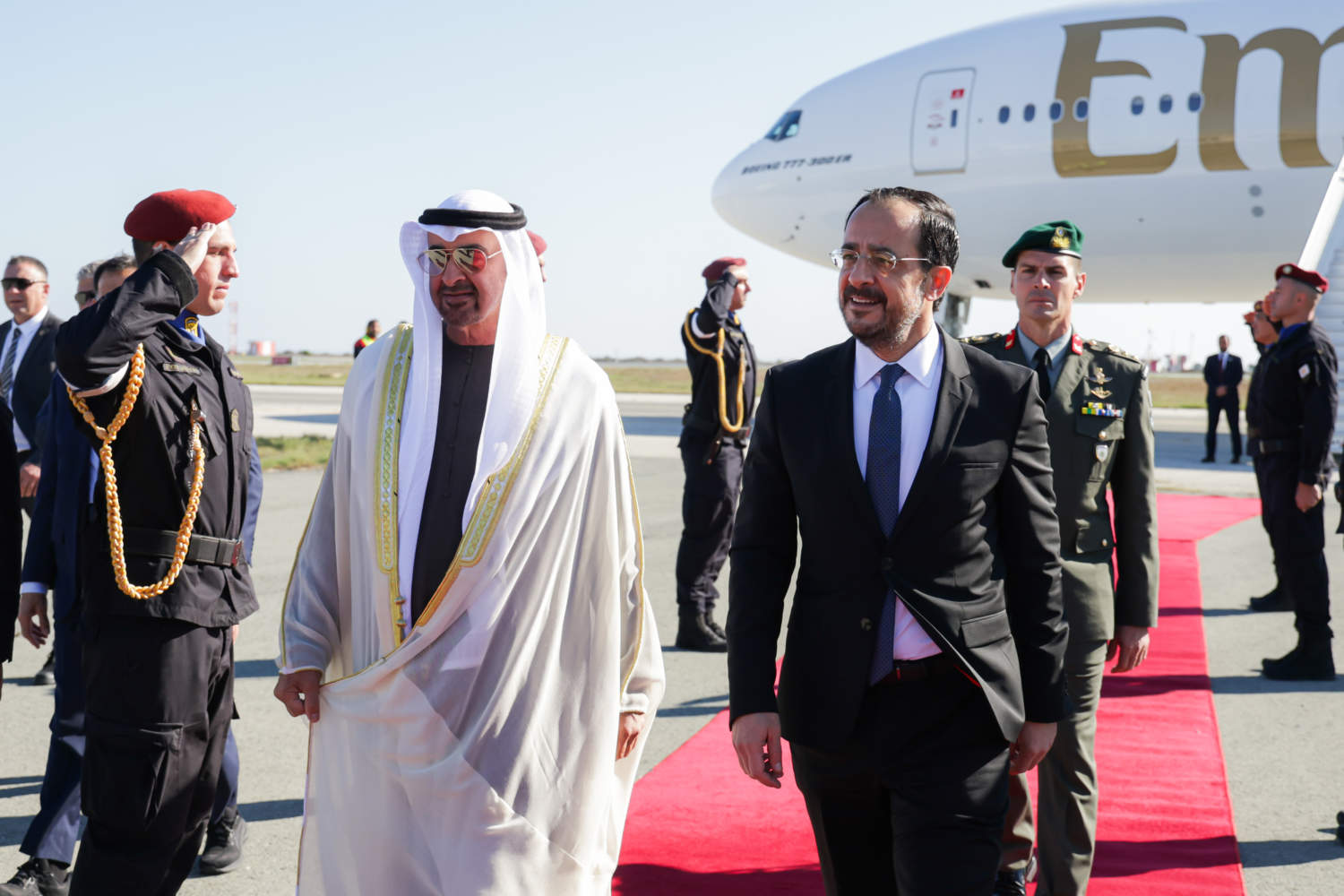
Iran’s Foreign Ministry summoned the Cypriot ambassador in Tehran on Tuesday to protest against what it described as “interventionist language” regarding its territorial integrity, following a joint statement between Cyprus and the United Arab Emirates (UAE).
The diplomatic rift centers on the long-standing dispute over three Persian Gulf islands—Abu Musa, Greater Tunb, and Lesser Tunb—which Iran controls but the UAE claims as its own.
Formal protest in Tehran
According to the Islamic Republic News Agency, Mohammad Alibek, Assistant Foreign Minister and Director General for the Persian Gulf at Iran’s Foreign Ministry, met with the Cypriot Ambassador, Petros Nacouzis, to deliver a formal written note of objection.
During the meeting, Alibek reaffirmed that the three islands are “integral parts of Iran’s territory,” describing Tehran’s sovereignty as “historical, undisputed, and effective.” He condemned any territorial claims as a violation of the fundamental principle of respect for national sovereignty and called on the Cypriot government to “take immediate steps to correct this serious mistake.”
The Cyprus-UAE joint statement
The friction follows an official visit to Nicosia by UAE President Sheikh Mohamed bin Zayed Al Nahyan on Sunday, 14 December 2025. In a joint statement with President Nikos Christodoulides, Cyprus backed the Emirati position: “Cyprus reaffirmed its principled support for the sovereignty of the United Arab Emirates, especially as regards its three islands, Greater Tunb, Lesser Tunb, and Abu Musa.”
The statement went further, reiterating previous EU-GCC declarations that call on Iran to “end its occupation” of the islands, framing the current situation as a violation of the UN Charter.
🇨🇾🇦🇪JOINT STATEMENT BETWEEN THE REPUBLIC OF CYPRUS AND THE UNITED ARAB EMIRATES
— Προεδρία της ΚΔ (@CYpresidency) December 14, 2025
The President of the Republic of Cyprus @PresidentCYP @Christodulides warmly welcomed His Highness Sheikh Mohamed bin Zayed Al Nahyan, President of the United Arab Emirates (UAE), for an official… pic.twitter.com/w61ndeM7zs
Regional context and ‘non-interference’
Iran has historically reacted sharply to third-party involvement in the island dispute. In October 2025, Tehran summoned several EU envoys after a similar joint statement was issued following an EU-GCC summit in Kuwait.
In Wednesday’s meeting, Alibek pointed to Iran’s “principled position of non-interference” in the sovereign matters of other countries, specifically referencing Cyprus’s own territorial issues. This was interpreted as a veiled reminder of Iran’s stance on the Cyprus problem, where it officially recognises only the Republic of Cyprus and supports its territorial integrity against the backdrop of the island’s 51-year division.
Key points of the dispute
The three islands, located near the strategic Strait of Hormuz, were seized by Iran in November 1971, just days before the UAE was established as a federation following the British military withdrawal from the region.
| Island | Context |
| Greater Tunb | Larger, controlled by Iran since 1971. |
| Lesser Tunb | Smaller, uninhabited; also controlled by Iran. |
| Abu Musa | Under a 1971 memorandum of understanding with the Emirate of Sharjah before full Iranian control. |
Read more:

