


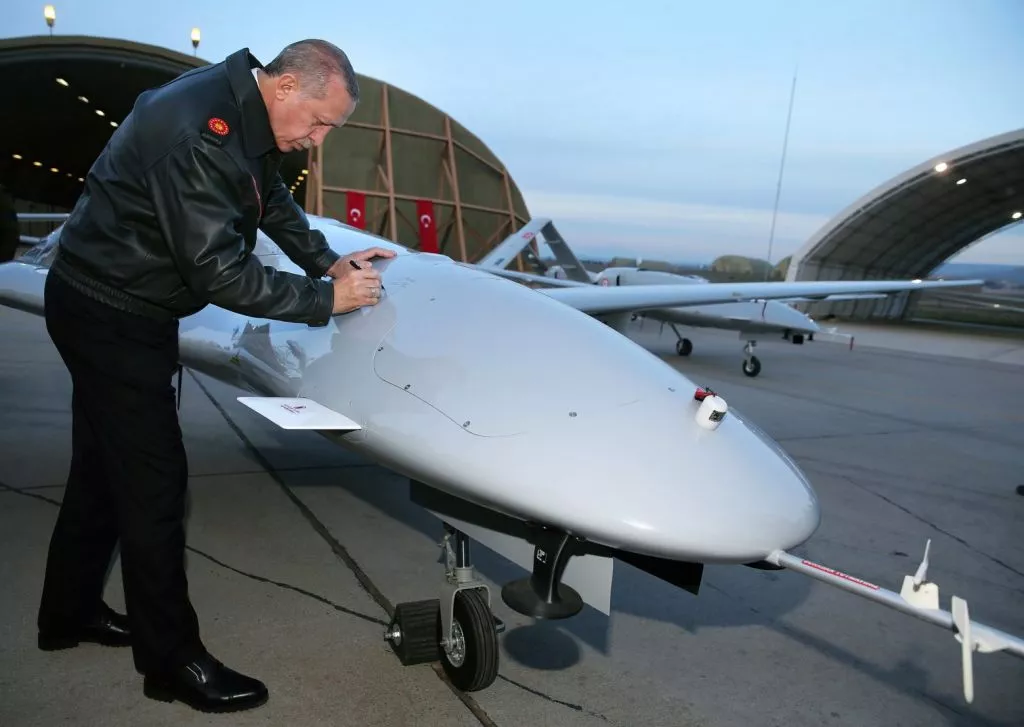
The defence industry of occupied Turkey is being used as a tool that enhances Ankara’s influence on a political and diplomatic level, creating relationships of dependence and military control over third countries. This control is established through the sale of weapons systems and military training.
It is clear that the Erdoğan regime has invested in the defence industry for geopolitical and economic reasons. The Turkish defence industry, which is experiencing a period of growth, is being used and operates as a vehicle for implementing Ankara’s expansionist plans. Simultaneously and in correlation with the above, it significantly boosts Turkey’s diplomatic influence. The map of countries with which it has dealings in this field, as well as its involvement in other sectors, confirms that the occupying power is following a plan that will establish it as a global power. And on this point, movements suggest a clear roadmap.
It is obvious that, aiming to achieve defence self-sufficiency through the production of its own systems, Turkey seeks to reduce its dependence on foreign markets. This remains a difficult undertaking today, as even its own weapons systems “borrow” components from industries in third countries.
Is Europe a Sponsor?
This systematic effort to strengthen and expand the industry requires “sponsors” to continue and upgrade. For this reason, in addition to sales to other countries, it is also seeking participation in the European SAFE (Sovereignty, Autonomy, Federation, Efficiency) initiative. That is, for the EU to subsidise the Turkish defence industry in one way or another. This is a request that may, for obvious reasons, be objectionable to Cyprus and Greece, but finds other partners in the Union ready to satisfy it. It is clear that Europeans, acting in their own interests and factoring in NATO, want Turkey within Europe’s security architecture, both as a buyer of systems and a partner in the defence industry.
The recent purchase of Eurofighters by Turkey and the bilateral agreements achieved are worth noting.
A “Great Power”
The data confirms that the occupying power is a significant force in the defence field. According to Al Jazeera, Turkey now controls 65% of the global drone export market, with Baykar alone accounting for 60%, as announced by the company’s chairman, Selçuk Bayraktar. The latter, who is Erdoğan’s son-in-law, states that his company exports drones to 37 countries and secures 90% of its revenue from international sales. “Our country holds 65% of the UAV export index. Baykar holds 60%,” he said.
According to the Stockholm International Peace Research Institute (SIPRI), exports have increased and now account for 1.7% of global arms exports, ranking Turkey 11th for the period from 2020 to 2024. Turkey’s exports reached 178 countries, marking a 103% increase compared to the 2015–2019 period.
According to TRT GLOBAL, data from the Center for a New American Security (CNAS) concerning the global military UAV market underscore Turkey’s rise to the top due to its strong performance in recent years. The report notes that drone technology has become increasingly widespread over the last 30 years, with a growing number of state and non-state actors acquiring these capabilities.
“Drone Diplomacy”
A BBC report noted that some have referred to Turkey’s export policy as “drone diplomacy,” serving strategic, economic, and diplomatic purposes abroad. For example, reports suggest that Baykar’s December 2024 agreement to acquire the Italian aerospace company Piaggio Aerospace is partly aimed at securing potential European procurement contracts in the defence sector. This acquisition, as well as others, will help Ankara participate in the processes shaping Europe’s security architecture. It will serve as an alternative route if the SAFE initiative does not proceed.
It is clear that the Turkish defence industry, being in a continuous process of enhancement and upgrade, is creating new realities. This is mainly because Ankara uses this weapon geopolitically. The concerning aspect is that the Ankara regime operates without limits. Equally worrying is that our European partners consider Turkey to be a part of the EU’s security architecture and are ready to do whatever it takes to achieve this.
It is obvious that Ankara has grasped the weaknesses of the Europeans and states it is ready to fill the gaps. At the same time, it is clear that the international system, both political and defence, is changing, power is being redistributed, and Turkey is stating its presence.
Model for Regional Security in Nicosia
The creation of a Regional Organisation for Security and Cooperation is reappearing—following the agreement on Gaza—and will be pursued in parallel with efforts for stability in the region. This idea was first developed by Nikos Christodoulides when he was Foreign Minister. The idea was not abandoned, but was temporarily halted by developments in Gaza, and is now being raised again.
It is recalled that President Christodoulides recently referred to it during his speech at the 21st Annual Economist Cyprus Summit, held in Nicosia. He said that “we are working—and the goal may sound ambitious—towards the maturing of the necessary political conditions for the establishment of a regional organisation for security and cooperation, a sort of OSCE or NATO for the wider Middle East, which will highlight the benefits of cooperation among all of us through the promotion of regional cooperation.”
This is a plan concerning our region, but it is clear that there is interest from the European Union and the United States. According to Nicosia, this idea concerns the formation of an organisation that is “inclusive and without exclusions, provided that the principles of International Law, good neighbourly relations, as well as the sovereignty and territorial integrity of every country are respected.”
It is noted that, along these lines, the Energy Forum has been established in the region, with the participation of Egypt, Cyprus, Greece, Israel, Palestine, Jordan, and Italy. This is a Forum that has proven that states with different interests can operate under the same roof.
For Nicosia, the creation of a Regional Organisation for Security and Cooperation can be instrumental in addressing regional problems and challenges, enhancing the prospects for utilising the opportunities that exist in the region.
Nicosia, formulating this idea and given that it maintains good relations with all countries in the region, will take initiatives to promote the endeavour.
It is clear that this plan cannot be viewed independently of the trilateral cooperation schemes of the countries in the region. The trilateral schemes, with the stable presence of Greece and Cyprus plus a third country in the region, remain—despite the difficulties caused by the war in Gaza—a “stable value.”
The proposal for the formation of a regional Organisation, like the OSCE, can develop cooperation, although the undertaking is difficult. Nicosia, however, could host such an Organisation, with its headquarters in Cyprus, as the only country that maintains good relations with all the others in the region.

