


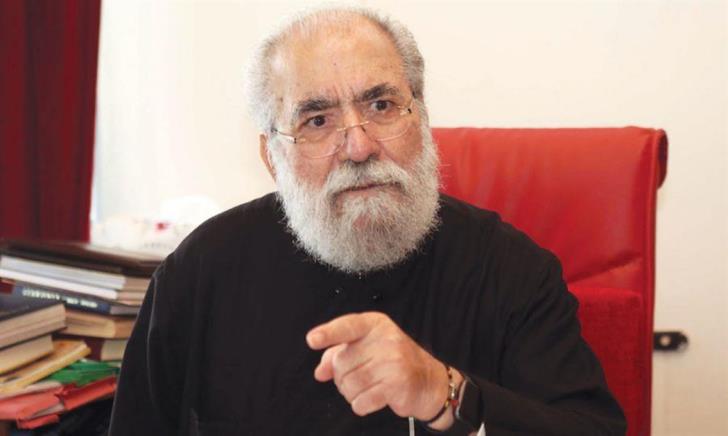
Former Bishop of Kition Chrysostomos has died aged 87 in Larnaca, two years after being convicted of indecent assault against a teenage girl in 1981.
Chrysostomos died from a respiratory infection at Larnaca General Hospital on Sunday after his health deteriorated. He had been transferred from a Larnaca clinic on Saturday, where he had been receiving treatment for several months.
The Larnaca District Court convicted Chrysostomos in June 2023 of indecent assault and sentenced him to 12 months’ imprisonment with suspension. The complainant, then aged 58, reported that the bishop had attacked her in his office in 1981 when she was 16 years old and had visited to collect an orphan’s allowance following her father’s death.
“He attacked me indecently on a sofa, kissed me and covered my mouth when I resisted,” the woman told the court during the months-long trial that concluded on 1 June 2023.
Following the conviction, the Holy Synod of the Church of Cyprus suspended Chrysostomos, expelled him from the Diocese of Kition, and stripped him of his right to conduct liturgical services. He was required to leave the diocese and moved to a house in Larnaca. Two criminal cases had been filed against him for rape and sexual harassment.
Chrysostomos contested both the court’s decision and the Holy Synod’s ruling, filing an appeal against the judicial verdict before his death.
The funeral service will be held on Thursday at 2pm at the Church of Saint George.
Court conviction led to suspension from Church duties
The legal proceedings against Chrysostomos lasted several months before the district court delivered its verdict. The complainant testified that she had approached the bishop seeking financial assistance as an orphan, only to be assaulted whilst alone with him in his office.
The court found the bishop guilty of indecent assault, a conviction that prompted immediate action from the Church hierarchy. Days after the 1 June 2023 ruling, the Holy Synod implemented disciplinary measures that effectively ended his ecclesiastical career.
Biography
Born in Palaiometochou in the Nicosia District on 4 June 1938, Chrysostomos (Machairiotis) entered religious life as a novice monk at the Holy Monastery of Panagia of Machairas in 1951. He was ordained a deacon in 1955.
After graduating from the Commercial School of Cyprus and the Pancyprian Gymnasium, he studied law at the University of Athens from 1962 to 1966, followed by theology at the same institution, graduating in 1970.
Chrysostomos was ordained a priest on 7 June 1970 and subsequently appointed archimandrite and chief legal officer of Machairas Monastery. On 24 October 1973, he was unanimously elected Bishop of Kition and ordained bishop two days later.
During his tenure, Chrysostomos represented the Church of Cyprus at numerous international gatherings. In June 1977, he led the Cypriot Church delegation to the World Conference on Religious Workers for Lasting Peace, Disarmament and Just Relations among Nations in Moscow.
On 15 September 2001, he represented the Cypriot Orthodox Church at the enthronement of former Patriarch of Jerusalem Irenaeus I at the Church of the Holy Sepulchre.
In June 2012, he presented Patriarch Kirill of Moscow with a reliquary containing a portion of the relics of Saint Lazarus during the patriarch’s official visit to Cyprus. The following month, he travelled to Russia to sign a cooperation agreement between the Russian and Cypriot Orthodox Churches for the development of joint pilgrimages.
In October 2013, Cyprus marked the 40th anniversary of his episcopal consecration, with then-President Nicos Anastasiades offering congratulations. A commemorative publication, “Journey through the Holy Diocese of Kition, 1973-2013,” was released to honour the occasion.
Chrysostomos served as a member of the Church of Cyprus delegation to the Pan-Orthodox Council in Crete in 2016.
On 19 June 2019, he submitted his resignation from the Diocese of Kition to the Holy Synod of the Church of Cyprus, citing reasons of old age. This resignation came two years before the criminal allegations against him became public.
Read more:

