


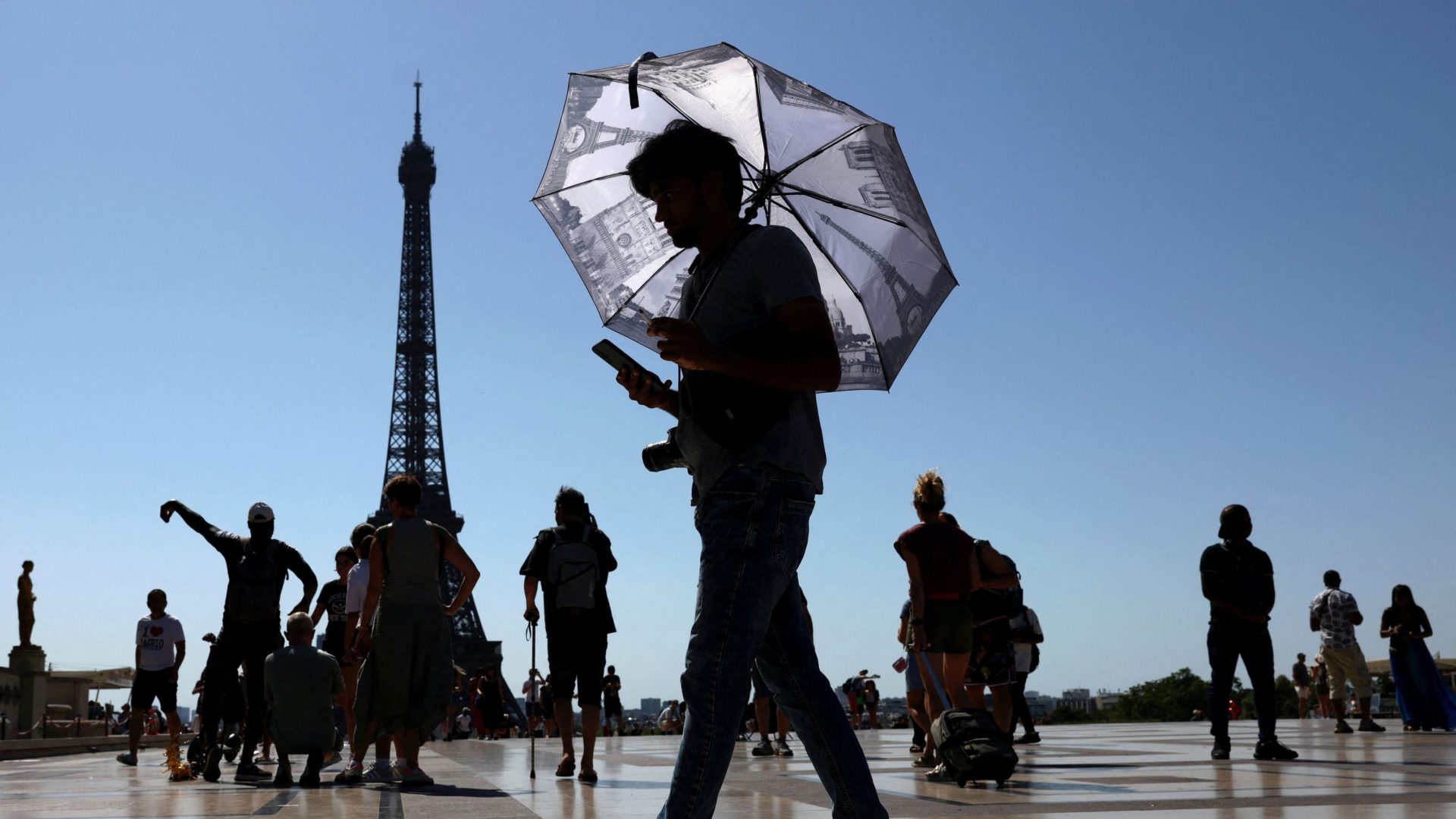
Most regions of Europe have experienced more than three heatwaves this summer. Rising temperatures are creating unbearable living conditions not only for northern countries unaccustomed to intense heat, but also for southern ones. The picture is similar elsewhere on the planet. The US experienced an unusual heatwave last June, China saw temperatures above 41 degrees Celsius recorded in May, whilst in India, an early, prolonged heatwave tested the limits of human endurance.
The situation isn’t going to improve, Andreas Matzarakis told Phileleftheros in an interview. He’s a professor at the University of Freiburg in Germany specialising in urban climatology, biometeorology and tourism climatology. As he explained, all the methods used to measure heatwaves show an increasing trend in both their frequency and duration. “The solution isn’t filling places with air conditioning. Extreme weather events test the system’s resilience—electricity supply and communications, for example. The collateral damage is now much greater, and what frightens me most are the consequences for other systems, other ecosystems, technical infrastructure,” he emphasised, noting that after 2050 in the Mediterranean we’re likely to see heatwaves lasting up to 50 days. In other words, we’ll be living through summers under heatwave conditions.
This means, practically speaking, that we must learn to live with extreme temperatures, since even if measures are taken to address climate change, it will take several decades before we see the first results. Actions are being promoted, he said, but it’s important to bear in mind that they also involve significant economic costs. “Perhaps a good solution would be to look to the past and see how our grandmothers and grandfathers built their houses to be warmer in winter and cooler, more airy in summer,” he noted, giving a characteristic example of how often the answers we seek are right before our eyes.

– Are heatwaves actually being recorded more frequently? And if so, how much more frequently and intensely in recent years?
According to measurements taken over many years—and I should note we have data from 1850 when meteorological services began developing—we see there’s an increase in heatwaves, in their intensity and duration as well as their frequency. All the methods used to count them show an increasing trend. And something equally important is that we all now have experience of heatwaves. In central Europe, where I live for example, one to three heatwaves per year were recorded, whilst now it’s predicted they’ll increase to three to five, possibly more. Regarding duration, from three to five days it will reach six to seven. What’s causing concern is that we might see heatwaves starting earlier, from April, and just as one ends another begins, with the result that their duration reaches 20 or more days. Both this year and last year India experienced 40 days of prolonged heat. This is dangerous because after three consecutive days of high temperatures we see an increase in mortality rates.
– Are there specific data for the Mediterranean region?
The Mediterranean hasn’t remained unaffected, and the figures clearly show this. According to Copernicus, the European climate monitoring system, on average one to two more heatwaves per year are being recorded. By the end of the century, we expect their intensity will also increase and they’ll last longer. After 2050 in the Mediterranean we’re likely to see heatwaves reaching up to 50 days—in other words, we’ll be living through summers under heatwave conditions.
– How is a heatwave actually defined?
To define a heatwave we use air temperature. For me, however, as a meteorologist this isn’t enough. We must add other factors such as humidity, atmospheric pressure, pollen count, radiation etc. It’s a cocktail with many factors. Also, it’s not just the situation during the day, but what happens at night too. It’s human nature—if we can’t sleep at night due to the heatwave, the next day we wake up with a background that grows as poor sleep continues along with high temperatures. And the consequences are increased hospital admissions and strain on public health. Heatwaves, unlike other weather phenomena, affect very large areas—they cover the entire Mediterranean, all of Western Europe—they don’t strike like rain, which affects much smaller geographical areas, a part of Nicosia, for example.
– How much worse will things get in future, considering few measures have been taken to address climate change?
The heatwaves we knew in past decades—such as in Greece in 1987 with 4,000 deaths—we could say were ordinary weather phenomena with little climate change. Now, the heatwaves we have are a mixture of normal meteorological conditions and climate change. What percentage climate change is responsible for isn’t so important—it possibly exceeds 30%. The magic number for a heatwave isn’t air temperature, but human temperature—around 37 degrees. The closer we get to and exceed this point, the more dangerous the situation becomes. And the solution isn’t filling places with air conditioning, which is essentially what we’re doing. Extreme weather events test the system’s resilience—electricity supply or communications, for example. The collateral damage is now much greater, and what frightens me most are the consequences for other systems, other ecosystems, technical infrastructure.
– Do you have data on how many people die each year due to heat and how much these numbers increase when there are extreme heatwaves?
This data isn’t easy to extract because, for example, the cause of death will be considered a heart attack and not the heatwave, even though it was the latter that caused it. If I must mention some figures, for 2024 it’s estimated we had an additional 30,000 deaths due to heat.
– Which areas and why show greater vulnerability to heatwaves?
Currently 50% of the world’s population is exposed to heatwaves, even in northern regions. I was reading recently and was struck by the fact that when temperature is above 20 degrees Celsius, every one-degree increase means a 2% to 3% reduction in productivity. I was saying, then, that wherever there’s large population concentration, there’s the greatest vulnerability, which means almost the entire northern hemisphere. The positive thing is that we now have very good warning systems for heatwaves.
– Infrastructure in northern Europe is traditionally built to withstand cold, whilst in southern Europe it’s built for heat. But we see northern regions being struck by heatwaves and southern ones experiencing extreme low temperatures. Is redesigning buildings and urban infrastructure feasible based on the new conditions imposed by climate change? And if so, how could this be implemented in practice?
For twenty years, action plans have been developed for unbearable heat and human health. This includes meteorological warning systems, plans for vulnerable population groups and training for the medical sector, whilst a large part concerns urban infrastructure. These are short-term, medium-term and long-term actions. The latter includes adaptation, though this requires attention. And of course we mustn’t forget that these solutions involve significant economic costs. Perhaps a good solution would be to look to the past and see how our grandmothers and grandfathers built their houses to be warmer in winter and cooler, more airy in summer. We simply use air conditioning, which requires more energy and the heat it produces is expelled outside buildings, creating a vicious temperature cycle. My suggestion is to find actions that are here and don’t require us to pay a lot to implement them.
Enormous impact on the economy
– What are the effects of heatwaves on the economy? Are there specific data or estimates for their economic footprint?
The impact is very large. I’ve already mentioned that productivity decreases with every degree the temperature rises. The consequences are cascading. There’s great strain on the energy system, on tourism. And what concerns me is that whenever we talk about heatwaves and tourism we usually refer to tourists and leave out all those workers in the tourism industry. There are costs when construction sites close, when businesses are forced to stop their operations. Germany applies the 26, 30, 35 system. That is, at 26 degrees Celsius workers must begin to be protected, at 30 degrees employers must take measures, and at 35 degrees you’re entitled to stop your work. Perhaps something similar should happen in other countries, though I can’t imagine similar measures being taken in sectors like tourism.
– We increasingly hear that we must learn to live with heatwaves. What exactly does this mean?
Living with heatwaves means that above all we must adapt and secondly seek to address, to the extent we can, the causes that create them. I’m sceptical when I hear experts saying this must be done or that measure must be taken, because all these will have results in 50 to 60 years. And what happens in the meantime? We must adapt and change our behaviour. And education plays an important role in this, which from early on must include all the information and all the actions we take.
– Recently new terms have entered our lives. What are thermal waves, thermal domes and what are their differences from ‘traditional’ heatwaves?
To answer this I’ll say that language evolves and doesn’t remain the same. Also, we often adapt scientific terms from English into Greek. In Greek, ‘heatwave’ is the thermal wave and we use this term to refer to heatwaves. A thermal dome is when we have a subtropical cyclone (high level pressure) that’s stable and where high temperatures are recorded for many days. There’s a tendency to give names to heatwaves as we do with cyclones, and I think all this money spent on naming weather phenomena might be better used for actions to address them.
– What measures must the state take to address thermal waves? And how can citizens protect themselves on a personal level?
Above all, cooperation between the state and institutions, bodies and all sectors of the economy is needed, starting with agriculture, tourism, health, social and civil protection. At the same time, it’s important for each of us to know what to do when there’s a heatwave. To know if there’s a warning and react accordingly—for example, reduce activities and be careful about food consumption, avoid the sun. And above all, help our fellow citizens. If, for example, there’s a block of flats without a lift in our neighbourhood, let’s see how we can help elderly people who need to get food or their food and shouldn’t go out. Cities certainly need more greenery, we want more water points, but all this doesn’t help people who can’t or shouldn’t go outside. Equally important is cooperation between local bodies and central government both for warning and for addressing heatwaves.
Warnings when needed
– Often, the Department of Meteorology in Cyprus receives criticism for its forecasts and the frequent warnings it issues. How often and how should warnings be made?
Warnings should be issued when conditions require it. When there are fewer than necessary, it’s dangerous if something happens. If there are many and something happens, nobody complains. But if there are warnings and nothing happens, then voices are heard. For heatwaves great care is needed because as I said they cover very large geographical areas. And perhaps warnings should include not only intensity and duration but also the percentage of population that might be affected. But this too is risky because if I say, for example, that 20% will be affected, this will create panic. In any case, for a warning to be issued certain criteria must exist. When these exist, issuing it is unavoidable, even if this happens frequently. And as I tell my students, it’s good to think about the consequences if we don’t have warnings.

