


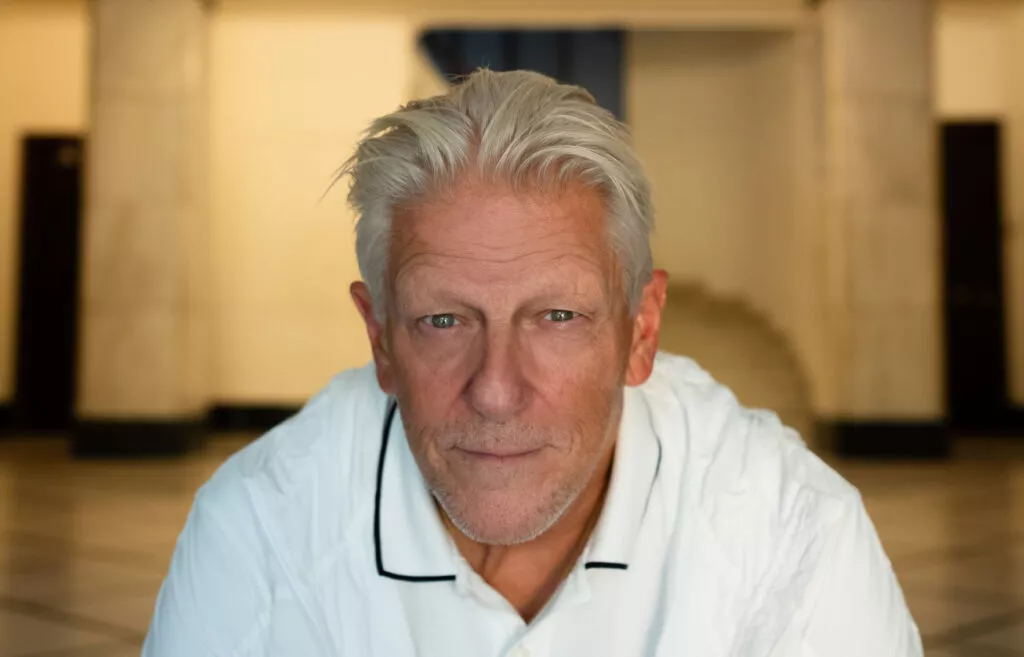
Belgian director and visual artist Jan Fabre speaks on the occasion of his arrival in Cyprus and addresses questions regarding the boundaries between art and ethics.
He arrives in Cyprus with his performance “Io sonno un errore (I am a mistake)” amid intense discussions about the limits of art and ethics, and concerning the responsibility and safety of performing arts professionals. His participation in the International Theatre Festival of Cyprus has provoked reactions that led to the withdrawal of Cypriot productions. Fabre was convicted in 2022 for sexual assault, harassment and violence artists he employed and worked with.
In his country and on the international scene, Jan Fabre remains a much-discussed, controversial and leading figure in the field of visual and performing arts. He views art as an exploration of psychological and physical boundaries. In an interview with Phileleftheros, the Belgian creator expresses his positions and addresses the issues that have arisen, while discussing the philosophical principles around his work, the importance of provocation, the relationship between aesthetics and ethics, and the professional policy now being followed in his group to ensure an open and safe working environment.
Τhe title itself (Io sonno un errore) suggests an embrace of imperfection, of failure even. How does the core idea behind this work connect to your broader artistic philosophy?
I wrote the text in 1988. In retrospect it feels like a very visionary text. The text also talks about my position as an artist on the public platform.
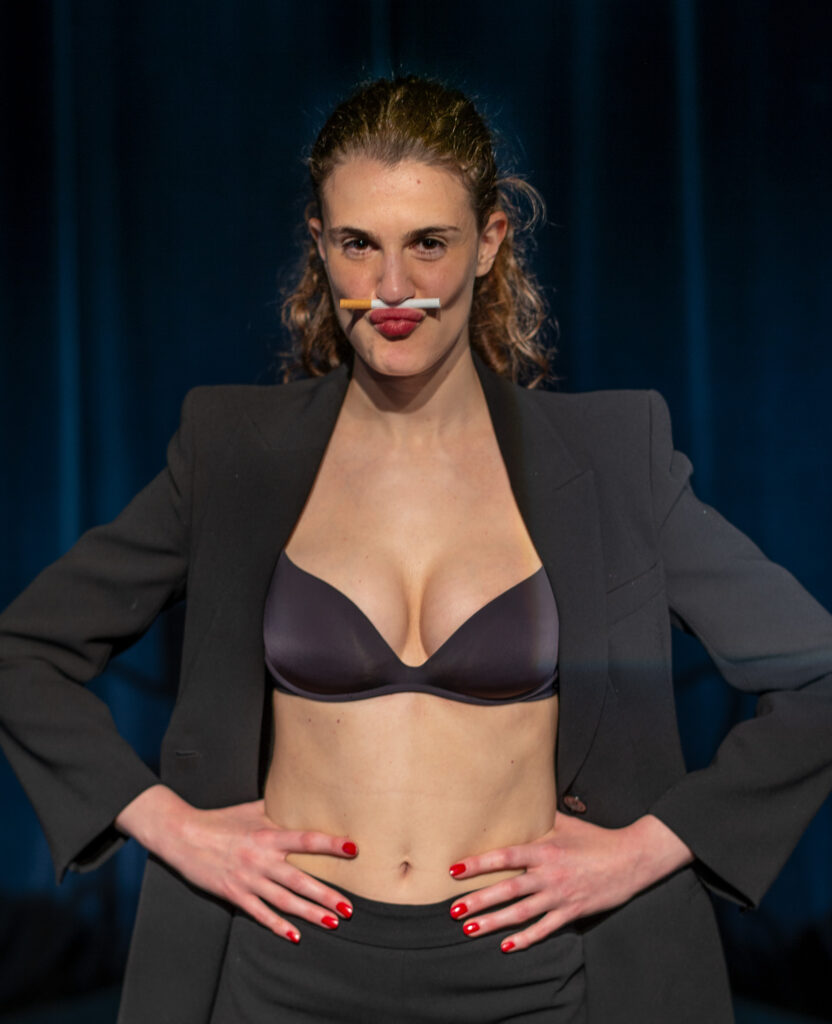
At the same time it is a theatre text on this moment performed by the wonderful Italian actrice Irene Urciuoli. The phrase “I am a mistake” expresses a deep discomfort with the reality of death.
The character’s relationship with death brings out a sense of defiance and courage, as if she’s trying to break free from the limits that hold her back, standing tall without shame. This defiance is reflected in her choice to keep smoking, a harmful habit that, at the same time, symbolises her claim to personal freedom. The text reads as a long, poetic expression—both a confession and a protest. By admitting to being a mistake and accepting it, the character challenges societal norms of respectability and hypocrisy.
How does «Io sono un errore» push the boundaries of physicality and movement compared to your previous works?
My warriors of beauty take their profession very seriously and they are always searching for themselves how they can push their own physical and mental boundaries. What is beautiful about the solo performance ‘I am a mistake’ that Irene Urciouli is performing, is that you can recognise different exercises of my guiding line for the performer of the 21st century, From Act to Acting. She performs this solo piece in a way that she researches every second the truthfulness of the moment.
The piece is dedicated to Luis Buñuel and Antonin Artaud—two artists known for their subversive visions. What influence have they had on your work, and how do they manifest in the piece?
These two great visionary artists were always an inspiration source for my visual arts, theatre arts, and writings. Because even still today their work is rooted in tradition and they are still very avant-gardist.
How does the collaboration with actress Irene Urciuoli shape this staging? What does she bring to the piece ?
Irene is since 2018 on my stage, training thoroughly on all levels, intellectual, physical and spiritual. It takes 5 years of training and working in my company before I give a performer the symbolic title of ‘Warrior of beauty’.
She is a real ‘Warrior of beauty’ and that means that I as a director am a servant of beauty for her. During the working process she guides me to the essence of the craft of acting and movement. With talented performers it is always easy to work with because they give you a lot.
Do you feel that contemporary audiences have become more resistant to artistic provocation and intellectual-visceral challenges, or are they more willing to engage?
I never underestimate nor overestimate my public. I am not an international artist, I do not have this disease called ‘internationalitis’. I am a very provincial artist. For that reason I believe that my work has a universal force and has a secret bound with every individual spectator.
Your work has often blurred the line between beauty and discomfort. Do you believe art should be unsettling in order to be meaningful?
Sometimes, my work provokes strong reactions from audiences or critics. But to me, provocation is meant as an evocation, to challenge the mind. I aim to make people think and feel differently, to open their minds, wake up their bodies, and spark their imagination—both mentally and physically. What some perceive as provocation, I see as an elegant, organic way to question our society. All my work is an exploration of the human body with a philosophical and social perspective. What some may call unsettling, I see as energetic vitality and the force of life. In my theatre arts and visual arts, as well as in my writings, beauty, even when it causes confusion and is subversive, it always brings the message of reconciliation.
You have a long history of pushing performers to their limits. How has your method evolved over time?
The education of a ‘Warrior of Beauty’ blends mental and physical skills, connecting art, performance, theater, and dance. I’ve developed a guiding line that helps performers act based on real physical sensations and heightened awareness. A “Warrior of Beauty” doesn’t pretend, imitate, or rely on psychological motivations. On my stage, only the truth of the body matters.
I’m excited to present the Greek edition of From Act to Acting – Jan Fabre’s Guidelines for the Performer of the 21st Century, published by Nissos in Athens. We worked on this book for more than ten years. It is co-written with Belgian theater expert Luk Van den Dries and my most experienced performers who are also a part of the Jan Fabre Teaching Group.
What is important to know about this book?
The book explains that performers are not pushed to their limits but encouraged to explore their own boundaries at their own pace. The exercises in the book, developed over 40 years of research, form the foundation of ‘physiological’ acting. The process also involved collaboration with the University of Antwerp, where we scientifically measured the exercises to understand how the body, organs, and muscles respond, and how to control them with proper breathing. Performers must learn that emotions are not external but physiological reactions within the body.
This book is for theater enthusiasts as well as actors, dancers, directors, and choreographers. For the general reader, it offers a behind-the-scenes look at how contemporary performers prepare. I hope that the book and my teaching create an awareness that the contemporary performer is more than the 19th century bourgeois concept of being an actor or a dancer and opens the door to the theater of the future with a strong knowledge of the past. Because real avant-garde is rooted in tradition.
The intersection of art and ethics has been a focal point of discussions surrounding your work in recent years. Do you believe an artist should be judged separately from their personal conduct?
Not only in recent years, already more than 40 years long my visual arts, theatre arts and my writings were attacked by different minority movements. It goes from radical animal movements who do not know anything about entomology to radical feminists who are not introduced into the history of theatre and dance. Usual these extreme radical people are very deaf, they only want to destroy and they are never open for a dialogue. They always defend the ideology of hate, never the ideology of love. Because if they would be open for a dialogue, then they would discover that the way I always have perceived beauty is as a consilience between aesthetical principles and ethical values. When beauty would be solely about aesthetics it would be make up.
Some have argued that art should be separated from the artist, while others insist that personal accountability is inseparable from public creative work. Where do you stand on this debate?
Luckily all great art in history is better than and surpasses the artist who created it. Because genuine art will feed coming generations on different levels. I would ask everyone to keep in mind the beautiful parable of Christ when he said: “he who is without sin should throw the first stone”. As a human being and as an artist, I always fail. I accept failing as a part of my creative process and life. In other words, ‘I am a mistake’ and I am learning from it. In my career as an artist, I always defend the vulnerability of beauty, and so that means I always defend the vulnerability of humankind and the animal realm.
I believe in the title of the last festival in Antwerp, Belgium that was dedicated to my theatre work: ‘Love and Beauty are the Powers Supreme’.
After the controversy surrounding your name, have you felt a shift in the way institutions and audiences engage with your work? Has it altered your relationship with the artistic world?
It’s hard to ignore that we’re living in regressive times. It feels like we’re slowly moving back to a more conservative era, similar to the Victorian period. I started my career in the 80s, when festival and theater producers were more open to challenging, risky, and avant-garde work. Today, however, producers and audiences play it much safer. Productions have to be neither too risky nor too complex. Nowadays, the audience tends to prefer things that are familiar and easily recognisable. We are living in conservative times, and this is reflected on today’s stages.
These days, political correctness often comes before the quality of art. People are often scared of being seen as wrong or being attacked themselves. This fear affects artistic freedom in many ways. Art shouldn’t be judged by someone’s skin color, body, or sexual identity. It shouldn’t be about what’s right or wrong. I believe that art should be free from every ideology and should talk about and defend the color of freedom.
I see my visual and my theatre works as letters in a glass bottle that I throw in the sea of time; I will never know where it arrives and who will read them. I have faith in the poetic, visionary power of my work to inspire and transform people’s bodies and minds; to open new doors in people’s thoughts and thinking.
“Io sono un errore” seems to contain an element of self-criticism. Could you say that the piece functions as an implicit response to these events? If so, how?
I wrote the text Io sono un errore in 1988 when I was 30 years old. It’s one of the manifests that companies and guides me in my life. For me, as an artist, is as accurate today as it was 35 years ago.
I believe that artists should have the freedom to create without restrictions. There should be no taboos or self-imposed limits. In today’s world, with the rise of extreme political correctness, one must be more insightful than those who consider themselves the guardians of righteousness. I feel that the visual arts and theater should stay bold and uncompromising. For instance, I oppose cancel culture—it’s harmful. We are all aware of the increasing amount of misinformation online, and it’s hard to trust what we read or see these days. I find value in engaging with or listening to people who hold different opinions, those who offer contrasting viewpoints. I still gain insight from meaningful conversations. After all, dialogue is the foundation and heart of democracy. I feel the same way about theater—I want a play to provoke me, to challenge my thinking, to spark new questions in my mind.
Has this period of your life changed your perception of power dynamics in the artistic sphere? Has it led you to rethink certain aspects of your practice?
New times demand a new language. Since 2019, since 6 years now, under the proposal of the board of directors, my company became one of the first independent companies in Europe to integrate a firm well-being policy that is considered “state of the art” in Belgium. Every member of the company has committed themselves to consciously applying this integrity policy, thus creating for everyone involved, myself included, an open and transparent safe working environment. In this structure, employees know where to go to if they are experiencing problems during work. Misunderstandings, if they exist, are clarified quickly. We have two persons of trust in the company and every step in the artistic process happens with explicit consent of everyone involved. Everyone in the company now feels very safe because people, later, cannot invent things out of their perception.
Information
Jan Fabre’s performance “Io sono un errore” (I Am a Mistake), starring Irene Urciuoli, will be presented at the Pattihion Municipal Theatre of Limassol on Sunday, March 16th in a double performance at 7pm & 9:30pm, opening the 2nd International Theatre Festival of Cyprus. Tickets: Soldout Tickets
Read more:

