


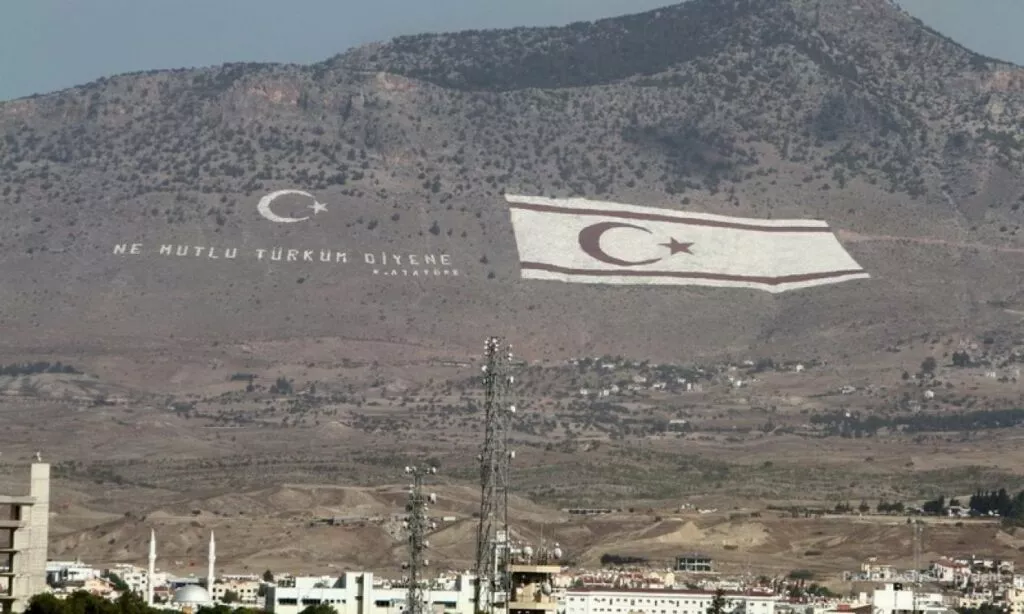
As discussions regarding the Cyprus issue gain momentum ahead of potential new negotiations, the role of the United Kingdom is coming under increasing scrutiny, particularly from Turkey, which has challenged British involvement in expanded talks.
The UK’s proposals, mainly focusing on issues of sovereignty and power-sharing, are reportedly being considered by United Nations circles as a means to persuade the Turkish side to cooperate. These proposals appear to navigate the complexities dividing the parties involved, with London seemingly aligning itself with Ankara’s interests.
Recent discussions have highlighted concepts such as the establishment of “Community States” within a federal framework for Cyprus, echoing the creation of the Republic of Cyprus in 1960. This approach, suggested to be linked to UN Secretary-General Antonio Guterres’ previous comments about a “bottom-up approach,” implies that sovereignty would derive from the communities and be transferred to a central authority. Such a model hints at a confederal structure, which could accommodate Turkish demands for recognition of Turkish Cypriots post any negotiation failure.
In response to Turkey’s longstanding demand to define the status of Turkish Cypriots, various proposals are being tabled. These aim to create pathways for international recognition of the breakaway entity, utilizing successful models from Scotland and Ireland as references. A potential future referendum on independence after a defined period of agreement implementation has also been suggested, although any such referendum would require approval from the UK government in London.
Nicosia is preparing to address these behind-the-scenes movements, with President Christodoulides advocating against entering negotiations that could lead to a confederal arrangement or agreements allowing for secession possibilities. He has developed scenarios to be deployed when necessary and is actively engaging with international stakeholders in Brussels and Washington to deter undesirable outcomes.
Meanwhile, a forthcoming document from Guterres, viewed as a revision of the previous envoy María Ángela Holguín Cuéllar’s report, is set to be presented to involved parties “at the right moment.” This document outlines an agenda for substantive negotiations, building on known frameworks discussed during the Crans Montana talks.
Additionally, Rosemary DiCarlo, the UN Assistant Secretary-General, is expected to visit Cyprus in November to follow up on discussions held at a recent New York dinner. This visit could mark the first step towards opening new crossing points based on reciprocal suggestions.
Economic Implications of New Crossing Points
Beyond political implications, the economic aspect of establishing new crossing points is critical for the Turkish Cypriot regime. A proposal for the Mia Milia crossing is linked to the transfer of goods and passenger traffic, particularly due to its proximity to the illegal airport in Tymbou. Nicosia has also proposed openings at locations like Kokkina, Pyroi, and a pedestrian road in old Nicosia.
Trade via the Green Line is flourishing, particularly concerning goods sold from occupied territories to free areas. According to the Turkish Cypriot Chamber of Commerce (KTTO), sales of goods from the occupied regions to the free areas reached €7.965 million between January and June 2024—a 0.6% increase from the previous year and the highest since trade via the Green Line commenced in 2004.
These developments counter the narrative of Turkish Cypriot isolation and suggest that ongoing economic exchanges may serve political interests.
Diplomatic Dynamics and Turkey’s Position
Diplomatic discussions are now considering Turkey’s stance that the UK should either refrain from participating in a multilateral meeting regarding Cyprus or be represented by a technocrat instead of a minister. This position reflects Turkey’s desire to influence the format of future talks and has been echoed by other stakeholders.
A reduced British representation sends significant signals, potentially appeasing Turkish ambitions, a tactic not previously employed consistently, as seen in the UK’s ministerial representation during the Crans Montana talks.

