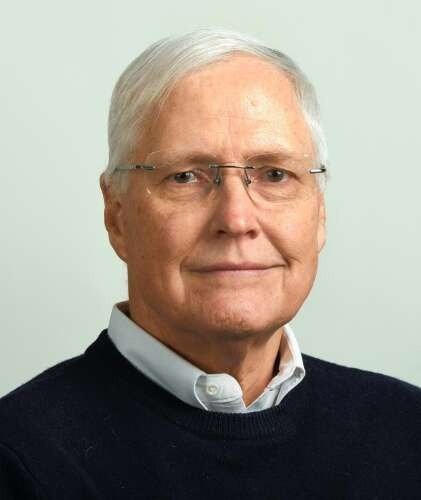
Keith Peterson’s relationship with Cyprus started in 1989 when he first came to the island as an Assistant Public Affairs Officer for the United States Embassy in Nicosia after his previous position in Tunisia was eliminated due to budget cuts.
A veteran journalist-turned-diplomat, he was initially meant to stay for nine months, to serve on the board of the Fulbright Commission as the alternate to board chairman Lane Cubstead.
Fate had it that he would return in 2011, this time as chairman of the board. He eventually left in 2014, just before the Commission’s closure, in what would be his last posting after 29 years in the diplomatic service.
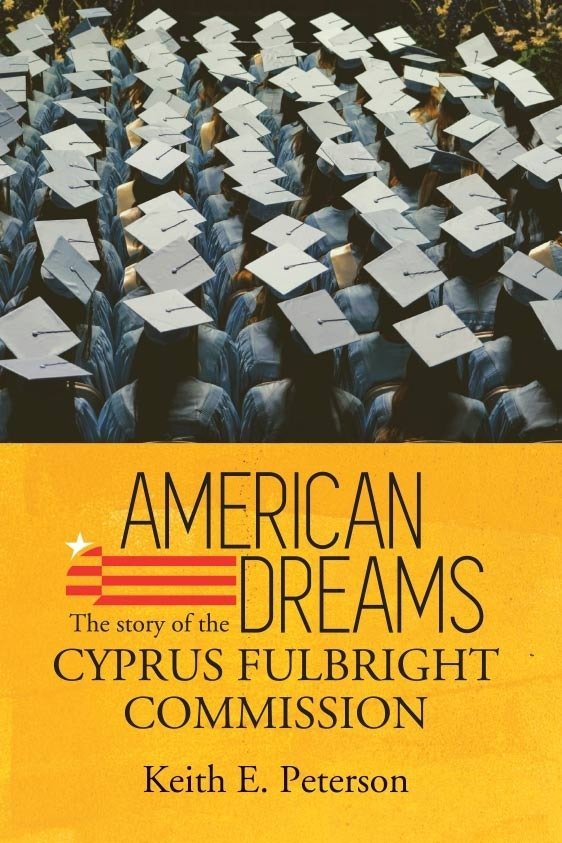
Peterson then spent the next seven years documenting the rise and fall of the programme which culminated in a book titled “American Dreams: The Story of the Cyprus Fulbright Commission,” published in 2024 by Armida Books.
Through a retelling of the Commission’s 52-year existence, the book is an enjoyable read on U.S. involvement in the island, anti-Americanism, the Cold War and the Cyprus problem, featuring many figures, both Greek and Turkish Cypriots, who came to shape, and still shape, the history of Cyprus.
Ultimately, the story of a “unique” commission turns out to be an insider’s eye into Cyprus’s relationship with itself and the world.
What led you to document the story of the Fulbright Commission?
I first came to Cyprus in 1989-90 for nine months as the Assistant Public Affairs Officer. It was a time of turbulence and budget cutting in the diplomatic service and my position in Tunisia has just been eliminated. I filled an immediate opening in Nicosia and, nine months later that position, too, was cut and I headed to a new post. During my nine months, I served on the board of the Fulbright Commission as the alternate to board chairman Lane Cubstead, who was the Public Affairs Officer at the Embassy. In 2011, I returned to Cyprus as the Public Affairs Officer at the Embassy and, as such, the Chairman of the Board of the Fulbright Commission. I departed in 2014, my last overseas assignment before my retirement after 29 years in the diplomatic service.
During that 2011-14 assignment, it was my job to first downsize the Commission from 11 employees and three offices (the building on Egypt Avenue near the museum, the Fulbright Center (now in disrepair) at the Ledra Palace crossing, and a small office in the Turkish Cypriot north) to four employees and one office (the Fulbright Center). Then, just after I left in August 2014, the Commission closed and what was left of the Fulbright programme was to be run by one person in the Public Affairs Section of the Embassy, Dr. Sondra Sainsbury.
The last executive director of the Commission (though she had the title of “senior counsellor”) Anna Argyrou said “Someone needs to write a history of this Commission” and I agreed. We put out a tender and had a couple of bids from Cypriots to write the history but I did not think an outsider would understand how unique the Commission was and as I was about to retire from the Foreign Service I decided that I should take on the task. I had written a long, historical Master’s thesis and had been a print journalist before entering the diplomatic service. I thought it was something I could do. And for seven years I researched and wrote the book.
What role does the Fulbright Programme play in the US’ ability to exert soft power?
Senator Fulbright, a former Rhodes scholar who studied at Oxford, had great concerns at the end of World War II about the devastation that had occurred, the power of atomic weapons, and the aggressiveness of the Soviet Union, which moved to take over Eastern Europe. He wanted to create a programme that would send Americans abroad to learn about the world and to have scholars from every country come to America to learn about us.
Some of his isolationist colleagues in the Senate did not agree, but he found a funding source in the sale of the surplus military equipment overseas at the end of the war. Ultimately, the program became popular and I think Cypriots who were Fulbrighters tell you that they feel that they are part of an important international community.
So, yes, part of the programme was always an attempt to bring some of the smartest students and scholars to America and introduce them to the American way of thinking and seeing the world. In the case of Cyprus, there was also some hope that if Cypriots studied in the U.S. in our multicultural society with students of every race and creed it would help Cypriots find a way to reconcile their differences.
The Commission played a role in conflict resolution efforts in Cyprus, even facing criticism. How did the political landscape of the time impact the Commission’s work?
Well, they tried to keep things very low profile. Many Cypriots did not know these programs were happening. The Commission did not put out a public call for applications for the conflict resolution programs. They started with the core group of peace activists like Katie Clerides, Costas Shammas and Fatma Azgin and expanded the group by word of mouth.
That said, some 2,500 Cypriots ultimately participated in one or more of the conflict resolution programmes. Most were just about communication skills…how to talk about difficult topics without using “trigger words,” for example. But some of the programmes – under Dr. Ben Broome and Marco Turk – really did try to make a contribution to solving the Cyprus problem. Dr. Broome noted that with his group there was an “Oh My God” moment when they realised that solving the problem was not all that simple. For example, removing the Turkish troops from the north did not solve the problem.
However, at the end of the day, political leaders on both sides did not want this group of people meddling in an area that they alone felt they were to control. They would say to the activists: “Who elected you? You have no legitimacy.”
In your opinion, why did the Commission face criticism from both Turkish and Greek Cypriots? Did anti-Americanism play a role?
With Denktash it was simple. He did not want anyone to contradict the narrative that Greek and Turkish Cypriots could not live together. There is an illustrative story in the book. Denktash came to the Fulbright Centre to meet with a group of Cypriot 15-and-16-year-olds who were going to a conflict resolution camp in the U.S. He was disturbed that he could not tell the difference between the Greek and Turkish Cypriot kids…they all dressed alike. So he asked the Turkish Cypriots to raise their hands. He assumed the two groups would be sitting separately, but they were all mixed up and he did not like that at all. He charged that the Fulbright Commission was trying to “brainwash” his people.
As for the Greek Cypriots, it was more complicated. Sure, there were those who still blame the U.S. and Kissinger for 1974. And AKEL was never going to be friendly toward the programme. Daniel Hadjittofi, for 26 years the Executive Director, kept a lid on things. When there was public criticism by some politician he would call them and ask: “What the hell are you doing?” Daniel was a refugee whose father and uncles were murdered by the Turks in 1974. No one could question his patriotism. At the end of the day, the scholarships were valued and that was the bottom line.
The book highlights the personal stories of many Fulbright grantees. Could you share a few of the most inspiring or impactful stories that you came across during your interviews?
From the earliest years, there were people like former Central Bank Director Sophocles Michaelides, former Finance Minister Michael Sarris, and former Turkish Cypriot ‘Foreign Minister’ Kenan Atakol who were all Fulbright grantees. All earned their PhDs (more than 400 of the Fulbright and Cyprus American Scholarship Programme grantees went on to earn their PhDs). For someone like Michaelides, studying in the U.S. (and the Ivy League) would have been impossible without the grant.
Dr. Constantinos Pitris at the U. of Cyprus, who came from a very poor background, did simultaneous doctorates at Harvard (medicine) and MIT (bioengineering) and heads a centre at the university. Dr. Leontios Kostrikis (who Cypriots got to know well during the pandemic) watched his American classmates at NYU take out loan after loan to pay for their studies while the American government paid everything for him. He thought the American government was crazy, but he said he was nearly 50 before he understood. It is one reason he was perhaps the first professor at the University of Cyprus to have a Turkish Cypriot PhD student.
The Commission also gave out nearly 1,000 Short-Term Training grants (up to three months of training in the U.S. all expenses paid) and the Commission must have trained half the doctors on the island in infant cardiology, transplant surgery, etc. However, on the Turkish Cypriot side I very much liked the story of Orcun Kamali, a football player who started a wheelchair basketball team. We sent him to three different centres to study wheelchair sports. After, his teams excelled and when other teams came to Cyprus from Turkey adjustments had to be made – there was no wheelchair lift at the airport, no toilets in hotels for the handicapped or doors wide enough to accommodate a wheelchair. The society had to learn and change.
What factors contributed to the closure of the Fulbright Commission?
Money. Most countries as small as Cyprus don’t have Commissions, especially countries that (in 1962) did not have universities. In the book, there is a memo from President Kennedy to Secretary of State Rusk. Kennedy did not like the “gloomy tone” of the State’s report on Cyprus. He noted the “inadequacies” of the Makarios government in contrast to the able leadership of AKEL. We did not want Cyprus to become the “Cuba of the Mediterranean”. So, in the early 1960s, we pumped a lot of money into Cyprus post-independence. Most of that money stopped quickly but the Commission kept going. It was modest. Perhaps 14-15 grants a year and a handful of American professors who were consultants.
Then 1974 happened. Between 1975 and 1980, the U.S. provided $100 million (half a billion in today’s dollars) for the resettlement of the 40 per cent of the population that was displaced. We built 30,000 houses, directly or indirectly. The State Department wanted the $15 million a year to stop (so did USAID). However, the Greek lobby pushed and certain Senators (such as Paul Sarbanes) kept the money going. So, what do you do with the money?
Ambassador Galen Stone had a conversation with Senator Claiborne Pell and they said let’s set up a scholarship programme. Too many Cypriots (the children of AKEL members) were going to the University of Moscow and to the East Bloc. These were all very “Cold War” calculations.
So, the Cyprus American Scholarship Programme was launched in 1981 with $5 million (the ROC opposed it). Everyone thought it was a one-off, but $5 million showed up the next year and the year after that. The CASP lasted 33 years and in constant, inflation-adjusted dollars was more than a quarter of a billion dollars. Managing a $6 million annual programme ($5 million, plus the Fulbright money, plus a contribution from the government of Cyprus) meant a large, active Commission. It was, on a per capita basis, the largest Commission in the world.
The $15 million became a symbol of America’s commitment to find a solution to the Cyprus problem. The other $10 million was paid for the Nicosia sewer and water system, the Nicosia Master Plan, the Cyprus Institute of Neurology and Genetics, the reconstruction of St. Mamas in Morphou, the Home for Cooperation, and much, much more.
However, that money should have stopped when Cyprus entered the EU. It shows the power of the Greek lobby that the money continued for another 10 years. As Ambassador Klosson told me: “That money should have disappeared in a nanosecond in a post-9/11 world.”
When I came to Cyprus in 2011, I knew the CASP money would stop. The Fulbright contribution continued to shrink through the years and, in the end, the government of Cyprus stopped its contribution over a dispute concerning control of the money. It wanted a board or advisory panel to give it a formal voice in how the money was used but the State Department lawyers said no.
A very modest Fulbright programme is now run by one person in the Public Affairs Section of the Embassy. It no longer gives scholarships, because one graduate scholarship could eat up a third of the budget and in Cyprus, you (politically) have to give two – one to a Greek Cypriot and one to a Turkish Cypriot.
Could you share some insights into the behind-the-scenes workings, during the ending of the Commission? What were the major challenges faced during that time?
Daniel Hadjttofi said he was doing “psychological management” as the employees wondered who would stay and who would be laid off in the downsizing. I write that I was pretty bloody-minded about it. It killed me to lay off Daniel. We had been friends for nearly 25 years, but we could not afford his salary given the reduced budget. There was a problem in getting the severance payments approved that resulted in some unnecessary drama and threats of lawsuits.
However, the worst were the fights with the government of Cyprus. It did not seem to grasp what was happening and why, though it was clear. The ROC failed to appoint board members to show its displeasure and that made things more difficult. Daniel also provided a huge service to the Commission when he came to me and told me his sources told him that the Bank of Cyprus and the Laiki Bank were in trouble. We moved millions of dollars out of those banks to safer banks and avoided a catastrophic “haircut”.
How do you see the legacy of the Commission influencing U.S.-Cyprus relations now?
There are about 6,000 names in the database of former grantees. About 40 per cent were participants in the conflict resolution programmes. The other 60 percent received Fulbright, CASP, or STT grants.
There were also hundreds who received grants to study at the American University in Beirut (before the kidnapping of two Greek Cypriots by the Adu Nidal terrorist group stopped that programme). And, in the early years, there were all kinds of programmes – grants to the American Academy in Larnaca, the American Farm School in Thessaloniki, teacher training and teacher exchange programmes, Humphrey grants, grants for social workers and youth leaders, and training for alumni groups.
There were 170 American Fulbrighters who did long-term stays on the island and were consultants and, eventually, professors at Cypriot universities. I would point out the work of Dr. Marla Stone who helped a group of Cypriot teachers write elementary school science textbooks that were so good that Greece bought them for their schools.
There were hundreds of visiting scholars who came for a conference or other events to lecture. The English language teaching assistants have touched the lives of thousands of Cypriot students. CAARI (the Cyprus American Archaeological Research Institute) would not exist without the financial support of the Commission and the scores of American archaeologists who received Fulbrights to do research. (I just rotated off the CAARI board after six years.)
I think most of the people who received grants and studied in the U.S. came away with a positive experience. Many of the grantees ended up staying in America, too, but returned and made a contribution. The doctors we trained with STTs say they have many contacts in the States that they maintain. CING personnel received 26 STTs.
So, how do you measure all that? It is hard. I want to believe that relations are better because of it. Many Greek Cypriots blamed the U.S. for 1974 (the book argues unfairly). The Papadopoulos administration did not like the fact that we were pushing for a yes vote on the Annan Plan.
Relations were frosty then, and Papadopolous punished the Commission by refusing to reappoint Nicosia Mayor Lellos Demetriades and former Education Minister Chrysostomos Sofianos to the board. Demetriades had served 40 years on the board and was the most important Cypriot voice on the Commission. He truly believed in Senator Fulbright’s vision. He was very bitter that Papadopoulos did not have the decency to tell him that he was being removed. Executive Director Hadjittofi always said that when the Commission was going to venture into sensitive areas (like conflict resolution work) as long as he had Lellos and Sofianos on his side he knew he had the support of the board.
At the end of the day, given all the ties that have been created between Cyprus and America through the work of the Commission, I think there has been enough connective tissue created to sustain positive relations between our two countries.