


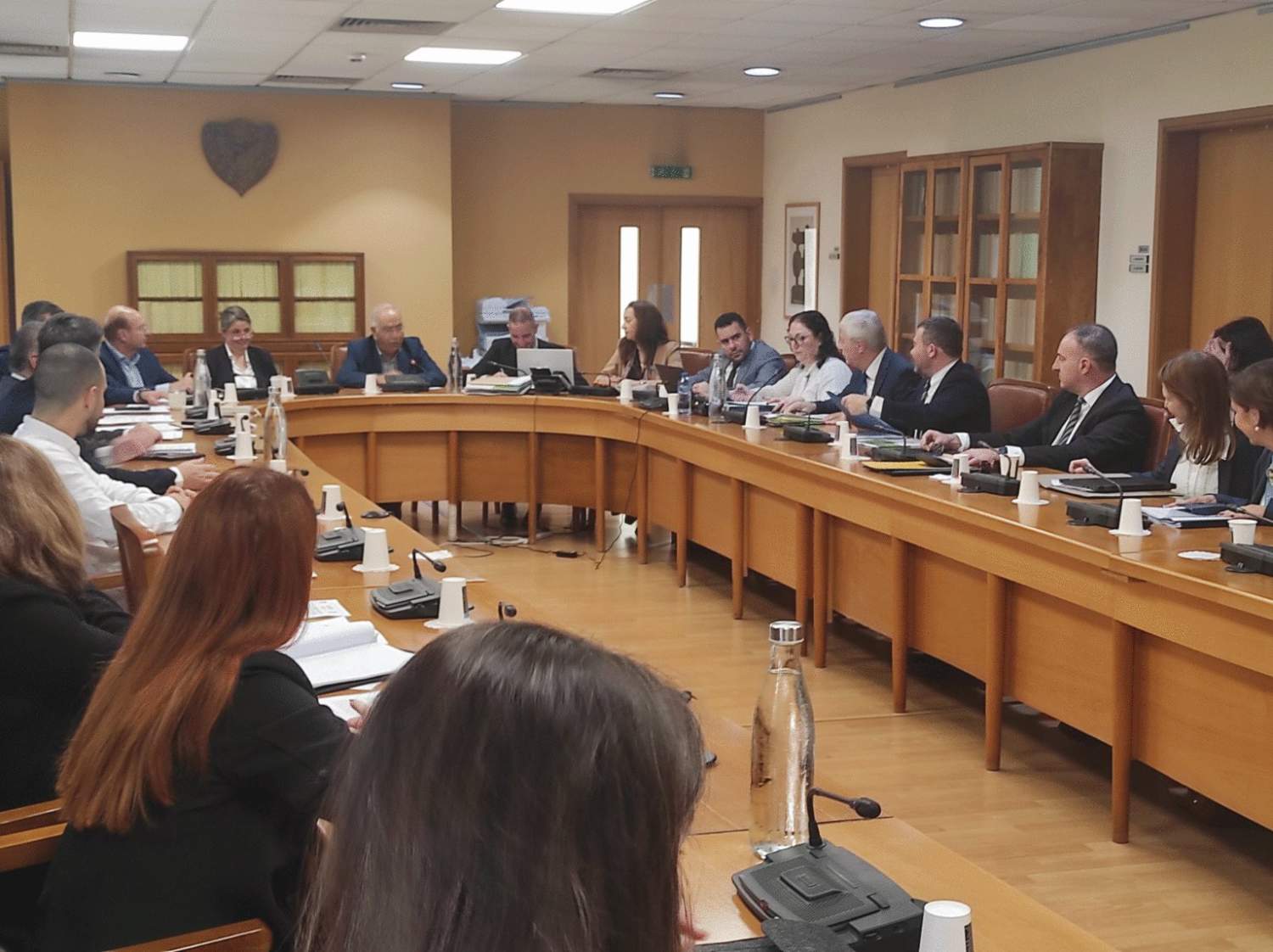
Fourteen cases concerning Cyprus had come before the European Public Prosecutor’s Office (EPPO) by 2025, involving estimated losses to the EU of about 1.32 billion euros, European Court of Auditors (ECA) member Lefteris Christoforou told parliament on Thursday. He said the ECA’s audit had found nothing against Cyprus in its use and sound financial management of EU funds in 2025.
Christoforou presented the ECA’s 2025 annual report to a joint session of the House Audit, Foreign Affairs and Finance committees, where parliament members pointed to the Vasiliko terminal and the Great Sea Interconnector (GSI) electricity link, both of which are before the EPPO.
The clean audit had a huge positive impact on Cyprus’s image and showed that the state was managing EU funds in the best possible way, Christoforou said.
Opposition criticism
AKEL parliament member Christos Christofides said after the session that “there was an obvious attempt to present everything as good and fine”. The EPPO, with the involvement of the ECA among others, was examining two huge scandals concerning Cyprus, he said. One was Vasiliko, which he said Cypriots were paying for every day through electricity prices and emissions. The other was the GSI, a project he said the finance minister had repeatedly opposed.
Christofides also cited an ECA special report on REPowerEU, which found that Cyprus, Greece, Portugal and Spain had not provided enough evidence on carrying out the required cross-border electricity interconnection projects. He said he had asked three times during the session what this meant but had not received an answer.
ALMA leader and parliament member Odysseas Michaelides described the session as “the height of hypocrisy”. He accused the government of boasting that its handling of EU projects and funds was flawless while two major projects, Vasiliko and the electricity interconnection, were under EPPO scrutiny.
Christoforou later said the ECA was limited to identifying suspected fraud and had no investigative role. It referred 17 cases as suspected fraud in 2025, he said. Vasiliko and the GSI were in the hands of the EPPO, which was responsible for handling them and reaching a final decision.
Absorption of funds
Cyprus is among the leading member states in absorbing EU funds, according to Christoforou. It absorbed the full 917.3 million euros available under the previous multiannual financial framework, and has so far absorbed 37.4 per cent, or 528 million euros, under the current one, against an EU average of about 30 per cent.
It also secured 992 million euros through its recovery and resilience plan, which he said amounted to essentially 100 per cent. The only cut, of 28 million euros, resulted from the government’s decision not to impose new fuel taxes, he said, arguing that the social benefit of that decision far outweighed the loss. Between 2021 and 2025, Cyprus received a net 1.76 billion euros from the EU after its contributions were deducted.
DISY parliament member Charalambos Petrides called the absorption of funds very positive, while ELAM parliament member Marios Pelekanos said the numbers spoke for themselves.
EU budget
For the EU budget as a whole, “for the seventh consecutive year we consider there are material errors”, Christoforou said. The errors ranged from 2.8 to 4.5 per cent, averaging 3.8 per cent, above the 2 per cent threshold. The ECA issued an adverse opinion on the 2025 EU budget, and a qualified opinion on the legality and regularity of spending and grants under the Recovery and Resilience Facility.
House Finance Committee chair Christiana Erotokritou said she was saddened by the share of the EU budget allocated to research and the economy, and warned that the European economy would soon lose its competitiveness if it continued at its current pace.
(Information from Cyprus News Agency)

