


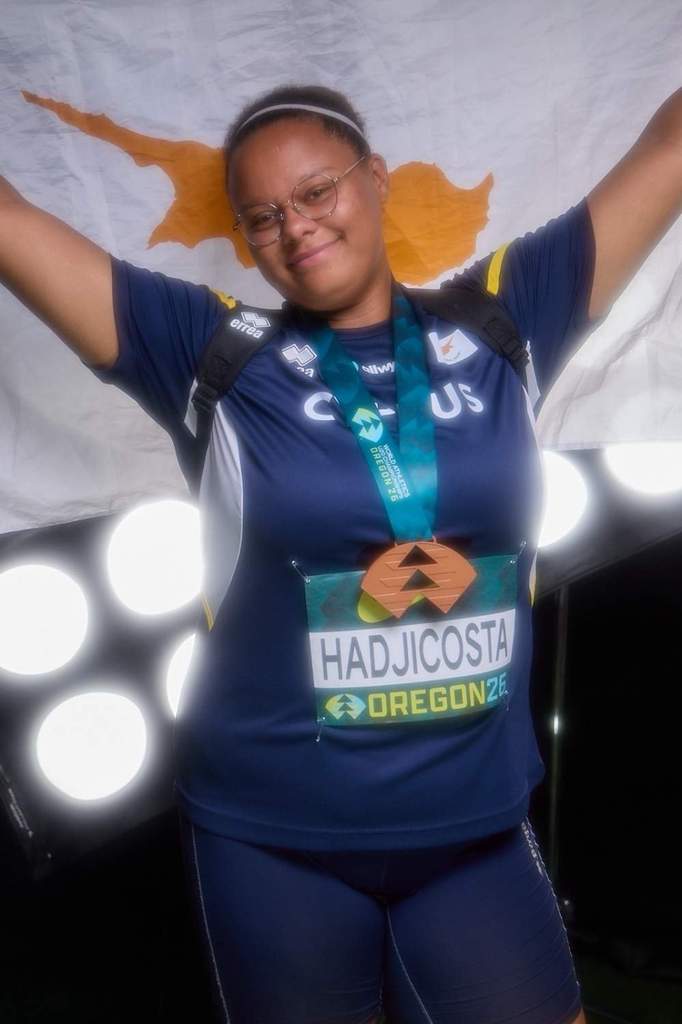
Marina Hadjicosta won gold in the discus at the fourth Youth Olympic Games in Dakar with a throw of 53.20 metres, Cyprus’s first gold of the Games. Next up is the World School Games in Rio, a month after Dakar.
At 17, she is ranked number one in the world in her age group and already has her sights set on the 2028 Olympic Games. After she rose to the top, comments followed online about her origins and whether she was Cypriot enough to represent the country. She has now chosen to respond publicly and tell her own story.
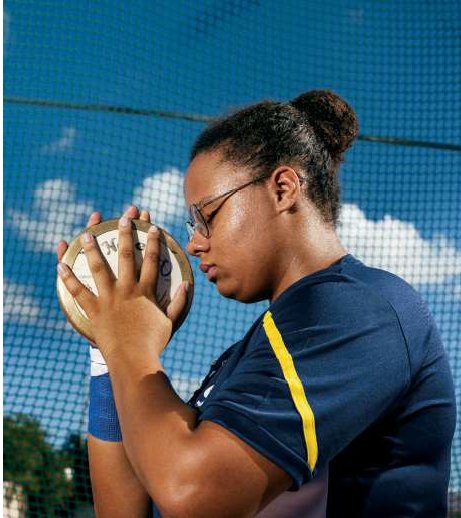
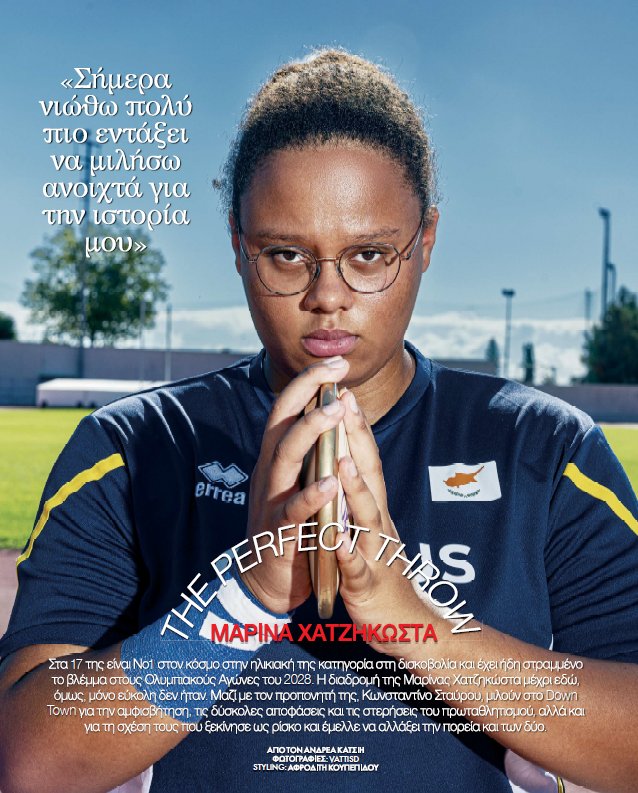
In an interview with Andreas Katsis for “Down Town”, Hadjicosta and her coach, Konstantinos Stavrou, spoke about the doubts over her identity, hard decisions, the sacrifices of elite sport and a partnership that began as a risk and changed both their careers.
What is it like to reach the top representing Cyprus while feeling you still have to prove you belong?
Marina Hadjicosta: That need to explain where I’m from and where I belong has been there since I was very young. At secondary school, especially at the start of each year, someone would almost always ask me: “Where are you from?” I’d say “Cyprus”, and then came: “No, where are you really from?” After that came the questions about my parents and how I ended up here. At the time it affected me a lot. There were times I came home in tears. I was young and it was hard to deal with. I may not have faced the most extreme racist comments, but they constantly made me feel I was different.
Did you think you’d left that behind? What happened when it resurfaced on social media?
Marina Hadjicosta: As people started to know me through sport and my results, those questions faded in my immediate circle. Outside it, though, the comments didn’t disappear. So when I saw them come back on social media, it wasn’t anything new for me. The difference is that today I’m much stronger in the face of them. I have my coach, my parents and my friends beside me, and the comments can’t get to me the way they used to. At some point you realise anyone can write whatever they want without knowing you or your story, so you stop paying attention.
This time you chose to respond publicly, in a very personal post about adoption, your origins and your relationship with Cyprus. Why share your story now?
Marina Hadjicosta: I think I finally felt ready. For many years I was very insecure about that part of my life. I knew some things, I’d seen photos, but I didn’t have all the information. Last year I also did a DNA test, because I wanted to know more about my biological origins. If you’d asked me two years ago, I’d simply have said “I’m from Cyprus” and wouldn’t have wanted to continue the conversation. Today, though, I feel much more at ease with myself and my story, and I can talk about it openly.
Would you like your story to support a child who feels the way you did?
Marina Hadjicosta: If I ever manage to reach the top and have a bigger voice, I’d really like to try to act as an ambassador for people going through similar things to me. Above all for children who are adopted and may feel the way I felt.
Was there a comment that made you laugh instead of angry?
Marina Hadjicosta: Someone wrote that if I can’t translate a Cypriot singer’s songs into English without help, and if I can’t cook Cypriot food without help, then I’m not Cypriot. When I read it, I laughed so much that I’ve kept it on my phone as a memento!
Konstantinos, you have seen all this up close. How do you feel when Marina receives comments like these?
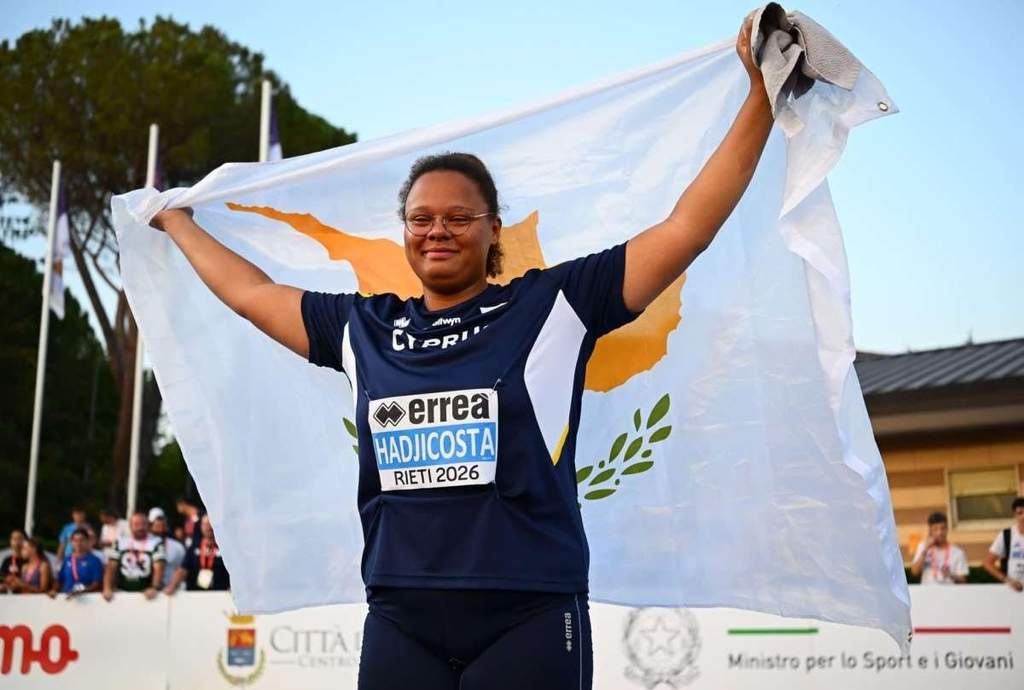
Konstantinos Stavrou: It bothers me, because I know Marina and her family and I know how far all this is from reality. Marina grew up in Cyprus with her parents, with Cypriot traditions and values. I remember a big competition abroad when she won gold and stepped onto the podium. As soon as the national anthem played, she put her hand on her heart, looked at the flag with pride and, with tears in her eyes, sang along quietly. That image, for me, says far more about her relationship with Cyprus than any comment online.
It’s hard to believe you’ve only been working together for the past year. How did your paths cross?
Konstantinos Stavrou: I’d known Marina for years because we trained at the same venue, but our relationship was more formal. The first real contact came in Skopje, at the European Youth Olympic Festival, where I was in charge of throwing events for the team. Because her coach at the time couldn’t travel, I was assigned to coach her. That’s where we had our first conversations, and I think it lifted her morale a little, as she was going through a difficult period in competition. When we got back, we each went our own way, until circumstances brought us together.
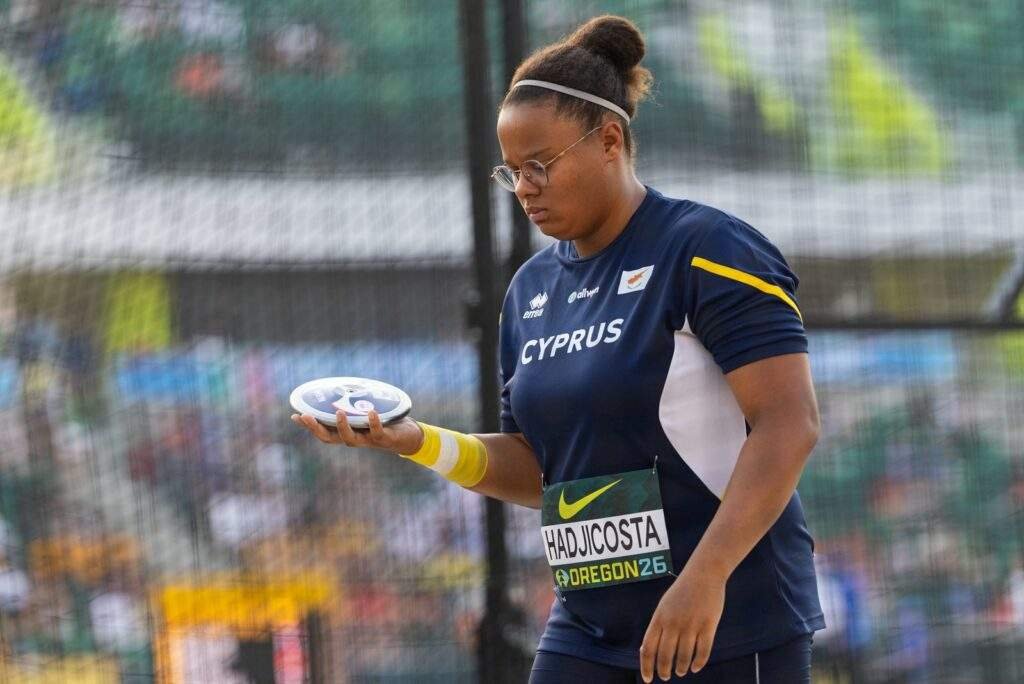
Marina, what stage were you at when your paths crossed?
Marina Hadjicosta: I was in a very difficult place. I was working extremely hard and had sacrificed a lot for sport, but I wasn’t seeing the results I wanted, and that had really brought me down psychologically. In the summer of 2025 I hit my lowest point. I wasn’t sleeping well or eating properly, and I realised it all had to do with my training. I’d been with the same coach for eight years and it wasn’t easy to leave, but I felt I couldn’t go on like that. I told my parents plainly that if I didn’t change coach, I would quit athletics.
What made you think of Konstantinos as the person to make that change with?
Marina Hadjicosta: In Skopje I’d seen something I hadn’t experienced until then. I saw the relationship Konstantinos had with his athletes and felt he was a coach you could really talk to. I saw it during the competition too. I was very nervous and, after my first throw, he told me exactly what to change. On my very next throw I did better. When we got back to Cyprus, I thought about it a lot.
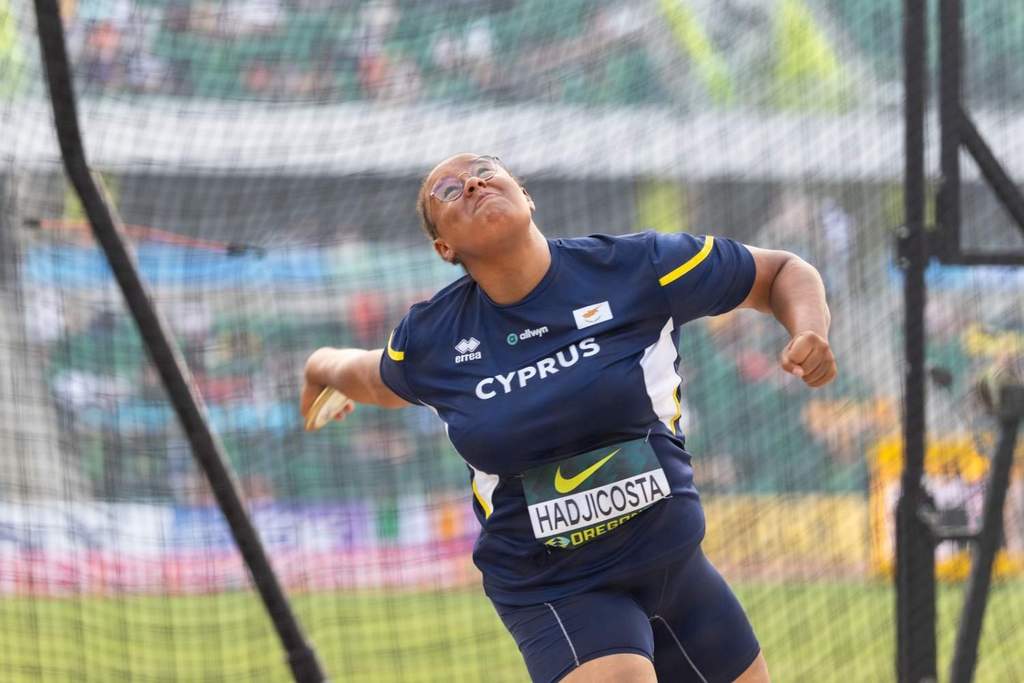
How did your parents react to you changing coach after eight years?
Marina Hadjicosta: At first it was hard for them to accept, because there was a relationship of so many years. But once I started with my coach, the difference showed very quickly, mainly in my state of mind. Not long ago, we sat down to eat one evening and my mum said to me: “Sorry we reacted the way we did.” That meant a lot to me.
Marina seems to have decided from the start that she wanted to work with you. Did you feel the same?
Konstantinos Stavrou: Not exactly. The federation and the club saw Marina as one of the biggest rising talents, but for about two and a half years she had stagnated, with no consistency in her performances. Let’s be honest, and I want to say this, many people said she was a spent force and that whatever she was going to achieve, she had already achieved. So yes, taking her on was a risk for me.
How important is it for a coach to know what is going on in an athlete’s mind, not just their ability?
Konstantinos Stavrou: It’s extremely important, especially at this level. You need to know your athlete so well that you can sense a difficult moment and know how to handle it. With Marina, the hardest came just five days before the World Championships in the US, when she told me she wanted to stop. That’s when you need to know when to stand beside your athlete and when to take a step back, giving them space to process what they’re feeling. And, when the moment comes, to find the right words to bring them back into competition.
Marina, are those difficult moments also about what you have to give up at 17, with friends going out while you’re at training?
Marina Hadjicosta: Very much so. At 17, I need to go out too, to rest and spend time with my friends. This season especially there was a lot of fatigue and we basically didn’t stop. But sacrifices have to be made when you compete at the top level.
Konstantinos, is that where your relationship is tested most?
Konstantinos Stavrou: Yes, that’s where we have the most disagreements, in the moments when she feels she has no time to just be a 17-year-old. I understand it, because I’m not that far from my own time as an athlete, but as a coach I have to be both supportive and strict.
Within a year you went from stagnation to world number one. What changed?
Marina Hadjicosta: We worked extremely hard. Last year I was around eighth or tenth in the world, throwing about 50 metres, while the top athlete had 53.82. Two days before a competition I made a phone wallpaper with “53.82” on it, so I’d see it every time I opened my phone. Before I went into the stadium I looked at it and said: “I’m going to throw over 53.82.” On my first throw I threw about 52. On the second, I let go of the discus, watched it land beyond 54 metres and couldn’t believe it. I turned to my coach and leapt on him with joy. It was 54.82. At the next competition came 55.02, and at the one after that, 56.54. From then on I stayed consistent all season. It was important, because I proved things first to myself, but also to my coach.
What comes next? University, or is everything on hold for 2028?
Marina Hadjicosta: The US has been in my plans for studying for years, but right now sport comes first. My coach and I decided to devote 2027-28 entirely to training, with the big goal of qualifying for the Olympic Games. After that we’ll see what the next step is. There are already options for universities in Cyprus, the US and elsewhere, with scholarships.
Before 2028, though, there are other important milestones…
Konstantinos Stavrou: We’re already in competition season. As we speak, we’re in Dakar, Senegal, for the biggest event for her age group, essentially the Youth Olympic Games, and a month later comes the World School Games in Rio. These are two very big events, where Marina now has to confirm her position as world number one.
Does a 17-year-old chasing Olympic qualification get the financial support she needs?
Konstantinos Stavrou: There is support from the federation and, through her results, Marina has moved up to the highest tier of support from the Cyprus Sport Organisation. The big gap, though, is still individual sponsors. Since the start of the year we’ve approached big companies, but there’s still some hesitation, perhaps because of her age and because the discus isn’t a particularly commercial sport. Some may be waiting for the next big step, such as Olympic qualification.

