


By Andreas Bimbishis, Frixos Dalitis
Six weeks before Cyprus heads to the polls, a new survey underlines how uncertain the outcome remains — with the race for first place too close to call and a three-way battle for third place decided by fractions within the margin of error.
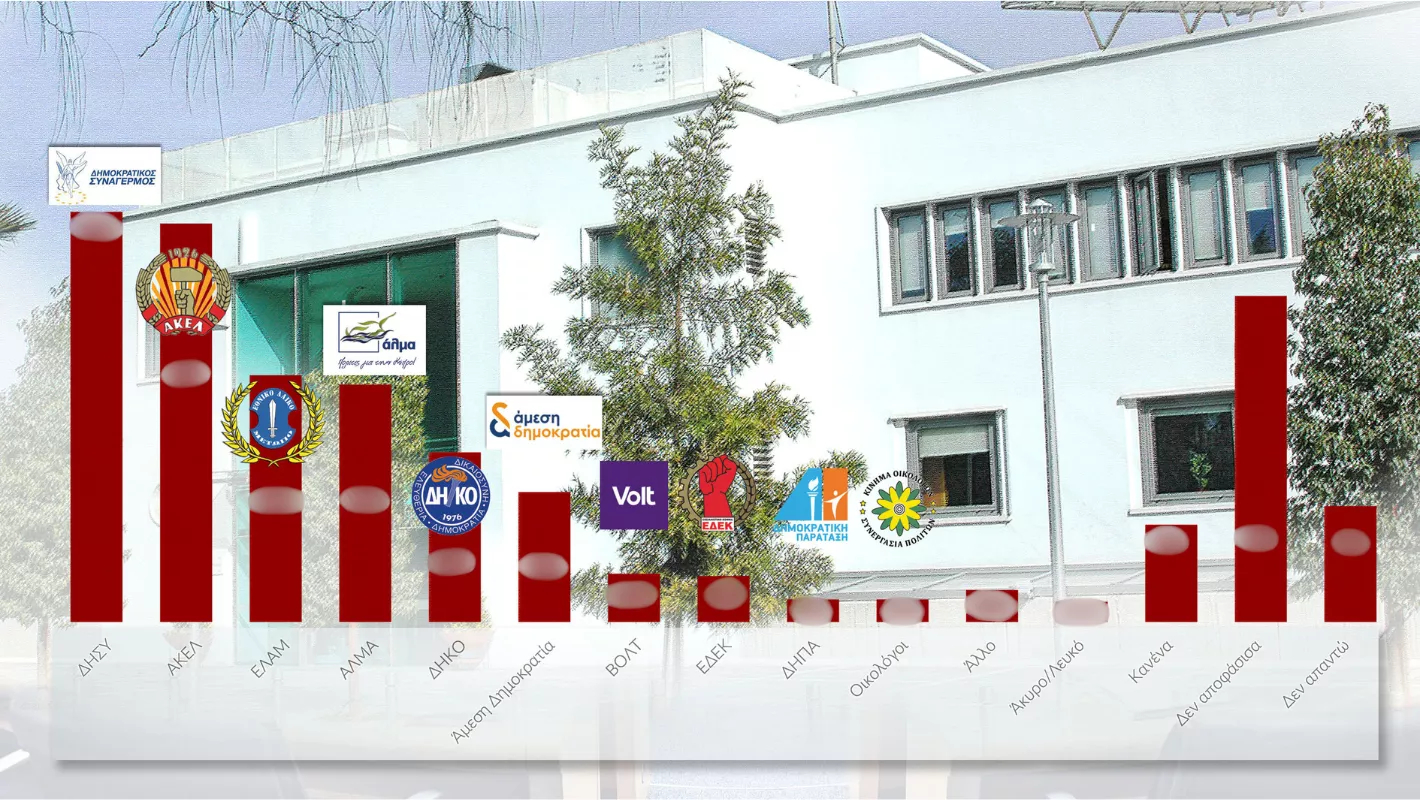
The EXPLORER poll, conducted for Phileleftheros between 30 March and 6 April 2026, places DISY first with 17.6%, up 0.5 points from the previous poll published on 1 March. AKEL follows at 17.1%, also up — by 0.4 points — leaving the gap between the two parties almost unchanged.
Third place is contested by ELAM, ALMA and DIKO, all within the poll’s ±3% margin of error. ELAM stands at 10.6%, down from 11.4% in March. ALMA has closed the gap, rising by nearly one point to 10.2% from 9.3%. DIKO is at 7.3%, up from 6.8%.
Direct Democracy falls to 5.6% from 6.7%. Further back, EDEK is at 2.1% and VOLT at 2%, with DEPA and the Greens both at 1%. Because the sample is unweighted and the margin of error is ±3%, all parties in this lower group may or may not clear the threshold for parliamentary entry. The poll projects six or more parties could be represented in the new parliament, with no clear majorities.
The poll was conducted while allegations by Makarios Drousiotis relating to the “Sandy” case were in the public domain. It does not cover subsequent developments, including the removal of Demetris Papadakis from ALMA’s candidate list and the turbulence that followed.
The consolidation picture
All traditional parties recorded increases in voter consolidation compared to March, a trend the poll attributes to rising voter engagement as election day approaches. However, consolidation rates for several parties remain low.
AKEL records the highest consolidation at 71%, up from 68%. ELAM is at 69%, up from 66% — though its overall vote share has fallen, a pattern the poll links to reduced inflows from other parties, particularly fewer defections from DISY and DIKO towards ELAM. DIKO shows the sharpest consolidation increase, jumping from 44% to 55%. DISY consolidates at 58%, up one point. EDEK falls slightly to 44% from 45%. DEPA rises to 21% from 20%, while the Greens drop to 22% from 25%.
Voter flows
DISY’s largest outflow remains towards ELAM at 10%, though this has fallen. ALMA accounts for 9% of DISY leakage, with additional movement towards Direct Democracy. One in ten DISY voters describes themselves as undecided.
AKEL’s leakage to ALMA has more than doubled, from 3% to 7%. A further 4% are moving to VOLT and 4% to Direct Democracy.
DIKO is haemorrhaging in two directions equally: 11% towards ALMA and 11% towards ELAM, both figures up from March.
ELAM’s largest outflow is to Direct Democracy at 8%, though this has fallen sharply from 18% in February. Leakage to ALMA has risen from 4% to 6%, and to DISY from 5% to 6%.
ALMA and Direct Democracy are both drawing heavily from former DISY voters. Among ALMA’s current supporters, 22% previously voted DISY, 11% AKEL and 11% DIKO, while 14% did not vote in the last elections. Among Direct Democracy voters, 32% previously voted DISY, 14% AKEL, 14% DIKO and 10% ELAM.
The anger problem
The poll identifies a significant retention problem for the traditional parties, with dissatisfied voters largely unwilling to return.
Among DISY voters from 2021 who say they are dissatisfied, six in ten say they will not vote DISY again; 40% say they will return. DIKO shows a similar pattern, with 58% of dissatisfied voters saying they will not return and 42% saying they will. At AKEL, the split is closer: 54% say they will not return, 46% say they will. At EDEK, two in three dissatisfied voters say they are done with the party.
ELAM stands apart: the majority of its dissatisfied voters still intend to vote for it in May. ELAM and AKEL are the only two parties whose voters are, in their majority, satisfied with their party. Across all other parties, dissatisfaction predominates.
Satisfaction figures for 2021 voters are as follows: DISY 53% dissatisfied, 43% satisfied; AKEL 40% dissatisfied, 60% satisfied; DIKO 52% dissatisfied, 46% satisfied; ELAM 33% dissatisfied, 65% satisfied; EDEK 66% dissatisfied, 34% satisfied; DEPA 60% dissatisfied, 40% satisfied; Greens 72% dissatisfied, 28% satisfied.
What voters want
The economy is the top voting criterion, cited by 40% of respondents, followed by the Cyprus problem at 31% and tackling corruption at 21%. Candidates rank fourth at 17%, ahead of the cost of living and education at 13% each, immigration at 12% and housing at 9%.
On voting motivation, 43% say they will vote based on specific candidates, 25% on party affiliation, 20% to reward a party, 15% as a protest vote and 6% to punish a party.
The priority areas respondents want the new parliament to address are: economy (38%), corruption (36%), education (35%), immigration (25%), health (22%) and housing (14%).
Party ratings by policy area
On a scale of zero to ten, respondents rated parties on key domestic policy areas. The poll does not record ratings on the Cyprus problem or foreign policy.
On the economy, DISY leads with 5.4, followed by AKEL at 4.95, DIKO at 4.48, ELAM at 4.04, ALMA at 3.45 and Direct Democracy at 1.99.
On corruption and crime, AKEL leads narrowly with 4.96, followed by ALMA at 4.27, ELAM at 3.95, DIKO at 3.77, DISY at 3.67 and Direct Democracy at 2.73.
On social policy, AKEL leads with 5.58, ahead of DISY at 4.68, ELAM at 4.3, DIKO at 3.93, ALMA at 3.63 and Direct Democracy at 2.64.
On education and health, AKEL leads with 5.41, marginally ahead of DISY at 5.2 — a gap of 0.2 points — followed by DIKO at 4.3, ELAM at 4.14, ALMA at 3.38 and Direct Democracy at 2.39.
Parliament and parties: still net negative
The majority of respondents remain dissatisfied with parliament’s record, though attitudes have shifted since February. Those describing themselves as fairly satisfied rose from 19% to 25%. Those saying they are not very satisfied held broadly steady at 48%, up from 47%. Those not satisfied at all fell from 30% to 24%.
Across all parties and among those who did not vote in 2021, the majority say they are not satisfied with parliament’s performance. When asked specifically about satisfaction with the party or MPs they voted for, two in three fall between fairly satisfied and not very satisfied. One in five says not at all satisfied — the same share as in February — and just one in ten says they are very satisfied.
The proportion believing parties fail to address citizens’ concerns has fallen sharply, from 46% to 36%. One in three still believes the parties need modernisation and a change of political leadership.
Attitudes towards new political formations have also shifted in a more positive direction. In April, 47% view them positively or very positively, compared to 40% in February. The proportion viewing them negatively or very negatively has fallen from 51% to 45%.
Poll details
Sample: 1,053 successful interviews | Coverage: island-wide | Sampling: random stratified | Method: telephone interviews (CATI) | Participants: aged 18+ | Field dates: 30 March – 6 April 2026 | Margin of error: ±3% at 95% confidence interval | Sample unweighted

